In a media landscape saturated with fear-mongering and conspiracy theories, Rohin Francis offers a rare, stabilizing voice that treats the pandemic not as a moral failing or a political football, but as a mathematical inevitability requiring collective behavioral adjustment. His central thesis—that the most effective strategy is for every individual to act as if they are already infected—cuts through the noise of conflicting government guidance and public panic, offering a clear, actionable path forward for a confused populace.
The Middle Path Between Panic and Denial
Francis identifies a dangerous polarization in public reaction: one side paralyzed by hysteria, the other dismissive of the threat. He argues that both extremes lead to the same disastrous outcome: inaction. "I think that the polarization you kind of refer to there about how there are two reactions to the virus... result in a lack of action because one is paralyzed by fear and the other one doesn't feel that there's any need to take action," Francis observes. This framing is crucial because it shifts the burden from emotional reaction to rational calculation. By acknowledging that early intervention often looks like an overreaction until it is too late, he validates the public's skepticism while urging them to look past the immediate calm.
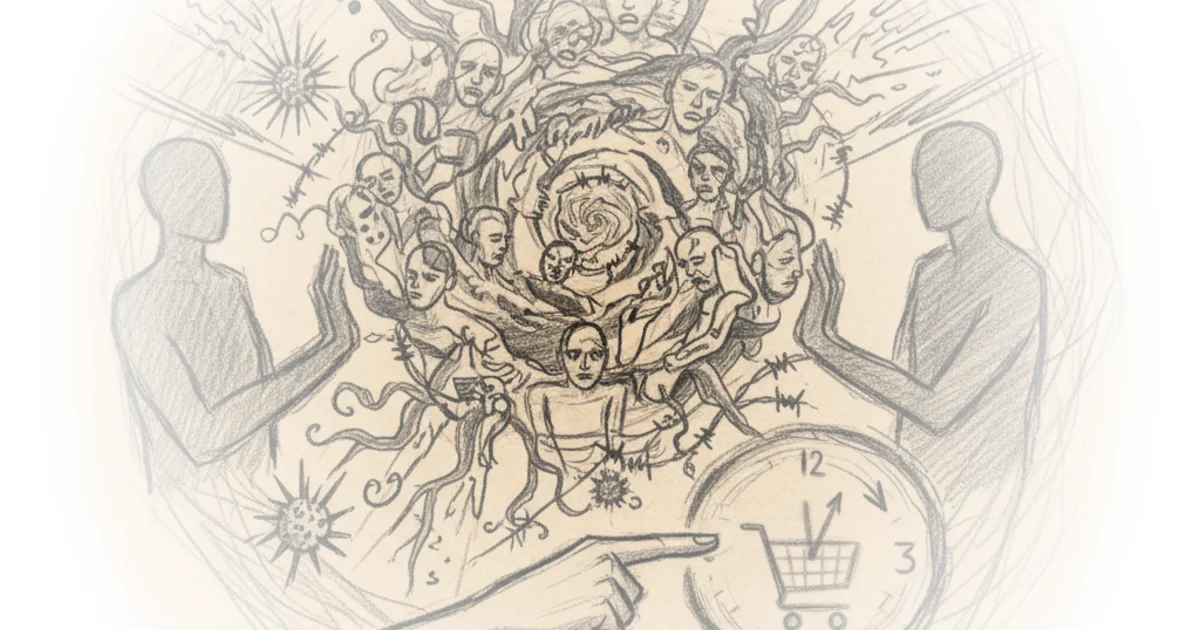
The core of his argument rests on the concept of exponential growth, a mathematical reality that human intuition often fails to grasp. Francis illustrates this with a stark hypothetical: if one person infects two or three others, the numbers spiral out of control within weeks. "If I can reduce that to just one person... at the end of the month there's just one additional person affected so it's a huge difference," he explains. This reframing of social distancing is powerful; it transforms a vague public health recommendation into a tangible, personal lever for change. Critics might note that relying on individual behavioral changes ignores the structural barriers many face, such as the inability to work from home or the lack of paid sick leave, but Francis's focus here is on the aggregate power of individual choices.
"Everything that's done before a pandemic will look like an overreaction that everything that's done afterwards will look like we weren't prepared."
The "Assume You Are Infected" Heuristic
Perhaps the most distinctive contribution Francis makes is the psychological shift he proposes: pretending to have the virus. He suggests that since testing is limited and many carriers are asymptomatic, the only safe default is to assume infection. "If you think that if you can say to yourself I've got this infection it will determine how you act around other people," he posits. This is a brilliant simplification of complex epidemiology. It bypasses the need for perfect information and replaces it with a robust, low-risk strategy.
He applies this logic to the confusion surrounding symptoms, particularly the definition of a "continuous cough." Rather than getting bogged down in medical semantics, Francis advocates for a low threshold for isolation. "We've got to have a low threshold for determining what symptoms are because this can present in different ways," he argues. This approach effectively neutralizes the ambiguity that often leads to risky behavior. It empowers the reader to make a safe decision without needing a doctor's confirmation, addressing the very real gap between official testing criteria and the reality of viral spread.
Protecting the Vulnerable and the System
Francis dismantles the dangerous misconception that the virus only threatens the elderly, a belief that often drives younger, healthier individuals to ignore social distancing. He points to evidence from Italy and China where fit, young people have been severely affected, but his more compelling argument is systemic. He warns that even if a young person survives, they risk overwhelming a healthcare system already stretched thin by the elderly. "If the hospitals are all full from older people being treated then when a 32 year old lady with a complication post-pregnancy or a 25 year old who has a road traffic accident is admitted they might struggle to find the same care," he notes. This is a pragmatic, self-interested argument for altruism that resonates with a broad audience.
He also addresses the anxiety surrounding specific measures, such as "elderly hours" in supermarkets. While acknowledging these measures are imperfect and cannot eliminate risk, he defends them as a necessary step in the "least worst scenario." "I think all the measures we're trying to take are directed at trying to minimize the risk to those vulnerable groups," he says. This nuance is vital; it admits the imperfection of policy without dismissing its value, a balance that is often lost in polarized debates.
"It's a misconception to think this doesn't affect young people entirely... we are trying to protect the vulnerable in society but it's a misconception to think this doesn't affect young people entirely."
Bottom Line
Rohin Francis's commentary succeeds because it replaces fear with agency, offering a clear, mathematically sound strategy for navigating an uncertain crisis. His strongest argument is the "assume you are infected" heuristic, which simplifies complex public health guidance into a single, actionable rule for every individual. The piece's primary vulnerability is its reliance on voluntary compliance in a society where structural inequalities make isolation difficult for many, yet the clarity of his message provides a necessary anchor for a public drowning in confusion.