The Algorithm That Chooses What You See
Last week, around 170 million Americans opened TikTok to find that the usual stream of influencers promoting health tips had been replaced by a digital speed bump. A pop-up message informed users that if they wanted to keep scrolling, they had to agree to new terms of service and an updated privacy policy. The average user probably clicked accept and kept going.
For the platform, it marked the official transition to a new corporate identity known as TikTok USDS Joint Venture LLC. Users reported that the digital atmosphere changed almost immediately. Within hours, reports surfaced that the platform had developed a sudden sensitivity to certain terms. Users were suddenly unable to send the word Epstein in direct messages. A quirk confirmed by reporters at CNBC and NPR who encountered an error message stating that the text was blocked to protect our community.
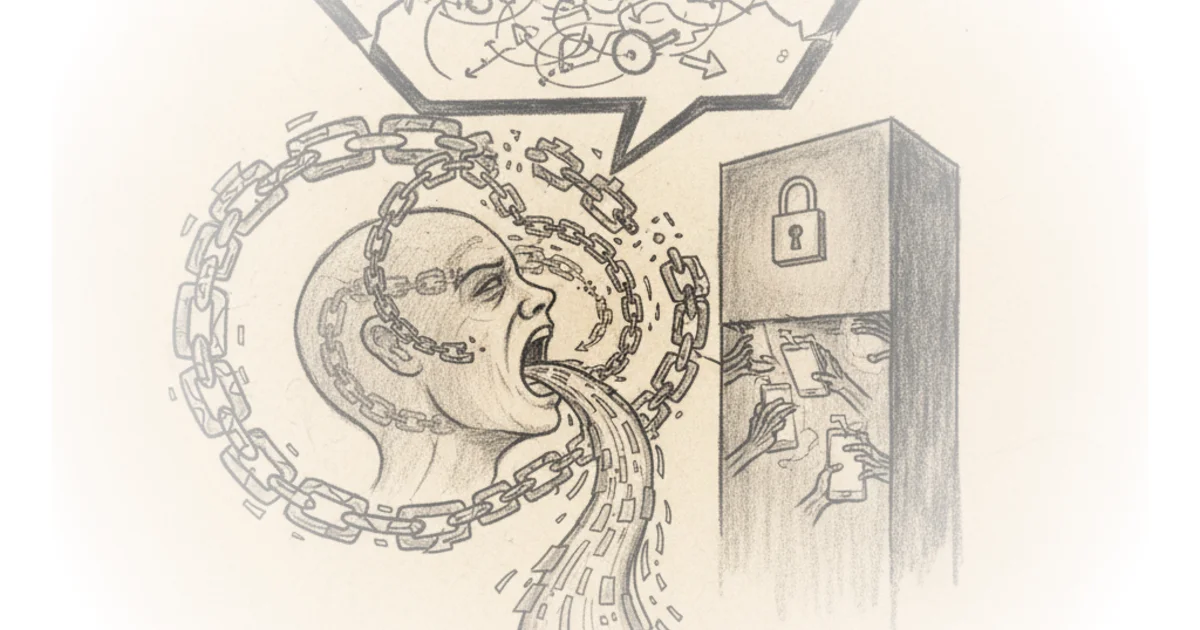
This made that morning particularly tough for the 13,000 Americans with that surname. While TikTok later characterized this as a technical glitch in its safety systems, the timing struck many as a surprising coincidence. The apparent censorship wasn't limited to historical scandals. In Minneapolis, the fatal shooting of protesters by federal agents had ignited a wave of protests around the country and a parallel wave of what felt like suppression on the app.
High-profile creators reported that videos documenting ICE raids were being shadowbanned or failing to upload altogether. The comedian Megan Stalter told the rap that while one of her posts on ICE raids had thrived on other platforms, it remained invisible on TikTok, leading her to delete her account in protest. In a viral Twitter post, the freelance journalist David Levid shared a screenshot showing his political videos were being flagged as ineligible for recommendation, resulting in view counts that sat stubbornly at zero.
By the end of the weekend, the hashtag TikTok censorship was trending across rival social media platforms as users attempted to document what felt like a coordinated purge of critical discourse, even prompting California regulators to question whether the platform was violating state laws by suppressing content critical of the current administration. As the first few days of American majority ownership drew to a close, it appeared that the new TikTok was off to a very rocky and for its critics, very quiet start.
The Deal Behind the Door
The rocky rollout was the first public act of a corporate transformation finalized just days earlier. On January 22nd, TikTok announced that it had successfully established TikTok USDS Joint Venture LLC, a new entity designed to satisfy the federal mandate for the Chinese-owned BiteDance to divest its American operations.
However, any expectation of a clean break from Beijing was quickly dispelled by the details of the deal. Despite the divestment label, BiteDance remains significantly involved in TikTok. They retain a 19.9% ownership stake in the new structure, the maximum allowed under the 2024 law. More importantly, the spin-off is far from total separation.
In a memo to employees, CEO Shiao Xi Chu clarified that while the joint venture would handle data security and content moderation, BiteDance would continue to run TikTok's primary money-making engines in America, including its advertising, marketing, and the rapidly growing TikTok Shop.
The deal consolidated control of the platform's American operations within a consortium of investors whose media ambitions have become increasingly controversial. Oracle, co-founded by Larry Ellison and the private equity firm Silver Lake, each took a 15% stake alongside the Emirati-backed MGX. The deal placed the app's most sensitive functions, including the recommendation algorithm and content moderation, under the oversight of Oracle.
According to Trump's September 2025 executive order, trusted security partners may also share information with other US government officials.
For the Trump-aligned Ellison family, this acquisition is one piece of a broader politically charged expansion into the American media landscape. Following the merger of SkyDance and Paramount Global, David Ellison, Larry Ellison's son, installed conservative figures at CBS News, a move that coincided with a $16 million settlement paid to President Trump over a 60 Minutes interview edit.
This payment was made just before the FCC approved the merger. At present, the Ellisons are in the middle of a hostile bid to buy Warner Brothers Discovery, the parent company of CNN. Larry Ellison has reportedly discussed the network's future direction and the potential firing of specific anchors with White House officials, while David Ellison has allegedly promised sweeping changes to the network to appease the administration.
Financial analysts were quick to point out that the consortium got TikTok at a bargain price. The $14 billion deal was announced by JD Vance rather than a corporate CEO, and Trump gave Vance credit for brokering the deal, which sat at a staggering discount from previous estimates of 35 to 50 billion.
In a final bit of theater, CNBC reported that no representatives from BiteDance were even present at the signing, and the deal was reportedly made with President Xi Jinping's direct approval. At $14 billion, TikTok US is trading at a price-to-sales ratio of about 1.4 times, a valuation usually reserved for mature industrial businesses like Exxon Mobile or General Mills.
As a reminder, Elon Musk paid $44 billion for Twitter, which has about a quarter the daily users of TikTok, and users stay on TikTok much longer than they stay on Twitter.
The Political Reversal
To understand how TikTok went from a national emergency to a sweetheart deal for politically connected insiders, we have to go back to August 2020 when Donald Trump issued an executive order declaring TikTok's Chinese ownership a threat to national security. At the time, the administration argued that the app's data collection was a tool for the Chinese Communist Party to build dossiers on millions of Americans for purposes of blackmail and corporate espionage.
While that order was blocked by the courts, the underlying fear of foreign influence and spying was one of the few things both political parties could agree on. In April 2024, Joe Biden signed a bipartisan law that gave BiteDance an ultimatum: sell the app's US operations within a year or face a total nationwide ban.
For a moment, it looked like TikTok's days in America were numbered. However, as the 2024 election cycle intensified, the political calculations began to shift. Trump, once the app's primary enemy, underwent a remarkable change of heart. He began publicly defending TikTok, arguing that a ban would only benefit Meta, the parent company of Facebook, which he characterized as a greater threat to the country.
This sudden U-turn coincided with a major American investor in BiteDance emerging as one of the most prolific donors in US politics. Reports indicate that Jeff Yass played a pivotal role in reversing Trump's support for the ban while contributing over $16 million to the Trump-aligned MAGA Inc. Super PAC.
On top of that, the Trump campaign realized that TikTok had been extremely helpful in reaching Gen Z voters who increasingly get their news from the platform's passive feed. Trump himself credited the app for his newfound popularity with young voters, amassing over 16 million followers on his personal account.
The new owners were quick to insist that the timing of these issues was purely coincidental. In their first major communication since the takeover, a series of statements posted on Twitter, the TikTok USDS Joint Venture blamed the platform's erratic behavior on a major infrastructure issue caused by a power outage at one of Oracle's US data centers.
It is, of course, quite funny for a massive social media app to be forced to communicate with its users on another much smaller social media app. Oracle spokespeople later pointed to a severe winter storm as the ultimate culprit for the server timeouts.
To be fair to the new management, there was objective evidence of a broader system failure. Site tracking services like Down Detector showed a massive spike in reports of outages, and even the NFL found itself shouting into the void when several of its posts were hit with the same zero-view bug.
Whether this was a genuine case of bad luck or a convenient screen for a more targeted retraining of the algorithm is a question that would linger as users began to look more closely at the new rules they had just agreed to.
The Real Power of the Algorithm
To understand why a $14 billion price tag and a few technical glitches matter, we have to look at how the architecture of the internet has changed over time. In the early days of the web, and even the early days of YouTube, you had to search for what you wanted to see. In this model, the user is the driver.
If you wanted to find out about the Minneapolis protests or the contents of the Epstein files, you had to actively go looking for them. TikTok represents a change to a push model. On TikTok, the search bar is an ornamental relic. Users don't usually open the app to search for something. They open it instead to be shown something.
It's a mostly passive entertainment experience. A digital conveyor belt that uses a sophisticated black-box algorithm to work out exactly what will keep you engaged for the next three hours. In this model, you're no longer the driver. You're a passenger in a high-tech self-driving car. It's a comfortable ride and you can see out the windows just fine, but you never actually selected a destination. You're just going wherever the car's programmer thinks you should go.
For a politician or a corporate owner, this is the ultimate prize. If you control a search engine, you can only hide information from people who are already looking for it. But if you control a passive feed, you have a much more subtle and powerful tool: the ability to set the ambient reality of 170 million users.
You don't have to ban a topic outright to kill it. You just have to turn the dial down by a few percentage points. This is what researchers call algorithmic nudging. If the algorithm decides to show you a bit more content that's favorable to one political side rather than another, you've no way of knowing. There's no neutral feed to compare to.
Every user's feed is different because the algorithm is proprietary and hosted on private servers. In this case, Oracle's thumb on the scale can be effectively invisible. In a world where people increasingly get their news by simply opening an app and waiting to be told what's happening, the person who writes the code for that discovery algorithm holds a level of influence that would make a 20th-century media mogul blush.
The Privacy Problem
For years, the American political establishment on both the right and left has characterized TikTok as a digital Trojan horse, a sophisticated piece of spyware that was allegedly funneling the private habits of 170 million Americans directly into the hands of the Chinese Communist Party. While most users were content to treat this as background noise, security researchers were becoming increasingly alarmed by what they found under the app's hood.
Throughout 2022 and 2023, experts documented technical behaviors that led many to recommend the app never be installed on any device used for sensitive communications. The creepy stuff wasn't just theoretical. Researchers discovered that TikTok's in-app browser was designed to inject JavaScript into every external website a user visited, giving the app the technical capability to log every keystroke typed while visiting external websites, including passwords and credit card numbers.
The app was caught poking at the phone's system clipboard every few seconds, potentially capturing private messages or any other data copied from other apps. This was combined with aggressive device fingerprinting that collected everything from battery levels to Wi-Fi network names, ensuring a user could be tracked even if they tried to remain anonymous.
Despite these warnings, the average user remained indifferent. Most were perfectly happy to trade their privacy for a more efficient dopamine hit. The 2022 admission that BiteDance employees had used the app to spy on Western reporters and monitor their physical locations to work out who their sources were should have been a breaking point. But for the millions of people scrolling through the For You page, it was just another headline to be swiped away.
The irony of the 2026 American takeover is that the new management hasn't removed this surveillance architecture. They've simply made it more explicit. While the permission to collect face prints and voice prints has been lurking in the US policy since 2021, the new ownership has shifted the context from marketing to compliance.
According to a report by Secure Privacy, once a user grants camera permissions on TikTok, often for a simple filter or a shopping feature, the app can use the front-facing camera whenever it wants to monitor things like involuntary physical responses in real time. This biometric harvest includes tracking of micro-expressions, facial movements lasting a fraction of a second, and even pupil dilation to measure emotional engagement with a product.
Critics might note that the technical problems described predate the new ownership and were present under Chinese control. The current issues may represent growing pains from the transition rather than intentional manipulation. Additionally, Oracle's infrastructure problems could easily explain the content suppression without assuming malicious intent. The platform has always struggled with algorithmic curation, and outages have affected content visibility long before this ownership change.
If you control a passive feed, you have a much more subtle and powerful tool: the ability to set the ambient reality of 170 million users.
Bottom Line
The most compelling argument in this piece is that TikTok's architecture represents a fundamental shift in how Americans consume information. The platform doesn't just host content; it actively shapes what 170 million users encounter. This makes the ownership transition significant not because of who owns it, but because whoever controls the algorithm now holds enormous power over the country's information landscape.
The piece's biggest vulnerability is that many of the concerns raised—the technical glitches, the content suppression—could equally be explained by ordinary growing pains during a corporate transition rather than deliberate manipulation. The evidence for intentional algorithmic nudging remains circumstantial.
What readers should watch for next is whether the new ownership structure actually changes how content flows to users, and whether regulators will treat this as a telecommunications provider subject to stricter oversight, or continue treating it as a simple software platform.