Noémie Goudal doesn't just photograph landscapes; she constructs them to reveal the hidden architecture of time itself. In this conversation with Louisiana Channel, the artist argues that the most profound truths about our planet are not found in the static image, but in the tension between the real world and the artificial layers we impose upon it. For busy minds seeking to understand how we perceive reality, Goudal offers a radical proposition: the landscape is not a fixed stage, but a fluid, moving entity that we are only just beginning to read correctly.
The Architecture of Illusion
Goudal's work begins with a rejection of the photograph as a mere document. She posits that a flat image can hold infinite depth if the artist is willing to manipulate the very medium of perception. "There are so many layers that I can compose, decompose, recompose, disrupt," she explains, describing a process that treats the image as a malleable object rather than a window. This approach is not about deception, but about revelation. By physically inserting paper backdrops, ropes, and tripods into the frame, she forces the viewer to acknowledge the human hand in the construction of nature.
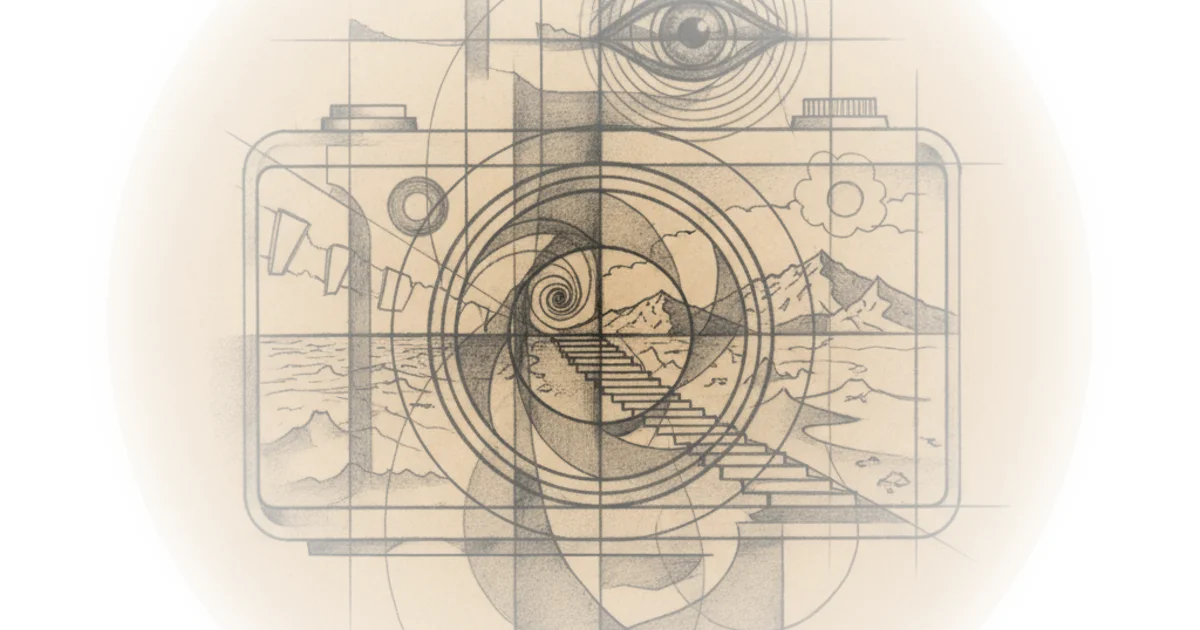
The artist's method is rigorous, often involving months of preparation for a mere fifteen-minute window of shooting. "Everything is set up and then we have 15 minutes and that's all we have," she notes, highlighting the extreme tension required to capture these moments. This constraint is not a limitation but a creative catalyst. It mirrors the geological processes she studies, where immense pressure over eons creates something entirely new. Critics might argue that such heavy-handed staging distances the viewer from the raw beauty of nature, yet Goudal counters that this distance is necessary to see the "human translation" of the landscape.
"I want the viewer to be able to understand what we have been through in order to build a landscape that is an installation that is in the photograph or in the film."
Time as a Material
The core of Goudal's argument rests on a deep engagement with the history of science, particularly the evolution of how we understand the Earth's formation. She draws a direct line from the natural philosophers of the Renaissance to modern paleoclimatologists, suggesting that her art is a continuation of their observational project. She points out that our understanding of the planet has shifted from a static map to a dynamic model of movement. "When I read about that I realized that I saw the planet as a fixed completely fixed entity... but it's also a very anthropocentric way of looking at the world," she reflects.
This perspective is enriched by the scientific concept of stratigraphy—the study of rock layers. Just as a geologist reads the history of the Earth in the strata of a cliff face, Goudal reads the history of human perception in the layers of her backdrops. She references the formation of coal, noting that "coal is made of mainly tropical jungle... it goes deep into the ground and then the heat of the ground has been sedimentated the nature those leaves and those trees for many millions of years." This scientific fact underscores her artistic thesis: that what we see on the surface is merely the tip of a vast, temporal iceberg. By weaving together images from different global locations, she creates a "universal" landscape that transcends specific geography, focusing instead on the "what this place does to you."
The Choreography of Light and Water
Perhaps the most striking element of Goudal's commentary is her transition from still photography to film, where she treats the backdrop not as a static prop but as a living participant. In her film Below the Deep South, she and her team burned printed backdrops to simulate the heat of the Earth's interior. In another piece, The Story of Fixity, she uses water to wash away layers of paint, revealing the day beneath the night. "It's almost like the night is leaking to let the day appear," she describes, turning the act of painting into a geological event.
This technique relies on a clever optical trick: filming the process in reverse so that water appears to build the landscape rather than destroy it. "The water is coming from the ceiling, but instead of washing away, it brings back the decor because it's in reverse," she explains. This reversal is more than a visual gimmick; it is a philosophical statement about the fluidity of time and the malleability of our memories. It challenges the viewer to accept that the "fixed" landscape is an illusion, and that the world is constantly being rewritten by natural forces.
"The accidents... sometimes things go wrong... and then when you watch it again you realize that this makes the film."
Bottom Line
Noémie Goudal's argument is compelling because it bridges the gap between hard science and artistic intuition, proving that the most accurate way to depict the Earth is to admit that it is a construction of our own making. Her work's greatest strength lies in its refusal to offer easy answers, instead inviting the viewer to grapple with the complexity of time, perception, and the layers that define our reality. The biggest vulnerability, however, is the sheer technical complexity of her process, which risks overshadowing the philosophical message for those who cannot see past the mechanics of the illusion. As the climate crisis forces us to rethink our relationship with the planet, Goudal's reminder that the Earth is a fluid, moving entity is not just art—it is a necessary shift in perspective.