This piece cuts through the standard narrative of rising interest rates to expose a more insidious driver of the housing crisis: the deliberate strategy of major homebuilders to prioritize shareholder returns over community stability. More Perfect Union argues that the industry has shifted from building homes for families to engineering assets for Wall Street, a transition that has quietly turned housing into a speculative vehicle while leaving buyers with structurally unsound properties and inflated debt.
The Architecture of Incentives
The author's investigation into D.R. Horton reveals a sophisticated mechanism for masking true costs. More Perfect Union writes, "The first tactic, incentivize... these incentives seem like a good deal for buyers and shareholders love them, too." The piece details how builders use their own mortgage divisions to offer artificially low interest rates, which allows them to keep base home prices inflated. This financial sleight of hand means a buyer might qualify for a $400,000 home at a subsidized 4% rate, whereas a standard 6% rate would only afford them a $300,000 property. By keeping the sticker price high, these builders ensure that the inflated numbers feed into real estate databases, pushing up valuations across entire neighborhoods, not just within their own subdivisions.
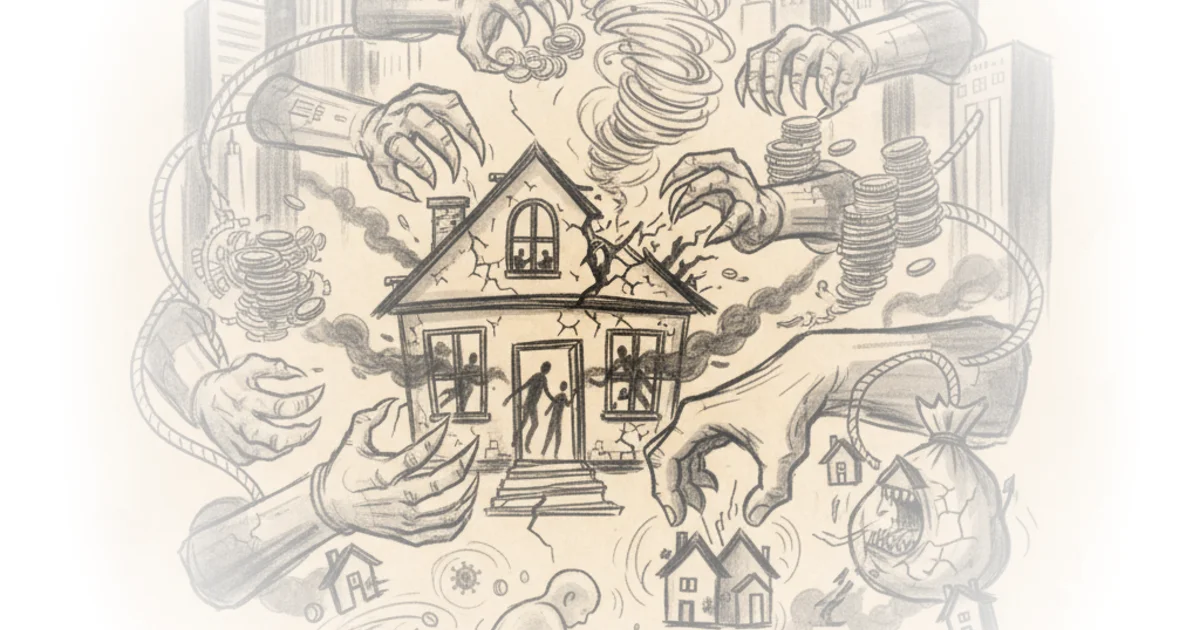
Critics might argue that these mortgage subsidies provide necessary liquidity in a high-rate environment, helping buyers enter the market who otherwise couldn't. However, the author effectively counters this by showing that the long-term cost is borne by the buyer through higher principal balances and the broader community through distorted market data. The argument lands because it reframes "affordability" not as a lack of buyer income, but as a manufactured illusion created by corporate accounting.
"These incentives seem like a good deal for buyers and shareholders love them, too."
The Human Cost of Cost-Cutting
The commentary shifts from financial manipulation to physical danger, presenting a harrowing account of the "cut costs" strategy. More Perfect Union notes, "Not only are some of these houses poorly built, but they are actually making people sick." The piece cites specific cases of mold infestations and structural failures, describing a home frame that moved "like Jenga." The author highlights a stark disparity in priorities: while D.R. Horton spent $194 million on repairs and litigation, their shareholders received $4.4 billion in profit. This ratio suggests that defects are not merely operational errors but a calculated line item in a profit-maximization model.
The author's use of direct testimony from families dealing with health crises adds a visceral weight that dry economic data cannot match. By juxtaposing the "comprehensive warranties" claimed by the corporation against the reality of children suffering from mold-induced illness, the piece exposes the hollowness of corporate assurances. This evidence holds up because it moves beyond anecdote to show a pattern of recurring issues across multiple locations, supported by the sheer scale of the company's litigation costs.
The Build-to-Rent Trap
Perhaps the most disturbing revelation is the pivot toward "build-to-rent" communities, where entire subdivisions are sold directly to institutional investors. More Perfect Union writes, "As home builders have pushed prices out of reach for many buyers, they've also created a new dystopian model. Build entire communities to sell directly to Wall Street landlords." The article points out a significant policy contradiction: while the White House has issued executive orders attempting to curb institutional investors from buying single-family homes, these orders contain exemptions that allow large homebuilders to continue selling entire tracts to Wall Street.
This section effectively weaves in historical context, noting that the consolidation of the industry began in earnest after the savings and loan crisis of the 1980s. As local banks disappeared, small builders lost access to capital, while large firms like D.R. Horton and Lennar (LAR) leveraged Wall Street connections to buy out competitors and control land banks. The author argues that this consolidation has led to "disciplined" production cuts, where builders intentionally restrict supply to maintain high prices, a strategy that has reduced housing production by an estimated $106 billion annually between 2005 and 2016.
"Homes are built for people, not for corporations, and America will not become a nation of renters."
While the article critiques the administration's executive order for its loopholes, it is worth noting that the scale of the institutional investor problem is complex. Some economists argue that institutional capital is necessary to build the volume of housing required to meet demand, though the author rightly questions whether this capital is being deployed to build for ownership or for perpetual rental extraction. The piece's strength lies in its focus on the "build-to-rent" model as a specific vehicle for this extraction, rather than a blanket condemnation of all investment.
The Path Forward
The author concludes by rejecting the notion that this is an unsolvable problem, pointing to the pre-1980s era when the housing market was more competitive and diverse. More Perfect Union asserts, "Before the 1980s, the basic philosophy of American economic policy was we wanted communities to be able to govern themselves and we wanted people to own property so that they would have a stake in the society." The proposed solutions involve breaking up the monopoly power of large builders, restricting their ability to act as mortgage lenders, and creating better financing options for small, local builders.
The argument is compelling because it identifies a clear historical turning point—the post-savings and loan consolidation—and traces a direct line from that event to today's affordability crisis. It challenges the reader to see the housing market not as a natural force of supply and demand, but as a constructed system designed to extract value from residents.
Bottom Line
More Perfect Union delivers a damning indictment of the modern homebuilding industry, successfully linking corporate consolidation, financial engineering, and physical neglect into a single coherent narrative. The piece's greatest strength is its ability to humanize abstract economic concepts, showing how "disciplined" production and "incentivized" mortgages translate into moldy homes and unaffordable rents. Its primary vulnerability is the assumption that political will alone can reverse decades of financialization, a hurdle that may prove higher than the author suggests. Readers should watch for how future policy debates address the specific loopholes allowing builders to bypass investor bans, as this will be the true test of whether the single-family home can be saved.