This piece from Compact Magazine refuses the comfortable binary that usually frames declining birthrates: it neither blames the left for material neglect nor the right for moral panic. Instead, it offers a haunting, first-person meditation on the genuine tragedy of modern women who feel forced to choose between their own autonomy and the continuation of their lineage. For the busy professional wondering why the demographic clock is ticking so loudly, this is not a policy brief but a profound cultural autopsy that suggests the problem isn't just economics—it's a crisis of meaning.
The Evacuation of Eros
The article opens by dismantling the standard political narratives. It notes that while observers on the left often dismiss the decline as a non-issue tied to material factors, and voices on the right fixate on abortion and contraception, both sides miss the deeper cultural rot. The piece argues that the root cause is a society that has "disparaged motherhood, treating it as a private matter that individual women had to reconcile with work as best they could." This framing is powerful because it shifts the blame from individual choices to a structural cultural failure.
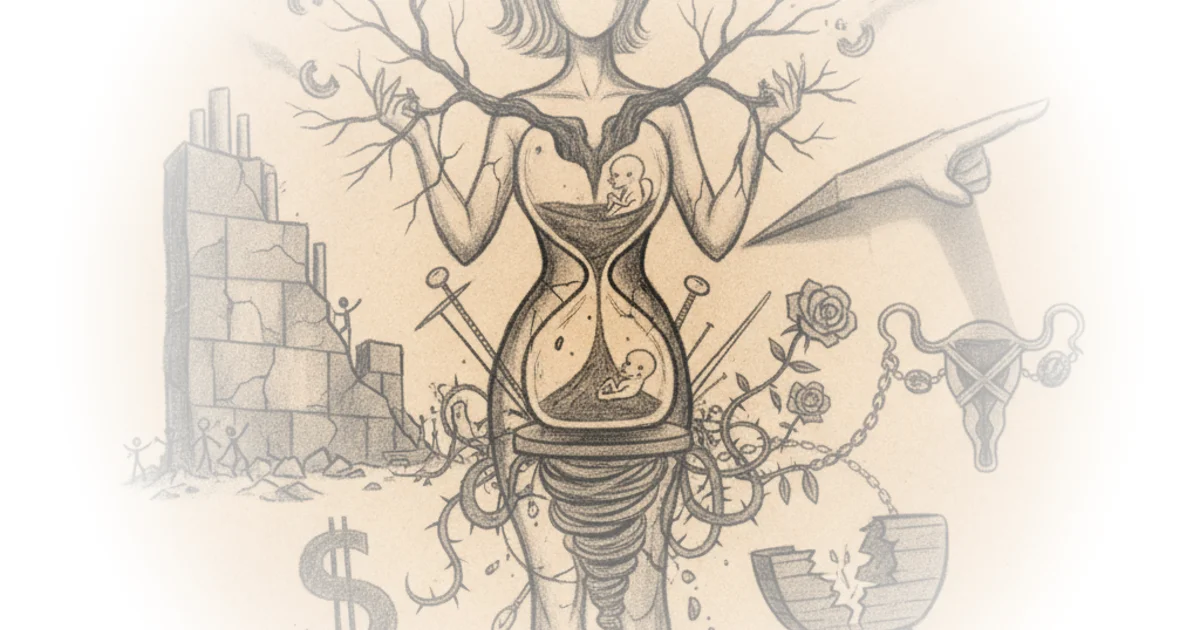
Drawing heavily on Germaine Greer's 1984 work Sex and Destiny, the commentary suggests that modernity has created a "sterile" society unable to honor the vital life force. The text posits that in a culture obsessed with "achievement and self-gratification," having a child feels like a kind of death. This is not merely about career costs; it is an aesthetic and psychological rejection of the biological reality of women. As the piece explains, pregnancy offends the "sleek lines, flat stomachs, and sharp hipbones" expected of modern women, conveying a "denial of fecundity."
The argument deepens when it connects this to the existentialist tradition. The author reflects on reading Jean-Paul Sartre as a teenager, identifying with the hero Mathieu, who was "disgusted by the discovery of his girlfriend's pregnancy and the prospect of a pinched conventional life." This historical nod to the Second Wave of feminism and the existentialist obsession with absolute freedom helps contextualize why the current generation feels such a deep aversion to motherhood. It wasn't just a lack of support; it was a philosophical commitment to a life unbound by biological destiny.
"Motherhood threatened the vision we shared."
This line captures the generational pact that was made: to break the cycle of self-sacrifice that defined the previous generation. The author recalls her own mother, who "abandoned or delayed her own interests and self-development," and the fierce loyalty the daughter felt to ensure she would have a different life. Critics might note that this narrative risks romanticizing the struggle of the past, ignoring that for many women, the "freedom" to choose was never truly available due to economic coercion. However, the piece acknowledges this tension, admitting that the choice to remain childless was also a form of "loyalty" to the sacrifices of those who came before.
The Impossible Choice
The commentary moves from the historical to the personal, illustrating the brutal reality of trying to hold both worlds. The author describes the "divided" life of the modern academic, who is expected to work with the focus of a man while bearing the lion's share of childcare. The result is a state where one cannot fully concentrate on or enjoy either role. The piece notes that for many, "the compensations of motherhood may not be enough to make up for the loss of freedom."
This section resonates with the themes found in Simone de Beauvoir's The Second Sex, where the free woman's "vital interests are divided." The article cites contemporary writer Sheila Heti, who describes the internal conflict of wanting to "outwit nature and society" by rejecting the "lizard brain" that urges reproduction. Yet, the piece also highlights the irony: when a partner encourages this rejection, the woman feels offended, recognizing the contradiction in being told to prioritize her career over her biology.
The stakes are framed not just as a personal regret, but as a civilizational risk. The author points to the Parsees, a community in India that adopted British values of individualism and education, only to see their numbers dwindle to the point of near-disappearance. "Perhaps the Parsees sketch out the fate of our own civilization," the piece warns. This comparison adds a layer of historical gravity, suggesting that the pursuit of individual autonomy, when taken to its logical extreme, can lead to the extinction of the very culture that enabled it.
"We chose the responsibility of our own existence, as thinking people, as financially independent women, over continuing our lineage—the long line of ancestors who had patiently borne children, who had suffered for them and in turn were justified by them, by passing on the blazing torch of life."
This admission is the emotional core of the piece. It acknowledges that the choice to end the line is a conscious, painful trade-off. The author describes the "existential loneliness" of being the last in the lineage, staring into a future that is "weightless, thin air, empty of human contact." This is a stark counterpoint to the usual policy discussions about childcare subsidies or tax credits; it suggests that no amount of policy can fix a fundamental loss of faith in the future.
The Search for a New Eternity
In its conclusion, the piece does not offer a tidy solution. It admits that "solutions are evasions" because the dilemma itself is the thing. The author dreams of a "pocket in time," a place where one can live a whole life as a mother and then return to their career, unbroken. But in reality, this is impossible. The only resolution offered is a shift in perspective, echoing Sheila Heti's idea that "Art is written for one's ancestors … Children are eternity forwards. My sense of eternity is backwards through time."
This reframing is the piece's most subtle and profound move. It suggests that perhaps the role of the modern woman is not to be a mother in the traditional sense, but to be a guardian of the past, ensuring that the sacrifices of the ancestors are not in vain. It is a melancholy but dignified acceptance of the current reality. The piece argues that we must find a way to "cultivate a moral accountability to posterity without basing it on patriarchal domination," a task that remains unfinished.
"This is not a choice women should have to face. But we do."
This final observation underscores the tragedy of the situation. The administration or the state may offer policies to support families, but the piece implies that the real barrier is cultural and philosophical. Until society can honor the "vital life force" without demanding total self-erasure, the decline will continue. The piece leaves the reader with the uncomfortable truth that the crisis of birthrates is, at its heart, a crisis of how we value human life itself.
Bottom Line
The strongest element of this piece is its refusal to treat declining birthrates as a simple economic puzzle, instead exposing the deep existential and cultural wounds that drive women to opt out of motherhood. Its biggest vulnerability is its reliance on a somewhat romanticized view of traditional motherhood, which may obscure the very real hardships and lack of agency that characterized the past. Readers should watch for how this cultural malaise interacts with economic pressures, as the two are inextricably linked in the real world.