This piece delivers a chilling paradox: the very systems designed to prevent the atrocities of the 20th century have become the instruments that make them inevitable in the 21st. Reason argues that the modernization of border control has successfully eliminated fraud, but at the cost of eliminating the one thing that saved lives during the Holocaust—the ability of a single bureaucrat to say 'no' to a rule and 'yes' to a human being.
The Death of the Rogue Diplomat
The article opens with a stark historical contrast, reminding readers that the 20th century was defined by "bureaucratic heroes like Raoul Wallenberg, Chiune Sugihara, Frank Foley, and Aristides de Sousa Mendes, diplomats who combined to save hundreds of thousands of lives by bending the rules and issuing unauthorized passports or visas to people fleeing persecution." These were not anomalies; they were the moral safety valve of a broken system. The piece notes that today, "these rule-bending insiders are nowhere to be found," not because of a lack of courage, but because "they physically can't do so."
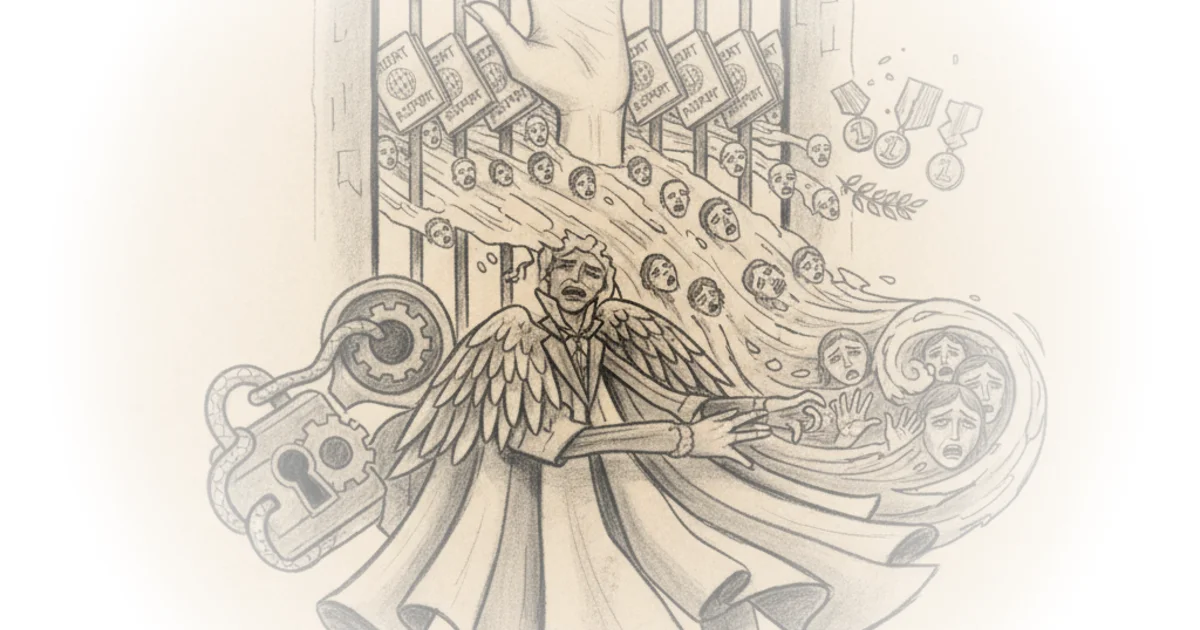
The argument gains immediate weight by grounding itself in the specific, tragic stories of the past. We are reminded that Wallenberg "rented dozens of buildings around the city, declared these buildings Swedish diplomatic facilities with full diplomatic immunity, and sheltered thousands of Hungarian Jews inside." Similarly, Sugihara, an Imperial Japanese official, "started signing transit visas... for basically anyone who needed to flee Lithuania," working 18-hour days and tossing visas out of a train window as he fled. The editors note that these figures are held up as exemplars in training, yet the system that trained them has evolved to make their heroism impossible.
"The modern biometric passport system and ID technology foreclose the possibility of individuals of conscience acting alone to do the right thing."
This observation is the piece's most devastating insight. The argument posits that the efficiency we celebrate is actually a cage. The system was built on the assumption that "making things systematized and efficient was the way to do that" regarding human rights. However, the piece suggests this efficiency has created a blind spot where moral agency is impossible. Critics might argue that strict adherence to rules prevents corruption and ensures national security, a point the article acknowledges by noting the State Department's "Wall of Shame" for corrupt officers. Yet, the trade-off is clear: the system is now so rigid that it cannot distinguish between a corrupt official and a compassionate one.
The Algorithm as the New Border
The commentary shifts to the mechanics of this new reality, explaining how the "biometric passport system" has transformed identity. The piece details how the International Civil Aviation Organization (ICAO) standards, rolled out before 9/11, created a world where "a 'fake passport' in the 21st century essentially does not exist." The technology is impressive; a passport now contains an embedded chip that allows any country to "instantly pull up a traveler's information at the border."
But the real story isn't the chip; it's the database. The article describes a world where "everything gets cross-referenced," linking a traveler's face and fingerprints to a centralized history that spans decades. This creates a scenario where "if an intelligence agency wants to send a spy to another country... their fake identity will be exposed as soon as the passport is swiped." While this sounds like a victory for security, the piece argues it is a disaster for humanity. The system is designed to be "unbeatable," meaning that when the rules are wrong, there is no way to bypass them.
The article illustrates this with a hypothetical scenario involving a Customs and Border Protection officer named John Smith. Every decision is logged, cross-referenced, and subject to "instant review." The piece argues that "if you take away individual agency, you expose everyone to the whims of executive power, centrally directed." This is a profound shift in how power operates. In the past, a diplomat like Sousa Mendes could ignore "Circular 14" and issue visas to everyone, saving 30,000 people despite the orders of his government. Today, "Headquarters today would have instantly noticed the discrepancy... Officials in an office in Tokyo could have digitally canceled every transit visa issued by Sugihara's user ID."
"If you aren't documented, you don't exist."
This quote, drawn from the 1938 novel Child of All Nations, serves as the grim thesis of the modern era. The piece suggests that the very tools meant to protect us from the horrors of the past have made us more vulnerable to them. The system is so efficient that it cannot accommodate the messy, unpredictable nature of human suffering.
The Bureaucrat's Dilemma
The most haunting section of the piece is the first-person account of a midlevel visa manager in Mumbai who tried to help an Afghan family. The manager describes a moment where "a computer overrode my decision" to issue a visa to a baby. The system was so rigid that it could not process the nuance of a family fleeing the Taliban, even when the parents already had visas. The manager notes, "To this day, I don't know what happened to that family."
This anecdote brings the abstract argument into sharp, painful focus. The piece describes a subordinate who was "viscerally uncomfortable" about issuing a visa because "her name is going to be on the case." The fear of being flagged by the system is so potent that it paralyzes moral action. The manager, knowing they were about to quit, stepped in to issue the visa, but the system fought back: "I saw a bright red warning and a grayed-out issue button." The technology itself was designed to stop the act of mercy.
The article concludes by reflecting on the legacy of Sugihara, who once mused that his government "probably didn't realize how many I actually issued." The piece argues that "that world doesn't exist anymore." The digital footprint of every action ensures that no one can slip through the cracks, for better or worse. The system is a perfect machine, but as the editors note, "it's the very thing that makes the repetition of the horrors of the past century possible."
Bottom Line
This is a vital, unsettling argument that reframes the narrative of border security from a triumph of technology to a failure of humanity. The piece's greatest strength is its ability to connect the historical heroism of diplomats like Wallenberg and Sugihara to the cold, hard reality of modern biometric systems. Its biggest vulnerability is the implicit assumption that the system cannot be reformed from within, though the evidence suggests the architecture is indeed designed to prevent such reform. Readers should watch for how this technological rigidity plays out in future crises, where the lack of a "human override" could have catastrophic consequences.