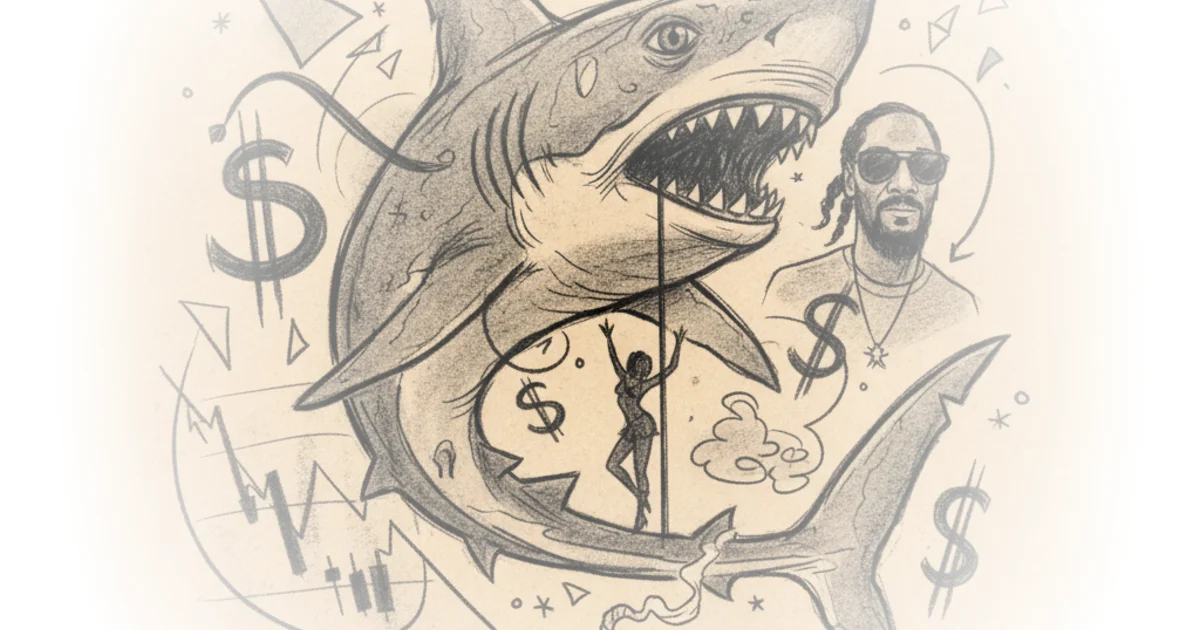
Patrick Boyle delivers a surprisingly lively tour of insider trading scandals, proving that finance history can be as colorful as any crime drama. His approach is distinctive: he frames these not as dry regulatory failures but as stories with characters, stakes, and even humor. The reference to "strippers bombers pickle sharks and even snoop dogg" isn't’t just filler—it signals that this piece refuses to take itself too seriously while still delivering serious content.
What Insider Trading Actually Means
Boyle begins by clarifying a common misconception. "When most people hear the term insider trading they think of the crime," he writes, "but insider trading is just the trading of a public company's securities by people with access to non-public or insider information about the company." This distinction matters because it sets up the entire piece: legal insider trading exists and is regulated; illegal insider trading is what fuels these scandals.
The core argument then becomes clear: "It's illegal to trade stock in a company based on insider information and it's also illegal to pass on that information to another person." The stakes are higher than most readers realize. "Securities regulators want to make sure that all investors are making decisions based on the same information," Boyle explains, "and this is important because in parts of the world where such rules are not enforced the public lose faith in markets which both makes it hard for companies to raise money as no one wants to invest without inside information."
This lands hard because it connects individual scandals to systemic consequences. The argument isn't just that these people broke rules—it's that breaking these rules erodes the foundation of market confidence itself.
Boesky: The Original Rogue
The Ivan Boesky story is where Boyle's storytelling really shines. "In 1985 Boesky was one of the top traders in the world," he writes, "and he had recently written the best-selling book merger mania." The detail about his speech at Haas School of Business becoming the inspiration for Gordon Gekko in the 1987 film Wall Street is exactly the kind of cultural connective tissue that makes finance history accessible.
Boesky's path to insider trading was remarkably transactional: "he entered into a deal with an investment banker at Kidder Peabody to get insider information on pending corporate transactions" and then "a similar deal shortly afterwards with another investment banker at Drexel Burnham Lambert." The pattern matters—these weren't desperate moves by a financial outsider but calculated relationships with established investment banks.
The resolution is equally dramatic. "In 1986 Boesky was arrested for insider trading he cooperated with the federal prosecutor Rudy Giuliani, pled guilty to a charge of making false statements to the government and received a then record 100 million dollar fine." The detail about how this "kick-started Giuliian's career" adds another layer—these prosecutions weren't just about punishment but about building political futures.
Martha Stewart: Celebrity and Consequences
The Martha Stewart section proves that insider trading scandals aren't exclusively about finance bros. "Martha Stewart is someone who would have understood securities regulation," Boyle writes, "as she started out her career as a stockbroker in the 1960s"—she wasn't just a lifestyle brand but someone with direct experience in the systems she'd later be accused of violating.
The Sam Waxel story is instructive: "He learned that the FDA had rejected their main product for approval and quickly dumped his five million dollars worth of shares prior to the news being made public." This was clean, straightforward insider trading—executives using non-public information to avoid losses. Stewart's case was different. "The SEC found that Marth had acted on a piece of non-public information but that the information was not knowledge of the FDA's decision—she was not a board member and had no other affiliation with ImClone."
What doomed her was obstruction: "She was sentenced to five months of prison time for obstruction of justice and conspiracy" plus a fine of four times the amount she avoided. The irony of being "refused entry to the UK due to her criminal record" adds an absurd coda that Boyle handles with appropriate understatement.
Galleon Group: Wiretaps and Networks
The Raj Rajaratanam case represents a turning point in enforcement. "The case was important because of the way federal investigators proved wrongdoing for the first time," Boyle writes, "investigators used wiretaps to try and catch an insider trading suspect." This wasn't just another prosecution—it was a methodological leap.
"Raj was caught on tape repeatedly discussing insider information with friends and colleagues" represents the core shift: the era of relying on informants and paper trails was ending. Wiretaps previously "had only been used for evidence against organized crime figures or drug dealers"—using them for insider trading "was a sign that regulators were very serious about enforcement."
The 2011 verdict is stark: "He was found guilty on 14 counts of conspiracy and securities fraud he was sentenced to 11 years in prison and fined 92.8 million dollars today this is the longest prison sentence ever handed out for insider trading." The detail that "two years before the end of his prison sentence Raj was quietly released to house arrest" thanks to a law lobbied by Kim Kardashian adds contemporary relevance.
SAC Capital: The Improvisation Defense
Steve Cohen's case reveals something darker about institutional insider trading. "The U.S regulators alleged that Cohen hired people specifically because they had relationships with senior management at publicly traded companies who they could mine for information," Boyle writes. "The regulators claimed that Steve incentivized employees to bring illegal insider information to the firm and pass it up the food chain to him."
The defense was remarkable: "Cohen they said lived in a swamp of information so deep that there was no way to prove that any particular email was read let alone acted upon—there was no method to what he did it was all improvisation." This is both a legal argument and an admission that Cohen's operation was fundamentally designed to be deniable. The settlement—"SAC agreed to pay a 1.8 billion dollar fine"—was actually "1.2 billion because they were given credit for the 600 million in fines that they had already committed to pay."
Securities regulators want to make sure that all investors are making decisions based on the same information.
Critics might note that Boyle's informal approach occasionally undermines the seriousness of these violations—the Snoop Dogg references feel more like clickbait than analysis. Similarly, while he effectively connects individual cases to systemic market functioning, the piece could have explored more thoroughly why insider trading specifically harms economies beyond just "losing faith in markets."
Bottom Line
Boyle's strongest contribution is making abstract financial regulation feel personal—these are stories of real people, real consequences, and real lessons. His weakest vulnerability is that the piece occasionally prioritizes entertainment over analysis, particularly when the sponsor read aloud feels grafted onto a video script rather than integrated into the argument. The most important takeaway isn't just which scandals to remember but why insider trading threatens the entire system: without shared information, markets cease to function fairly.