Phillips P. O'Brien delivers a jarring, high-stakes assessment: the most consequential development for Ukraine and Europe in months is not a battlefield victory, but the stark revelation that the U.S. administration has abandoned the hope of American rescue. In a piece that reads less like a standard update and more like a wake-up call, O'Brien argues that the recent U.S. National Security Strategy and the administration's handling of the "Tomahawk" missile rumors were not mistakes, but a deliberate strategy to shatter European illusions. For busy readers tracking the war's trajectory, the value here lies in the shift from analyzing what is happening on the front lines to understanding why the diplomatic landscape has fundamentally collapsed.
The End of the American Mirage
O'Brien's central thesis is that the administration has moved from ambiguous signaling to a policy of explicit containment regarding European security interests. He posits that the new National Security Strategy reveals a startling inversion of priorities: "Europe is now viewed as more threatening to the USA in Trump's mind than either Russia or even China." This is a bold claim, suggesting that the executive branch sees a unified Europe as a greater geopolitical risk than the very powers it claims to oppose. The author argues that the administration's goal is not merely to end the war, but to dismantle the current European security architecture.
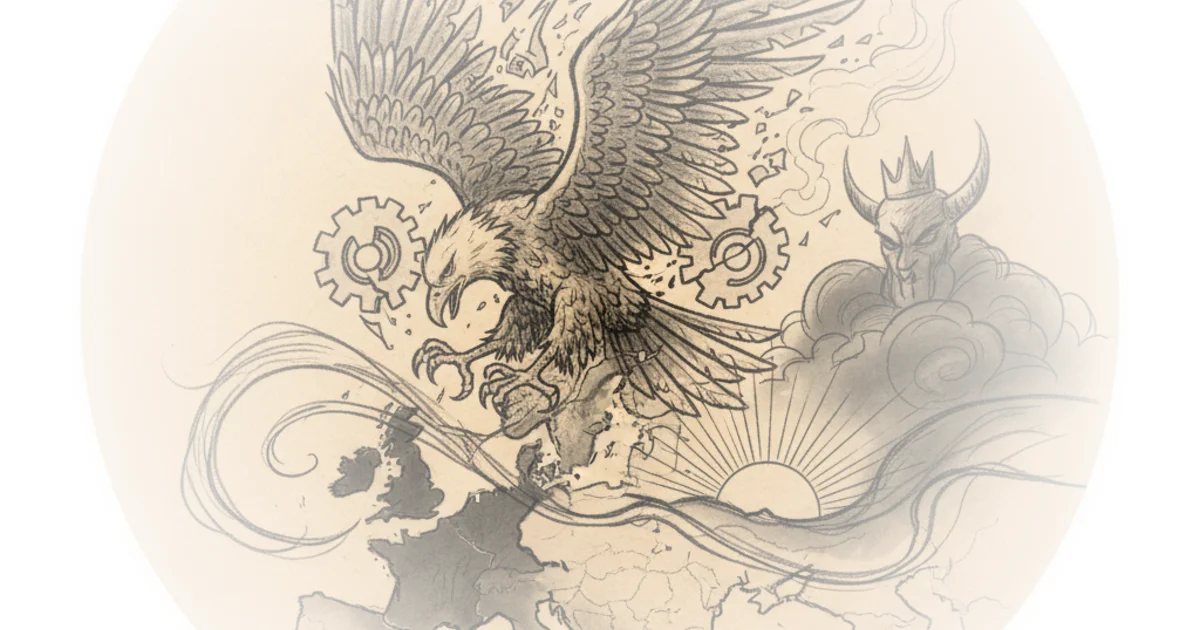
The evidence O'Brien marshals includes the specific language of the National Security Strategy, which he interprets as a green light for Russian territorial gains. He notes that the document calls for Ukraine to survive "as a viable state," a phrase he deems catastrophic. "What is that? That means it could lose most of its territory and the US would be happy," O'Brien writes. This interpretation reframes the diplomatic language of "stability" as a euphemism for capitulation. While critics might argue that "viable state" implies a functional government rather than a specific border, O'Brien's reading highlights the absence of any commitment to territorial integrity, a critical distinction for a nation currently under invasion.
"The truth is now being so starkly revealed that it can or at least should no longer be denied."
The author connects this diplomatic shift to a broader pattern of behavior, suggesting the administration has been coordinating with Moscow for months. He points to the rejection of peace deals by Vladimir Putin not as a sign of aggression, but as a signal of confidence in his relationship with Washington. "Putin has every reason to be confident as he was never conned," O'Brien observes. This perspective forces a re-evaluation of recent diplomatic stalling, suggesting it is not a failure of negotiation but a feature of a deal already in motion.
The Tomahawk Con
Perhaps the most damaging section of the commentary is the dissection of the "Tomahawk con." O'Brien details how the administration allegedly fueled rumors of sending long-range cruise missiles to Ukraine in mid-2025, only to have no intention of following through. He describes this as a "deliberate effort by the Trump administration to make people believe something would happen to hurt Russia/help Ukraine—something that HAD NO CHANCE OF EVER HAPPENING."
The narrative arc O'Brien constructs is one of calculated deception. He notes that the White House did not squelch stories of potential missile transfers; instead, they amplified them. "President Trump told Ukrainian President Volodymyr Zelensky he was open to lifting restrictions... but he didn't commit to doing so," O'Brien writes, highlighting the ambiguity that kept hopes alive. The author argues this was a strategic delay tactic. While the public story was one of potential escalation, private negotiations were reportedly focused on financial deals and sanctions relief for Russia. "The Trump administration was working out the details of a deal with Putin privately but publicly was deceiving Europeans and Americans," he asserts.
This framing draws a parallel to historical instances where great powers manipulated smaller allies, though O'Brien's focus is on the immediate psychological impact. The "con" kept European leaders and Ukrainian officials from mobilizing their own resources. "Instead of mobilizing resources, acting with purpose, coordinating actions, European leaders were dreaming about rainbows and butterflies," he writes. The tragedy here is not just the deception, but the opportunity cost: time and energy spent chasing a phantom American intervention while the war ground on. A counterargument worth considering is that keeping options open is standard diplomatic practice, but O'Brien's evidence of simultaneous private deals with Moscow suggests a level of bad faith that goes beyond standard maneuvering.
"They were played for patsies, openly and deliberately, and they fell for it. Their actions have hurt Ukraine and their own security."
The author also touches on the human cost of this geopolitical game, noting that while leaders debated missile transfers, the reality on the ground remained grim. The administration's "slow walking" of anti-air supplies is presented as a direct contribution to Russian success in targeting power grids. "The US, btw, is slow walking anti-air supplies to Ukraine, to help Russia as much as possible," O'Brien states bluntly. This connects the high-level diplomatic betrayal to the immediate suffering of civilians facing blackouts and missile strikes.
The European Awakening
The piece concludes by highlighting a shift in the European mindset, driven by the very clarity of the administration's stance. O'Brien cites leaked notes from European leaders, including French President Emmanuel Macron and Finnish President Alexander Stubb, who have begun to voice their concerns openly. "There is a chance that the US will betray Ukraine on territory without clarity on security guarantees," Macron is quoted as saying. Even leaders known for their rapport with the administration, like NATO Secretary General Mark Rutte, are reportedly warning against leaving Ukraine alone with the current U.S. negotiators.
O'Brien argues that this realization, painful as it is, is the "best week since November 5, 2024." The date marks the election that sparked the hope of continued U.S. support, a hope the author now views as a dangerous delusion. "If Europe understands that Ukraine's fate is its concern and its responsibility, this makes it the best week since Trump was elected," he writes. This reframing suggests that the collapse of the U.S. alliance is the necessary catalyst for European strategic autonomy. It is a grim silver lining: the administration's actions have stripped away the option of dependence, forcing a reckoning.
The commentary also weaves in the context of "Finlandization," a historical concept where a state aligns its foreign policy with a more powerful neighbor to avoid conflict. O'Brien implies that without U.S. protection, Europe faces a choice between this historical precedent or a new, independent defense posture. The author's tone is urgent, warning that the window for this transition is closing as the war continues to erode Ukraine's position. "It will be hard to see another Trump 'pivot' to Ukraine changing that dynamic," he warns, suggesting that the current trajectory is now locked in.
Bottom Line
Phillips P. O'Brien's strongest asset is his unflinching willingness to interpret the administration's silence and ambiguity as active malice, a reading that transforms confusing diplomatic signals into a coherent, albeit terrifying, strategy. The piece's greatest vulnerability lies in its reliance on leaked notes and the interpretation of the National Security Strategy, which could be viewed by some as overly pessimistic or speculative. However, the argument's power lies in its ability to explain the disconnect between public rhetoric and private actions, urging readers to look past the noise of political theater to the stark reality of shifting alliances. The next critical development to watch is not a new policy announcement, but whether European capitals can translate this painful clarity into the independent military and diplomatic capacity they now desperately need.