Egor Kotkin delivers a brutal autopsy of the modern Democratic Party, arguing that its thirty-year drift toward the political center wasn't a strategy for victory, but a slow-motion suicide pact. The piece's most jarring claim is that the party's 2024 collapse wasn't an anomaly caused by a single candidate's performance, but the inevitable mathematical result of a party that has economically indistinguishable itself from its opponents while alienating its own base. For busy readers trying to understand why the political landscape feels so fractured, Kotkin offers a framework that shifts the blame from personality to a decades-long structural failure.
The Illusion of the Center
Kotkin traces the party's transformation from the social democracy of the Roosevelt era to the "neoliberal revenge of capitalism" that took hold under Jimmy Carter and crystallized under Bill Clinton. He argues that the party's leadership made a fatal calculation: they believed they could secure power by adopting the economic policies of the right while retaining a liberal stance on cultural issues. "Clinton's Democratic Party is today's Democratic Party, in which the pro-Roosevelt, pro-labor tendencies have been marginalized, in order to limit progressiveness only to the moral progressiveness of cultural policy," Kotkin writes. This framing is effective because it strips away the nostalgia often associated with the Clinton era, reframing it not as a golden age of compromise but as the moment the party abandoned its working-class roots.
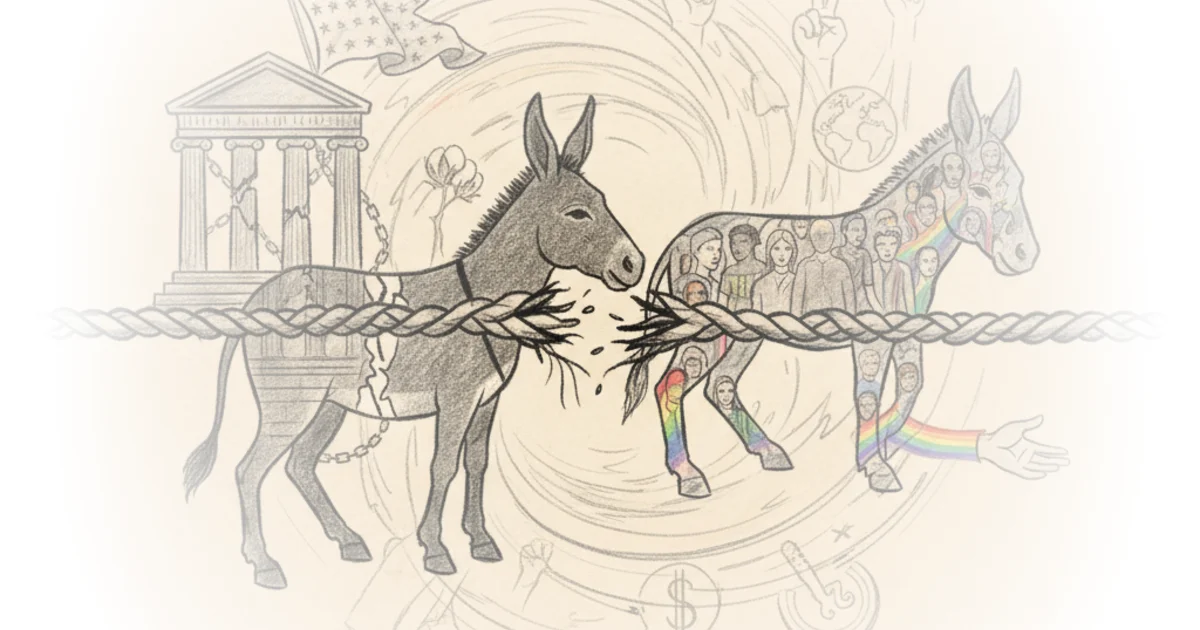
The author suggests that this "triangulation"—a constant movement to the right—created a self-fulfilling prophecy where the political center shifted so far right that the Democrats eventually became indistinguishable from the Republicans. "The political center is a shadow you cast, not a direction to follow," Kotkin observes. "In a two-party system, it is impossible to occupy the center, because there is no one to hold the left flank, and by shifting to the right, the Democrats just shifted the center between them and the Republicans to the right." This is a compelling geometric analysis of American politics: by ceding the left flank, the party allowed the entire spectrum to slide, leaving them with no distinct economic platform to offer voters.
Critics might argue that the party faced genuine constraints in a polarized environment where moving left would have guaranteed immediate defeat, suggesting that the "neoliberal" path was the only viable option to prevent total Republican dominance. However, Kotkin counters this by pointing to the 2008 election as proof that a different approach works. He notes that when Barack Obama ran on a "leftist, populist rhetoric," it "activated leftist activists and groups to participate politically on a scale that the left had not been involved in American politics since the 1960s."
Strong victories with a large margin in elections are available to the Democratic Party when it is associated with a return to the social democratic agenda, to the party of the working class and trade unions.
Yet, Kotkin argues, the party elite immediately "bottled up left-wing energy" after the victory, replacing populists with "Wall Street lobbyists" and prioritizing the interests of bankers over homebuyers during the financial crisis. This betrayal, he contends, is the root cause of the party's subsequent struggles. "The Democratic voter responds to the hopes given and the hopes betrayed by turnout," he writes. "When the Democrats promise nothing, they slowly cede ground to the Republicans; when they offer hope and then fail to deliver, voter turnout drops, ensuring a crushing defeat for the Democrats in the next elections."
The 2024 Dead End
The commentary takes a sharp turn toward the 2024 election results, which Kotkin interprets not as a narrow loss but as a total collapse of the party's strategic logic. He argues that by 2024, the Democrats had so few economic differences with the Republicans that they were forced to weaponize cultural issues as economic ones, a move that backfired spectacularly. On immigration, for instance, the party adopted a "Republican fascist anti-immigrant platform" in an attempt to appeal to right-wing voters, only to alienate their traditional base without gaining any new support. "It didn't win them the right-wing voters for whom this pivot simply confirmed the Republican 'crisis at the border' narrative, but it deprived the supporters of humane immigration policies, the former Democratic base, of representation," Kotkin explains.
The piece also highlights the foreign policy dimension, noting that the administration's hawkish stance on Israel, Ukraine, and NATO allowed the Republican candidate to position himself as the "dove" and the party of peace. This rhetorical flip was possible only because the Democrats had moved so far to the right on economic and social issues that they lost their moral high ground on international conflict. "After 32 years of moving to the right... the Democrats led themselves into an electoral desert where there weren't enough votes for them to pick up," Kotkin writes. The data supports his grim conclusion: the party's candidate won 15 million fewer votes than their predecessor, a drop that sealed their defeat.
For the Clinton-Obama Democratic Party, a victory of the Democratic base is more dangerous than the Republican one.
This is perhaps the most provocative claim in the piece: that the party establishment fears its own voters more than its opponents. Kotkin argues that losing to the Republicans is merely a "gentleman's sport" that allows the elite to continue fundraising off the threat of the right, whereas losing to the base means losing control of the party itself. "Losing to the Democratic base means for the neoliberal Democratic establishment losing the party," he asserts. This dynamic, he suggests, has created a feedback loop where every defeat is met with a further shift to the right, blaming the "far left" for the loss rather than the party's own economic policies.
The End of the Rope
Kotkin concludes that the party has reached the "end of the neoliberal rope." With no more economic principles to surrender and no distinct platform left to offer, the Democrats face an existential crisis. The only way forward, he argues, is a radical reversal of course—a return to the social democratic agenda that defined the party before 1992. "Either Democratic candidates are unable to win in the electoral desert, lose relevance and donor support... or the party will have to reverse course for the first time in 32 years and begin to move back towards its former base," he writes. He warns that the establishment may try to double down, potentially colluding with Republicans to sacrifice progressive cultural gains in exchange for political survival, a move that would only cement Republican dominance.
The piece ends with a stark warning: the marriage of liberal cultural values with unfettered capitalism has proven unsustainable. "There is no room in politics for such a thing as a gayer, pro-choice Republican Party," Kotkin writes, suggesting that the attempt to maintain cultural liberalism while surrendering economic justice has left the party with nothing to stand on. "By voluntarily abandoning a [leftist economic agenda], they have abandoned the very coalition that made them a majority party."
The marriage of the cultural political gains of the 1960s with capitalism proved unsustainable.
Critics might note that Kotkin's analysis underestimates the difficulty of implementing a social democratic agenda in a country with deep structural barriers to progressive policy, such as the Electoral College and the influence of money in politics. They might also argue that the party's shift to the right was a necessary adaptation to a changing demographic landscape, rather than a betrayal. However, the sheer volume of evidence Kotkin marshals—from the 1994 Republican Revolution to the 2024 popular vote collapse—makes a strong case that the current strategy has reached its limit.
Bottom Line
Kotkin's strongest argument is the historical continuity he draws between the Clinton-era pivot and the 2024 defeat, proving that the party's current troubles are not a glitch but a feature of a thirty-year strategy that has finally run out of road. Its biggest vulnerability is the assumption that a sudden return to social democracy is politically feasible without a complete overhaul of the party's donor base and institutional structure. Readers should watch for whether the party establishment acknowledges this structural failure or doubles down on the very policies that led to the "electoral desert."