This piece from Wayfare does something rare for a Christmas reflection: it argues that the very contradictions in the biblical birth narratives are not errors to be fixed, but the essential feature that keeps the story alive. Rather than smoothing over the fact that Matthew and Luke tell different stories, the article suggests that our desperate need to merge them into a single, coherent picture is actually a form of "taming" a figure who was never meant to be controlled. For busy readers navigating a world of rigid ideologies, this reframing offers a surprising liberation: the power of the story lies in its resistance to our definitions.
The Confabulation of the Manger
Wayfare opens by dismantling the familiar Christmas pageant, noting that the standard Nativity scene is a "confabulation born of the page flipping required to merge the stories in these two Gospels." The editors point out the glaring omissions: "Matthew doesn't mention shepherds, Luke doesn't mention wise men; Matthew doesn't say much about Mary, Luke doesn't mention Joseph's visions." This is not a critique of the text's reliability, but an invitation to sit with the discomfort of the unknown. The piece argues that this lack of a single, unified narrative is intentional, reflecting a deeper theological truth that "what has happened in Jesus is incomprehensible."
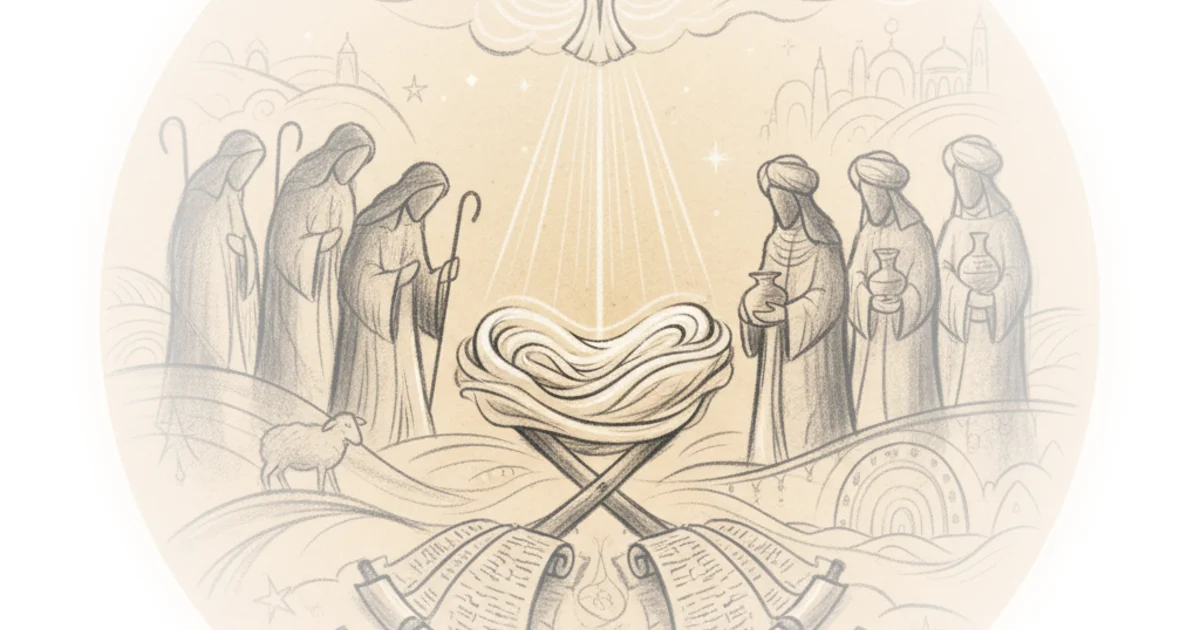
The commentary here is sharp and necessary. In an era of curated certainty, the article insists on the value of the "uneasy fact" that the Gospels are distinct and sometimes contradictory. It draws a parallel to the French sculptor Antoine-Louis Barye, whose dynamic animal sculptures captured the raw, untamed energy of nature rather than a static ideal. Just as Barye refused to soften the lion's ferocity, the text suggests we must stop trying to soften the "mystery in the manger" to make it palatable. The argument holds up because it shifts the burden of proof from the text to the reader, challenging us to accept that the divine might not fit into our neatly arranged boxes.
Much of the work of Christianity has been the work of taming the lion.
Taming the Lion
The piece then pivots to the psychological impulse behind religious tradition, using C.S. Lewis's description of Aslan as "not a tame lion" to illustrate the danger of reducing Jesus to a manageable concept. Wayfare notes that "it's too simple to say we should just stop trying and let Jesus be free, because it's impossible not to tame Jesus." The article argues that even modern attempts to liberate Jesus as a rebel or philosopher are themselves acts of taming, filtering him through "a post-1960s culture instinctively suspicious of tradition and institution."
This is a crucial distinction. The editors suggest that "taming him means making him comprehensible," and that the Incarnation itself is an act of God choosing to be "wed to a specific body in a specific time and a specific place." By grounding the divine in the human, the text implies that our attempts to understand are inevitable, yet always partial. The reference to the theological concept of kenosis—the self-emptying of God—adds historical depth here, reminding us that the miracle is not just the birth, but the voluntary limitation of the infinite. The argument is compelling because it validates the reader's struggle to understand while simultaneously warning against the arrogance of thinking we have fully grasped the subject.
Two Jesuses, One History
The most distinctive section of the article applies the framework of theologian H. Richard Niebuhr to the specific history of the Latter-day Saint church, tracing a shift from a Jesus of moral effort to a Jesus of grace. Wayfare describes the mid-twentieth-century view, championed by leaders like B. H. Roberts and James Talmage, as a religion where "human beings were placed on earth to prove their capacity for moral growth and development." This "Jesus the teacher" was a figure of self-discipline and aspiration, echoing the "myth of bootstraps self-creation that has thrived in the United States since the nineteenth century."
However, the piece argues that this model eventually calcified into a religion of "self-doubt and worry and scrupulosity," where Jesus became a "grader, someone constantly measuring whether his followers were living up to his expectations." The editors cite Stephen Robinson's 1990 book Believing Christ as a turning point, where the exhaustion of obedience led to a new emphasis. This shift is quantified by the editors, who note that by the 2010s, the word "grace" was uttered "three or four times more frequently in general conference than it was in the hundred years before."
Critics might note that framing this shift as a move from "teacher" to "grace-giver" risks creating a false dichotomy, as many believers likely held both views simultaneously. Yet, the piece effectively uses this contrast to show how cultural changes—moving from the optimistic post-war era to the therapeutic language of the 21st century—reshape religious expression. The article highlights Emily Belle Freeman's articulation of this new view, where grace is not just a pardon but a force that "rescues us, heals us, delivers us, and helps us overcome death, sin, and the weakness of mortality."
His saving grace rescues us, heals us, delivers us, and helps us overcome death, sin, and the weakness of mortality.
The editors are careful not to declare one view superior, but rather to show that "these respective emphases can help us to learn one aspect of the possibilities Jesus offers." This nuanced approach avoids the trap of theological tribalism, instead presenting the evolution of doctrine as a living response to human frailty. The argument is strengthened by the observation that "the very limitations of our ability to fully comprehend Jesus makes him powerful."
Bottom Line
Wayfare's strongest move is reframing the contradictions in the Nativity stories not as problems to be solved, but as the very mechanism that prevents the faith from becoming a static idol. The article's vulnerability lies in its heavy reliance on a specific cultural trajectory within one religious tradition to illustrate a universal point, which may feel abstract to readers outside that context. However, the core insight remains vital: in a world obsessed with optimization and control, the most powerful spiritual force may be the one that refuses to be fully understood.
The thing which keeps life romantic and full of fiery possibilities is the existence of these great plain limitations which force all of us to meet the things we do not like or do not expect.