In a moment where the world often feels like it is spinning off its axis, George Saunders offers a radical prescription for the artist: stop waiting for the sky to clear and start taking notes on the flying elephants. Rather than retreating into cynicism or despair, Saunders reframes the current chaos not as a reason to stop creating, but as the very signal that art is most urgently needed. This is not a platitude about resilience; it is a strategic manual for sustaining a creative life when institutional support vanishes and the news cycle becomes a source of terror.
Designing a Life for the Long Haul
Saunders begins by addressing the practical anxiety of the emerging writer: the sudden withdrawal of the academic cocoon. He argues that the world, in its current state, effectively prefers that young writers stop writing. "I sometimes joke that the world would prefer that a young writer stop writing," Saunders notes, highlighting the external pressure to abandon the craft for stability. His advice is not to fight the world head-on, but to engineer a life that can withstand it. He urges writers to conduct a forensic audit of their own habits. "What do they actually need, to be creative? How many hours a day? What conditions have produced their best work?" he asks, pushing readers to reject the romantic myth of the starving artist in favor of a sustainable, perhaps even mundane, reality.
This pragmatic approach is a necessary counterweight to the idealism of the MFA program. Saunders admits that for him, the "starving artist" model was not just unappealing but counterproductive. "I didn't like the idea of making my young family deal with that," he writes, choosing instead to work a "real" job and sneak writing in during the cracks of the day. This creates a wilder, less pressured creative environment. While some might argue that financial stability dulls the edge of artistic urgency, Saunders suggests the opposite: removing the desperate need for the work to pay the bills allows the work to breathe.
What do I need to thrive? That is the question every artist must answer for themselves, not the world.
The Flying Elephants and the Duty of Witness
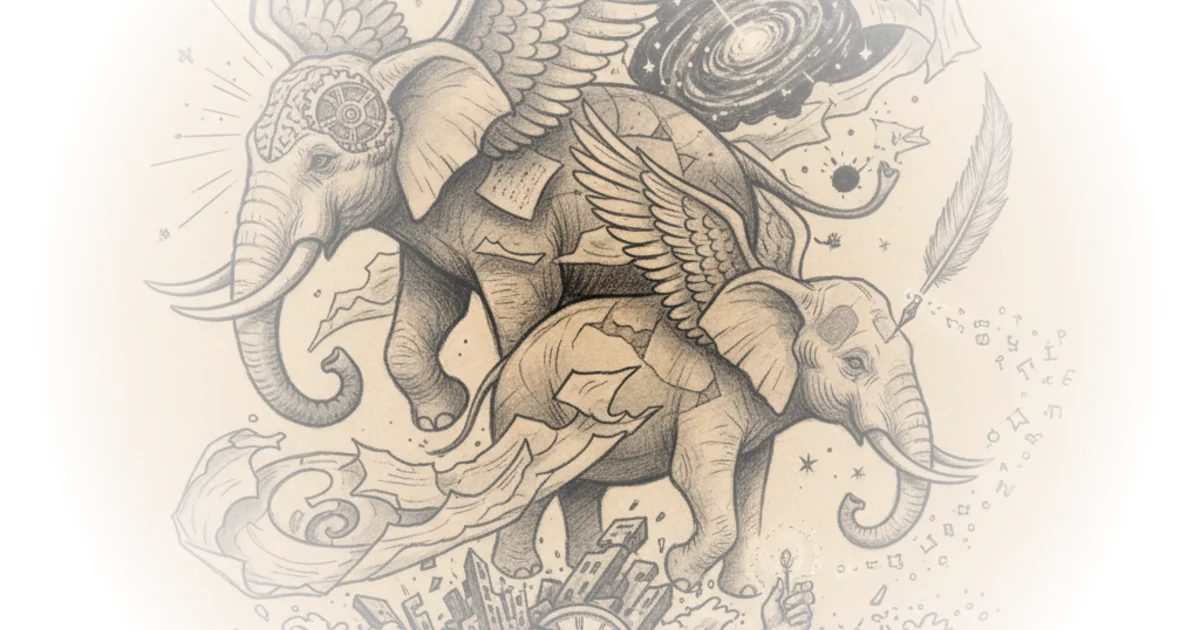
Shifting from the practical to the existential, Saunders tackles the paralysis caused by the sheer strangeness of current events. He borrows a metaphor from journalist Thomas Friedman to reframe the overwhelming nature of the news. "Whenever you see elephants flying, don't laugh, take notes," Saunders quotes Friedman, using this image to describe the absurdity and horror of the modern political landscape. The danger, Saunders argues, is getting stuck in the initial reaction of disbelief. "How long do I want to stand here below, going, 'I can't believe it!'" he asks, challenging the reader to move past the shock.
The core of his argument here is a shift from victimhood to curiosity. Instead of asking why the world is so broken, the artist must ask, "Why is this surprising to me? How did I so poorly understand dogs, and how can I rectify that?" This reframing is powerful because it restores agency to the writer. It turns the chaos into material. However, critics might note that this intellectual detachment can feel cold when the "flying elephants" represent real human suffering and policy decisions that cause tangible harm. Saunders acknowledges this tension, admitting it is "easier said than done" when the elephants seem to be "blocking out the sun."
To ground this abstract concept, Saunders reaches back to the Russian poet Anna Akhmatova and her collection Requiem, written during the Yezhov terror of the late 1930s. He recounts the moment a stranger in a prison queue in Leningrad asked, "Could one ever describe this?" and Akhmatova's response: "I can." Saunders uses this historical touchstone to illustrate that the act of witnessing and describing is itself a form of resistance. The parallel is stark: just as Akhmatova faced the machinery of the Great Purge, the modern writer faces a different kind of terror, but the mandate remains the same. The art is not a distraction from the horror; it is the only way to process it.
The Long Arc of Fiction
Saunders then confronts the fear that writing fiction is a futile exercise when the roof is caving in. He recalls his own hesitation after 9/11, feeling like he was "painting designs on the baseboards of a house as the roof caved in." Yet, he argues that fiction operates on a different timeline than the news. "We write it so that it will be able to be read profitably far into the future," he asserts. He points to Sherwood Anderson's "Paper Pills," written around 1910, as proof that great work transcends its immediate context to offer wisdom decades later.
This separation of art and immediate political advocacy is a contentious point. Saunders suggests that while some work is overtly political, the most enduring art often explains human tendencies that "writ large, becomes political." He cites Chekhov's "Enemies" and the tribalism in Huck Finn as examples of stories that illuminate the roots of conflict without being mere pamphlets. A counterargument worth considering is that in times of acute crisis, the demand for direct, unambiguous political art is higher than ever, and the "long arc" argument can sometimes serve as an excuse for inaction. Saunders anticipates this, admitting that sometimes he simply cannot help but write overtly political pieces, but he insists that even then, the work must rise above mere advocacy to function as art.
What we do and what we write matters, simply because there are people on the other end, receiving those actions and words and being, even subtly, changed by them.
The Bottom Line
Saunders' most compelling contribution is his refusal to let the current climate dictate the terms of artistic creation; instead, he invites writers to use the chaos as a catalyst for deeper observation. The argument's vulnerability lies in its reliance on individual resilience, which may feel insufficient to those facing systemic oppression or immediate material deprivation. Ultimately, this piece serves as a vital reminder that in an era of flying elephants, the act of taking notes is not just a creative choice, but a moral imperative.