Adam Tooze abandons standard geopolitical forecasting for a surreal pop-culture allegory, arguing that the United States is no longer a coherent state but a chaotic "zone" where distinct dystopias collide. Rather than analyzing policy in isolation, he frames the nation's 250th anniversary as a "crossover" event where the forces of MAGA politics and unregulated artificial intelligence converge with terrifying unpredictability. This is not a story about one leader, but about a system where elite coherence has collapsed, leaving the country to drift as an incubator for world-altering shocks that defy traditional economic logic.
The Gotham City Metaphor
Tooze begins by rejecting the idea of the US as a singular power-state, comparing its current condition to the fictional "Batman: Dead End" universe where heroes and monsters fight in overlapping narratives. He writes, "Not one nightmare, not one drama, not one cast of 'bad guys' v. 'good guys', but distinct, overlapping dystopias, in a giant melange." This framing is striking because it moves beyond the usual binary of political polarization to suggest a fundamental structural disintegration. While China represents a recognizable, albeit massive, historical state model—what Tooze calls "Godzilla" or "King Kong"—the US has fractured into something unrecognizable.
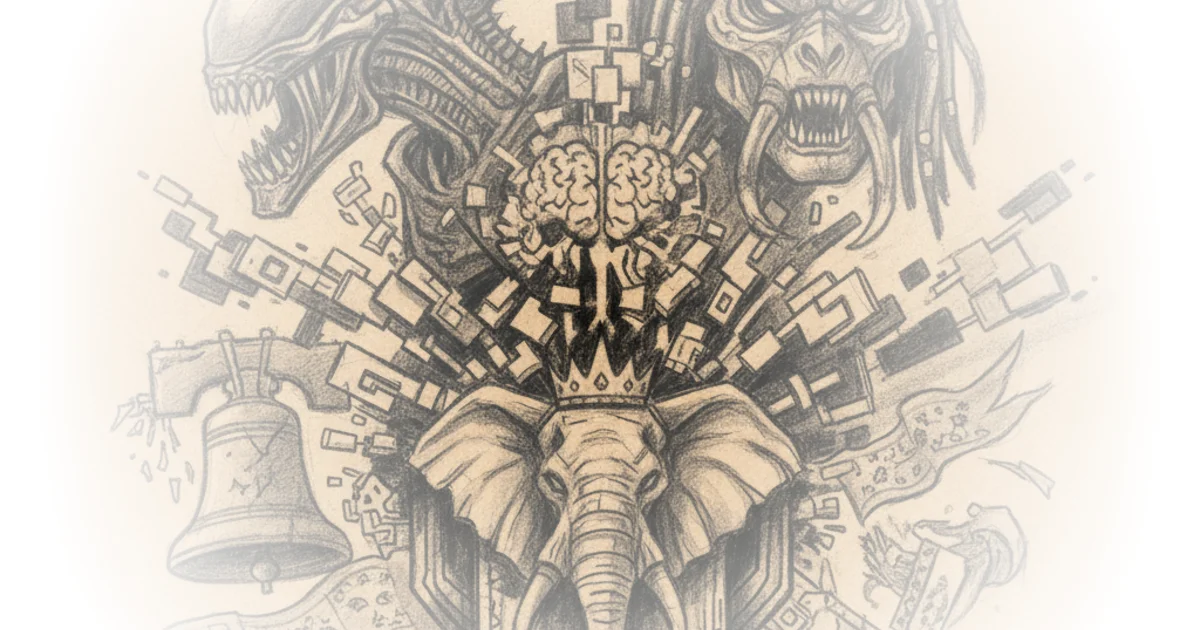
The author posits that the American experiment has mutated from Jeffersonian ideals into a corrupt urban sprawl presided over by self-enriching figures and tech oligarchs. He observes, "In the current moment, the environment that comes to mind is not a slave-based idyll like Jefferson's Monticello, but Batman's Gotham city - a mythical, corrupt and depraved urban sprawl." This comparison effectively captures the sense of lawlessness and private power dominating public life. Critics might argue that this metaphor is overly cynical, ignoring the resilience of American institutions or the genuine prosperity in many sectors. However, Tooze counters this by noting that while "private prosperity" exists, it is overshadowed by a leadership engaged in "haphazard and fly-by-night self-enrichment."
"The US as it enters its second quarter millennium, is best thought of not as a single coherent agent, but as an incubator, a petri dish, a 'zone' from which things emerge that defy summation in a single graphic image."
The AI Shock and the Death of the State
The core of Tooze's analysis shifts to artificial intelligence, which he identifies as the primary "monster" emerging from this Gotham-like landscape. He contrasts the mid-20th century model of state-directed science with today's private-sector frenzy. "The world-transforming technologies of the mid 20th century were driven by engineers... But, ultimately, they were under state control," he writes, noting that figures like Wernher von Braun and J. Robert Oppenheimer built the state apparatus they served. In stark contrast, today's AI boom is fueled by "private money and the giant unfettered egos of tech entrepreneurs."
This distinction is crucial: it suggests that the political economy of innovation has shifted from a public good to a private gamble with global consequences. Tooze points out that while the Pentagon intervenes sporadically over security risks, there is a broader silence regarding the societal impact. He highlights a grim projection from the Bank for International Settlements (BIS), noting that the current trajectory envisions "a future... in which the labour share of income collapses to 20 percent over the next forty years." This data point serves as the chilling climax of his argument: the financial markets are betting trillions on a future where human labor is systematically devalued.
The author draws a parallel to the "China shock" discourse but warns that the AI disruption will be far more profound, potentially "orders of magnitude larger than anything contemplated by even the most extreme 'China shock' scenarios." He asks, "What would you expect in our 'crossover' reality in which MAGA meets AI?" The implication is that without state guidance, the convergence of political chaos and technological acceleration creates a volatile mix where no single entity is steering the ship.
"The promise, for the investors it is a promise, to totally disrupt our familiar way of life, our ways of living and working... Is anyone taking action to seriously regulate or guide this?"
A Monument to Chaos
Tooze concludes by framing the current AI boom not as a triumph of innovation, but as a "crossover monument" to the US at 250. He argues that the wealth generated is sustained by a collective wager on the total disruption of society, with the bottom quintile of Americans now holding fifteen percent of their wealth in stocks—a significant increase from 1998—while the top one percent holds over fifty percent. "This isn't the kind of state-guided industrial policy that has unleashed China shock 2.0," he writes, but rather a micro-to-macro explosion driven by private finance.
The argument lands with force because it connects abstract economic data to a tangible sense of existential dread. By invoking the "alienated and crushing objective force" of capitalism, Tooze suggests that AI is simply the latest manifestation of a system that consumes human creativity. A counterargument worth considering is that this view underestimates the adaptive capacity of labor markets or the potential for new regulations to emerge from the political chaos. Yet, Tooze's point remains: the current trajectory is not inevitable, but it is being actively pursued by powerful actors who treat society as a testing ground.
"Amidst the red, white and blue and the hot dogs, let that stand as a 'crossover' monument to the USA at 250."
Bottom Line
Tooze's most compelling contribution is his reframing of US decline not as a loss of power, but as a fragmentation into competing, uncontrolled forces where private tech moguls have replaced state architects. The argument's greatest vulnerability lies in its deterministic tone, which may overlook the potential for democratic backlash or regulatory intervention to rein in these "monsters." Readers should watch whether the gap between the AI boom and public policy continues to widen, as that divergence will likely define the next quarter-century of global stability.