History often gets reduced to the clash of personalities, but Kings and Generals offers a chillingly mechanical explanation for the descent into total war: the naval arms race was not merely a symptom of tension, but a self-sustaining engine that made conflict inevitable. This piece distinguishes itself by treating the pre-1914 buildup not as a series of diplomatic blunders, but as a calculated, industrial feedback loop where technology, doctrine, and domestic politics conspired to trap two great powers in a zero-sum game. For the busy reader, the value lies in understanding how a specific military theory, when adopted by a rising power, can shatter a century of stability regardless of the leaders' personal intentions.
The Doctrine of Risk
The narrative begins by establishing the technological shift that made the race possible. "The 1500s to the 20th century were an era of colonial expansion when the nations of Europe dominated much of the world," Kings and Generals writes, noting that this domination was secured by naval supremacy. However, the true pivot point was the adoption of American naval theorist Alfred Thayer Mahan's ideas. The author explains that Mahan "asserted that sea power was the key factor that enabled strong nations to prosper and exert their influence over weaker ones," a concept that became gospel in military academies globally.
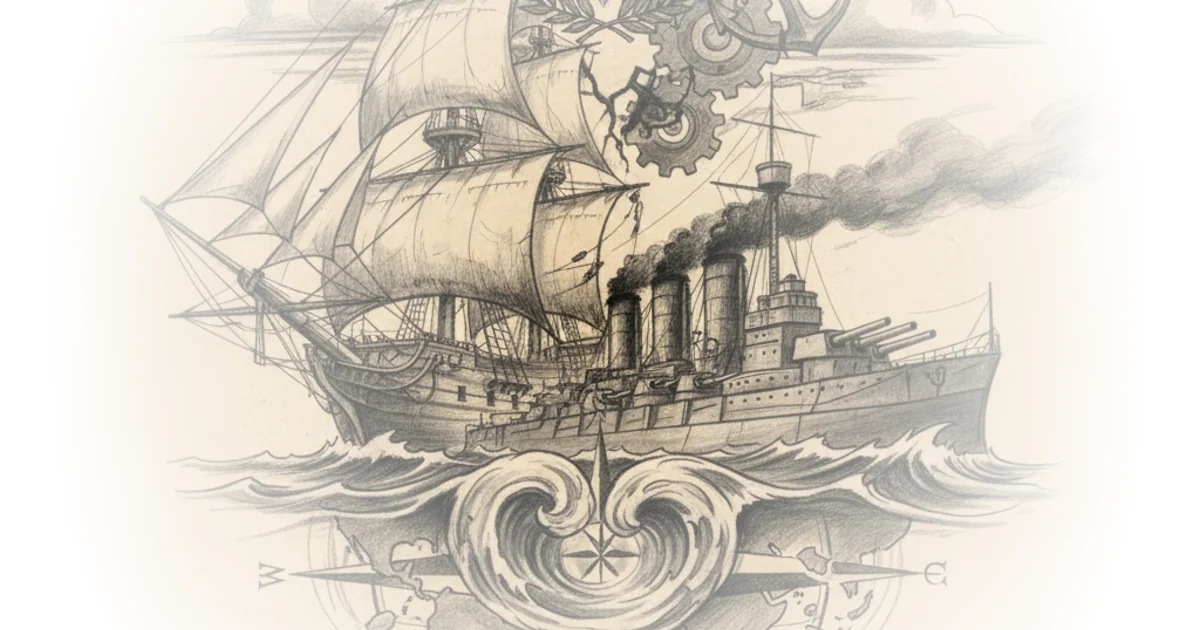
This theoretical shift is crucial because it moved naval strategy from trade protection to fleet-on-fleet annihilation. When Kaiser Wilhelm II took the throne, he didn't just want a navy; he wanted a weapon of diplomacy. As Kings and Generals puts it, "Wilhelm and his advisers had done this due to the belief that it would improve Anglo-German relations," a fatal miscalculation that ignored the reality of British dependence on the sea. The commentary here is sharp: the German leadership believed that building a fleet would force Britain to the negotiating table, but they failed to realize that for an island nation, a rival fleet was an existential threat, not a bargaining chip.
"If Germany's navy reached a strength where Britain could not defeat it without crippling losses, Turpitz believed Britain would be forced to negotiate with Germany as an equal."
The piece correctly identifies Admiral Alfred von Tirpitz as the architect of this strategy. His "Risk Theory" was a gamble: build a fleet two-thirds the size of the Royal Navy, and Britain would be too afraid to risk a battle, effectively neutralizing their global power. Kings and Generals notes that Tirpitz "argued that by building a fleet two-thirds the size of Britain's... Germany could exploit the Royal Navy's global dispersal." This framing is effective because it highlights the strategic logic behind what looks like irrational aggression. However, a counterargument worth considering is that this theory assumed Britain would act purely rationally; in reality, the psychological impact of a challenger to the sea's supremacy often triggers a defensive overreaction rather than a diplomatic accommodation.
The Industrial Feedback Loop
As the race intensified, the narrative shifts from strategy to the sheer momentum of industrial capacity. The author details how the German Naval Laws of 1898 and 1900 committed Berlin to doubling its fleet, creating a situation where "Britain's political and military leaders contemplated the potentially disastrous economic, social, and political ramifications if the Royal Navy failed to ensure Britain's freedom of action." The stakes were absolute: "by 1900, 58% of the caloric intake of the average British citizen came from overseas." This statistic grounds the abstract concept of naval power in the visceral reality of starvation and economic collapse.
The British response was not just to build more ships, but to revolutionize their entire fleet. The entry of Admiral Sir John Fisher into the picture marks a turning point. "Fischer standardized 12-in guns for battleships... and both classes powered by steam turbines," Kings and Generals writes. The launch of the HMS Dreadnought in 1906 is presented as the moment the game changed entirely. The author describes the ship as "the first capital ship powered by steam turbines, which were capable of 21 knots, and had a uniform main battery of 10 12-in guns." This technological leap rendered all previous ships obsolete, effectively resetting the race and forcing Germany to start over.
"The quest for maritime supremacy became a central theme of political mobilization, public discourse, and nationalist identity politics."
Here, Kings and Generals makes its most insightful point: the race was no longer just about ships; it was about national identity. The author argues that "public enthusiasm and media coverage centered around the dramatic presentation of naval power... which became theatrical displays of strength and deterrence." This theatricality fueled the hostility. The piece suggests that once the naval industrial complex was established, with its own lobby and media narrative, de-escalation became politically impossible. Critics might note that the piece focuses heavily on the naval aspect and underplays the role of the alliance system (the Entente) in encircling Germany, which was equally critical in driving the conflict. Yet, the argument that the naval race created a psychological trap is compelling.
The Trap Closes
The final section of the coverage illustrates how the momentum became unstoppable. Despite the massive costs, the political pressure to continue was overwhelming. "Fear gave into nationalist sentiment and right-wing hawks encouraged by the navy and industry promoted escalation while left-wing doves encouraged more peaceful foreign relations," Kings and Generals observes. The author notes that the failure of the Algeciras Conference in 1906 convinced many in Germany that Britain was actively working to encircle them, validating the hawkish narrative.
The piece concludes by highlighting the irony of the situation: Germany's attempt to force a diplomatic settlement through military strength only accelerated the formation of the very coalition it feared. The ratio of capital ships shifted, and the British response was to concentrate their entire fleet in the North Sea, "positioned just hours from Germany's coasts." The narrative effectively shows how a policy designed to secure peace through strength instead created a hair-trigger environment where a single incident could ignite a continental war.
"The HMS Dreadnaugh was launched, astonishing Germany. Turpitz was deeply troubled by the debut of the HMS Dreadnaugh. He recognized that Germany had no choice but to respond despite the high costs."
Bottom Line
Kings and Generals delivers a powerful analysis of how strategic miscalculation and industrial momentum can override diplomatic sense, turning a rivalry into a suicide pact. The strongest part of the argument is the detailed breakdown of Tirpitz's "Risk Theory" and how its failure to account for British existential fears turned a defensive buildup into an offensive threat. The piece's biggest vulnerability is its relative silence on the domestic political constraints within Britain that also prevented de-escalation, but as a study of the mechanics of the arms race itself, it is essential reading. Watch for how modern great power competitions mirror this same feedback loop of technology, doctrine, and nationalist pressure.