This is not a story about syrup; it is a masterclass in how a fragmented industry can dismantle a global monopoly through collective action and strategic rebranding. The Walrus, in a piece by Peter Kuitenbrouwer, reframes the history of the maple trade not as a bucolic tradition, but as a brutal struggle against predatory capitalism that nearly erased a national industry. For busy leaders watching modern supply chains fracture, the lesson here is urgent: when a single buyer dictates terms, the only path to survival is vertical integration and the audacity to redefine the product itself.
The Anatomy of a Monopoly
Kuitenbrouwer opens by dismantling the romantic myth of the maple industry, replacing it with the stark reality of George Clinton Cary's ascent. The author details how an American salesman, stuck in Vermont mud in 1886, stumbled into a monopoly that would eventually control eighty percent of the world's bulk maple sugar. "Like a gluttonous dinner guest, Cary developed a voracious appetite," The Walrus writes, capturing the insatiable nature of his expansion. This framing is effective because it strips away the nostalgia of the sugar bush to reveal the raw mechanics of market dominance.
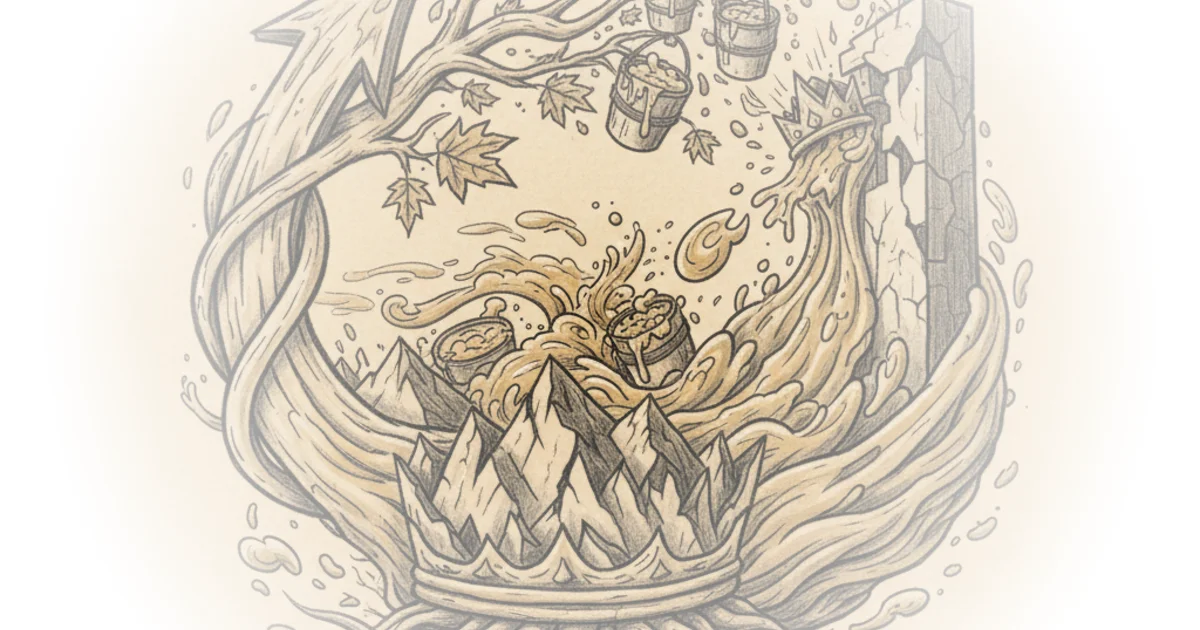
The coverage meticulously tracks how Cary leveraged his position to squeeze producers on both sides of the border. He didn't just buy the product; he controlled the logistics, the packaging, and the pricing. "Cary called the shots: he paid Quebec farmers four cents per pound for maple sugar in the 1910s, but in 1923, he cut the price to two cents," Kuitenbrouwer notes, illustrating the volatility farmers faced under a single buyer. The author's choice to highlight the specific mechanism of this control—the border closure engineered by Cary to depress Canadian prices—adds a layer of geopolitical intrigue often missing from agricultural histories.
"Cary laughed in his face. Then, with a sardonic grin, Cary dared Vaillancourt to try to gain control over the price of maple sugar and maple syrup."
This anecdote serves as the narrative pivot. It transforms the story from a historical report into a David-versus-Goliath drama. The Walrus effectively uses this moment to set the stakes: the failure of the Vermont cooperative meant that the next attempt had to be flawless. Critics might note that the piece leans heavily on the charisma of the protagonist, Cyrille Vaillancourt, potentially underplaying the broader economic shifts that made cooperation viable. However, the human element is necessary to explain why a scattered group of farmers would risk everything against an entrenched giant.
The Strategy of Dignity
The core of the argument shifts from resistance to innovation. Kuitenbrouwer argues that the Quebec farmers' victory wasn't just about bargaining power; it was about changing the product's identity. Vaillancourt realized that competing on price with cane sugar was a losing battle. "I thought, 'If this is really our national sweetener, we have to get out of this rut and present the product with more dignity,'" the author quotes Vaillancourt, highlighting a strategic pivot from commodity to luxury good.
This section of the coverage is particularly insightful for modern business leaders. The Walrus explains that Vaillancourt didn't just organize a co-op; he enforced quality standards and rebranded the output. He sent empty barrels to producers, demanding they fill them with their finest syrup, rejecting the "torn and gutted bags" that had previously defined the trade. This move mirrors the historical rise of the Desjardins Group, which similarly leveraged local trust to build a financial powerhouse from the ground up. By focusing on quality, the farmers created a new market segment where price was secondary to prestige.
The narrative acknowledges the immense difficulty of this transition. "Vaillancourt realized that the maple sweetener industry could never win a price war with cheaper cane sugar and corn syrup," Kuitenbrouwer writes. The author's analysis holds up because it recognizes that organizational unity without a value proposition is insufficient. The farmers had to convince the world that maple syrup was not just a sweetener, but a specialty product. This required a level of discipline and foresight that the individualistic Vermont farmers lacked, a point the article makes clear by contrasting the two regions' outcomes.
The Power of Collective Action
The final act of the story details the formation of the Société coopérative des producteurs de sucre d'érable. Kuitenbrouwer paints a vivid picture of Vaillancourt's grassroots organizing, from his basement operations in Lévis to his relentless lobbying of government officials. The author emphasizes that this was not a spontaneous uprising but a calculated campaign. "To raise the quality of the product and attract more sales, the province had, in 1914, created the first sugaring school," the text notes, showing how institutional support was crucial to the farmers' success.
This historical context strengthens the argument that collective action requires infrastructure. The Walrus suggests that the Quebec model succeeded where the Vermont one failed because it combined farmer organization with state-backed quality control. The article implies that without the backing of the Quebec government and the vision of leaders like Vaillancourt, the farmers would have remained at the mercy of buyers like Cary. This is a powerful reminder that market power often requires political will.
"Today they all bring me their products, and they don't speak of their failed co-operative. You won't do any better, young man, and you will soon be happy to see me again. I am still the Maple King."
The irony of Cary's taunt is the article's emotional climax. The Walrus uses this quote to underscore the magnitude of the farmers' eventual triumph. By the time the story concludes, the reader understands that the "Maple King" was not defeated by force, but by a superior business model that prioritized quality and unity over volume and exploitation.
Bottom Line
The Walrus delivers a compelling case that the Quebec maple industry's dominance was not inevitable, but the result of a deliberate, high-stakes strategy to rebrand a commodity into a luxury good. The piece's greatest strength is its refusal to romanticize the industry, instead exposing the predatory mechanics of the monopoly that preceded it. Its only vulnerability is a slight over-reliance on the singular genius of Vaillancourt, which may obscure the broader structural changes required for such a transformation. For any leader facing a dominant market player, the lesson is clear: unity is necessary, but redefining the value of your product is the only way to win.