Michael Huemer doesn't just explain skepticism; he dissects why the most absurd-sounding philosophical claims feel so intellectually seductive. In a field often bogged down by abstract jargon, he offers a rare clarity: the problem isn't that we can't prove we aren't brains in vats, but that our own rules for what counts as "justification" might be the trap. This piece matters now because it exposes a hidden fragility in how we validate truth itself, challenging the very foundation of our daily certainty.
The Architecture of Doubt
Huemer begins by redefining the battlefield. He isn't interested in the wild claims of conspiracy theorists but in "common sense beliefs"—those cross-cultural, cross-temporal convictions that seem obvious on their face, like the existence of your own hands. He writes, "By 'common sense beliefs,' I mean beliefs that have about the highest degree of initial plausibility of any beliefs... Denying one of them is a sign of insanity (unless you're doing philosophy)." This distinction is crucial. It separates the skeptic from the madman by framing skepticism as a technical, rational exercise rather than a breakdown of reality.
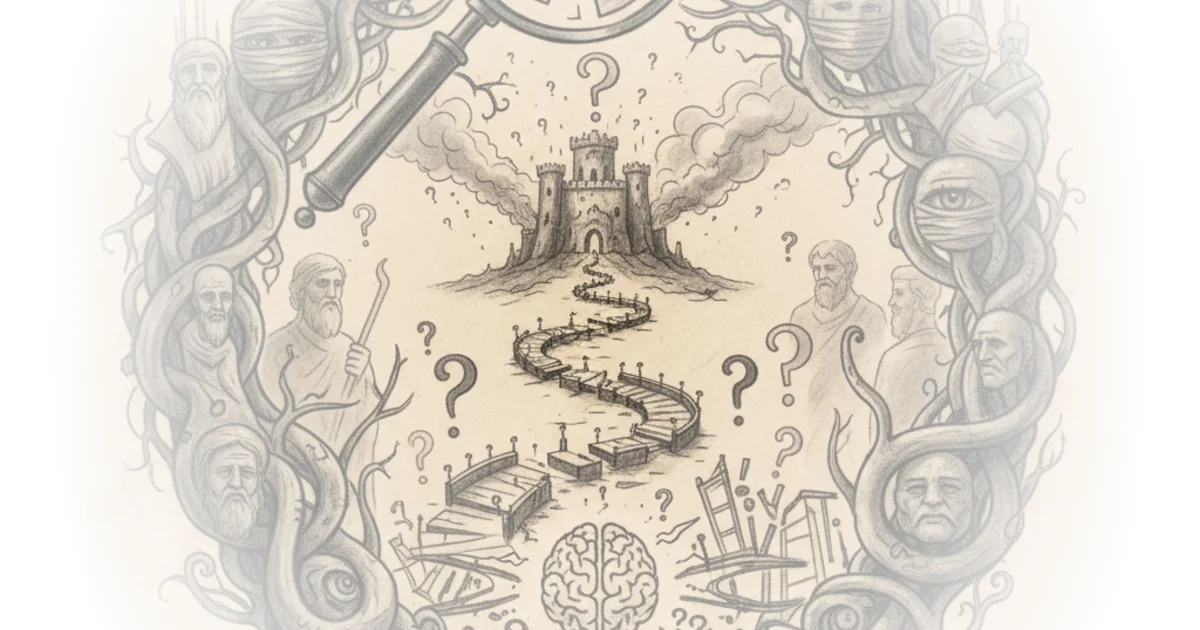
The author then lays out four distinct engines that drive this doubt. The first is the regress argument, which suggests that for any belief to be justified, it needs a reason, which needs a reason, ad infinitum. Huemer notes, "You can't have an infinite series of reasons behind any actual belief. Circular reasoning can't generate justification." He argues that since we can't have an infinite chain, and circles don't count, we are left with no justified beliefs at all. This logic mirrors the ancient problem of infinite regress that plagued early epistemology, forcing philosophers to choose between an endless chain or a foundational stop that itself lacks proof.
"If the arguments succeed, then they are counter-examples to their own conclusions. Hence, they can't succeed."
The second engine, the reliability argument, deepens the trap. To trust your senses, you must first prove your senses are reliable. But how do you prove that? You can't use your senses to prove your senses, as that would be circular. Huemer illustrates this with a Tarot card reader: "The Tarot card reader can't just read the Tarot cards to verify that her card reading is reliable." This creates a parallel regress where every method of verification requires a prior verification, leading to the same dead end. Critics might note that this assumes a hyper-rational standard of justification that doesn't match how human cognition actually functions in the wild, but Huemer's point is that the logic of justification, not the psychology, is what's failing.
The Trap of the Mind
The third and fourth arguments tackle the isolation of the mind. Huemer channels David Hume, arguing that we are never directly aware of the external world, only of our own mental phenomena. "No one is ever directly aware of anything external; we're only directly aware of things in our own minds," he writes. This creates a barrier: we can't step outside our heads to check if our mental images match reality. This connects to the famous "Brain in a Vat" scenario, a modern twist on the skepticism that has haunted philosophy since Descartes. Huemer explains that if you were a brain in a vat, your sensory experiences would be identical to a normal life. Therefore, "your sensory experiences are not evidence against the BIV hypothesis."
This is where the argument becomes most unsettling. If our only evidence is our experience, and that experience is compatible with both reality and a simulation, then we have no reason to reject the simulation. Huemer summarizes the chilling conclusion: "So you don't know anything about the external world." The power of this framing lies in its simplicity; it doesn't require complex physics, just the realization that our evidence is trapped inside the very system we are trying to verify.
The G.E. Moore Shift
So why discuss this if it leads to such a bleak conclusion? Huemer argues that the value lies in the incoherence. "There seems to be some kind of incoherence in our beliefs and intuitions about knowledge and justification," he observes. The goal isn't to become a skeptic, but to find the flaw in the argument. He introduces the "G.E. Moore shift," a clever logical maneuver. If a skeptic says, "Premise A and Premise B lead to Conclusion C (that you know nothing)," Moore argues we should look at the plausibility of the premises. Since it is more obvious that "I have two hands" than that "all knowledge requires reasons," we should reject the skeptical premise instead of the common sense fact.
Huemer writes, "It's more obvious that I know how many hands I have than it is that all knowledge requires reasons." This is the piece's strongest move. It doesn't solve the logical puzzle, but it reframes the debate: the skeptic is the one making the implausible claim, not the person with hands. However, Huemer admits this doesn't actually answer the philosophical question of what is wrong with the argument. It just tells us which side we should intuitively trust.
"The skeptic is just irrationally picking the least plausible of the three."
Bottom Line
Huemer's analysis is a masterclass in exposing the hidden costs of demanding absolute certainty. His strongest contribution is showing that skepticism isn't a failure of the world, but a failure of our own rules for justification. The biggest vulnerability remains his admission that the "Moore shift" is a rhetorical victory rather than a logical solution; it tells us what to believe, but not why the skeptic's logic is flawed. Readers should watch for his next post, where he promises to finally identify the specific error in the skeptical chain.