Hal Johnson delivers a devastatingly surreal satire that exposes the absurdity of modern warfare by stripping it of its heroism and replacing it with bureaucratic farce. Rather than focusing on grand strategy or noble sacrifice, the story reveals a conflict where the primary enemy is not the opposing army, but the sheer incompetence of one's own leadership and the random cruelty of faulty equipment. This narrative forces the reader to confront the dehumanizing logic of war where survival depends on luck, and victory is measured in the number of enemy soldiers killed by a single, impossibly skilled marksman while the rest of the battalion plays softball.
The Theater of Absurdity
Johnson constructs a world where the rules of engagement are inverted to highlight the madness of the situation. The narrator, Anthony Boy, describes a trench environment where soldiers are ordered not to fire their weapons because the rifles are so defective they are more likely to explode in the user's face than hit the target. "All our rifles were fifty years old... and exploded in your face about one time in six if you tried to fire them," Johnson writes. This detail is not merely a gag; it is a critique of how military institutions often prioritize the appearance of readiness over the actual safety and efficacy of their troops. The administration's logic—that if both sides stop shooting, the enemy will eventually blow themselves up—is a chilling illustration of how bureaucratic reasoning can detach completely from human reality.
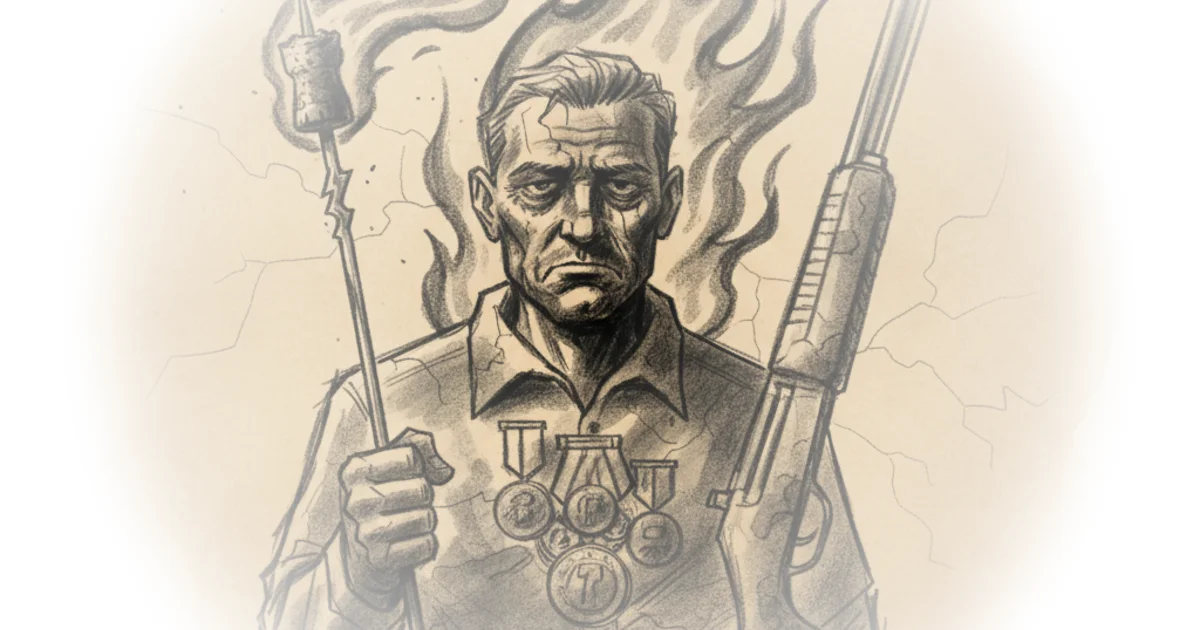
The story introduces Zugazagoitia, a "cracksman" who arrives with a pristine, high-tech rifle hidden in a violin case, instantly becoming the center of attention. He represents the anomaly in a system designed for mutual destruction through incompetence. "You see that man doing callisthenics there?" Zugazagoitia asks before firing, and the narrative shifts from a grim stalemate to a one-sided slaughter. Johnson uses this shift to satirize the sudden, often arbitrary nature of military "success." The soldiers' reaction is not one of horror at the killing, but of manic celebration. "We jumped up and down. We yelled, 'We're number one!' and 'In your face!'" Johnson captures the dangerous euphoria that can accompany violence when it is framed as a game or a sporting event rather than a tragedy.
The only people who fired were simpletons and greenhorns, and evolution was weeding them out.
This line, attributed to the character Effingham, perfectly encapsulates the story's dark Darwinian view of the battlefield. Johnson suggests that in a war of attrition defined by faulty gear, the only survivors are those who adhere to the absurd logic of non-combat, or those who are granted impossible advantages by chance. The narrative voice remains detached and matter-of-fact, which makes the grotesque details—like a soldier losing a leg to a nail while the others cheer for a sniper—hit even harder. The author forces the reader to sit with the dissonance of celebrating a victory that is built on the systematic dehumanization of the enemy and the trivialization of one's own casualties.
The Mechanics of Dehumanization
As the story progresses, the soldiers begin to treat the enemy not as human beings, but as targets for entertainment. The arrival of Zugazagoitia turns the war into a spectacle. The soldiers request "stunt shooting" to boost morale, asking him to kill enemies while standing on his head or eating an apple. "We thought it would be real demoralizing for them if they died and you were doing all sorts of capers at the same time," Effingham explains. Johnson uses this request to expose the moral rot at the core of the unit. The soldiers are so desensitized that they view the act of killing as a performance art, a way to pass the time and feel superior.
The portrayal of the Corolonians is equally telling. They are depicted as "ignorant natives" who are confused by the sudden return of gunfire, laughing at the Palamans for firing again before realizing they are being hunted. Johnson writes, "Like ignorant natives, I bet, when they first discovered, with superstitious dread, the power of the 'thunder-sticks' so-called." This framing mimics the colonialist rhetoric often used to justify violence against those perceived as less civilized. By having the Palaman soldiers adopt this perspective, Johnson critiques how armies construct narratives of superiority to make the act of killing palatable. The enemy is reduced to a prop in the soldiers' theater of war, their deaths serving only to validate the soldiers' own sense of invincibility.
Critics might note that the story's heavy reliance on satire risks trivializing the actual horror of war by making it seem like a cartoon. However, Johnson's intent appears to be the opposite: by pushing the absurdity to its logical extreme, he strips away the romantic veneer of combat to reveal the cold, mechanical indifference of the machinery of war. The human cost is not ignored; it is simply rendered invisible by the soldiers' own delusions. When a soldier named Swanstrom loses a leg to a nail, the group's reaction is to dismiss it as a minor inconvenience in the face of their "great victory." "That was sad," the narrator admits, but the tone quickly returns to the celebration of the sniper's feats.
The Inevitable Return to Chaos
The story's conclusion brings the narrative full circle, reinforcing the idea that the "cracksman" is merely a temporary anomaly in a system designed for mutual destruction. When the code "723486" is heard on the wireless, it signals that a Corolonian cracksman has been dispatched to counter Zugazagoitia. The implication is clear: the cycle of violence will resume, not through strategy or honor, but through a tit-for-tat escalation of individual skill. "It literally means that a…a 'cracksman'... has been dispatched by the Corolonians to this theater. Wouldn't do to have two around, now, would it?" Zugazagoitia explains.
The story ends on a note of unresolved tension, suggesting that the war is not about territory or ideology, but about the random interplay of chance and skill. The soldiers' joy is fleeting, and the underlying reality of the conflict remains unchanged. Johnson leaves the reader with the unsettling realization that in this world, the only thing that matters is who has the better rifle and the better aim, while everyone else is just waiting to be killed by a piece of metal moving too fast to see.
The thoughts of the absolute hell the Corolonians must be going through... and always afraid, afraid they could be killed at any minute by a tiny piece of metal moving too fast to see, too fast to hear.
This reflection from Effingham serves as the story's moral anchor, even as the narrator dismisses it with a hollow "Yeah, we're number one." Johnson forces the reader to acknowledge the fear and suffering that the soldiers are so eager to ignore. The story is a powerful reminder that behind every "victory" and every "stunt shot," there are human beings living in terror, reduced to targets in a game they did not choose to play.
Bottom Line
Hal Johnson's "The cracksman" is a masterful piece of satire that uses absurdity to expose the dehumanizing logic of war, arguing that the true enemy is not the opposing army, but the bureaucratic indifference and moral detachment that allow violence to become a game. While the story's cartoonish tone risks oversimplifying the complexities of conflict, its unflinching portrayal of how soldiers rationalize killing makes it a potent critique of the military-industrial mindset. The narrative's greatest strength lies in its ability to make the reader complicit in the soldiers' delusions, forcing a confrontation with the uncomfortable reality that war is often less about heroism and more about the random, cruel mechanics of survival.