This piece stands out not for its reporting of new facts, but for its terrifying mathematical framing of political decay. Robert Reich amplifies a Canadian observer's argument that the current administration is not merely chaotic, but operating on an exponential curve of derangement that threatens to render the United States unrecognizable. For the busy reader, the urgency lies in the claim that we are witnessing a structural collapse where the rate of worsening behavior must itself accelerate to maintain the attention of a specific base, creating a feedback loop that bypasses all traditional checks and balances.
The Mathematics of Derangement
Reich leans heavily on Andrew Coyne's observation that the executive branch is trapped in a cycle where "he can only stir the media and establishment outrage on which both he and his supporters thrive if he behaves even worse than we are accustomed to him behaving." This is a crucial distinction: the administration is not reacting to external events, but actively manufacturing a crisis of escalating magnitude to feed its own momentum. Reich notes that this dynamic creates a "hyperinflation of presidential derangement," a phrase that effectively captures the economic metaphor of value collapsing under its own weight.
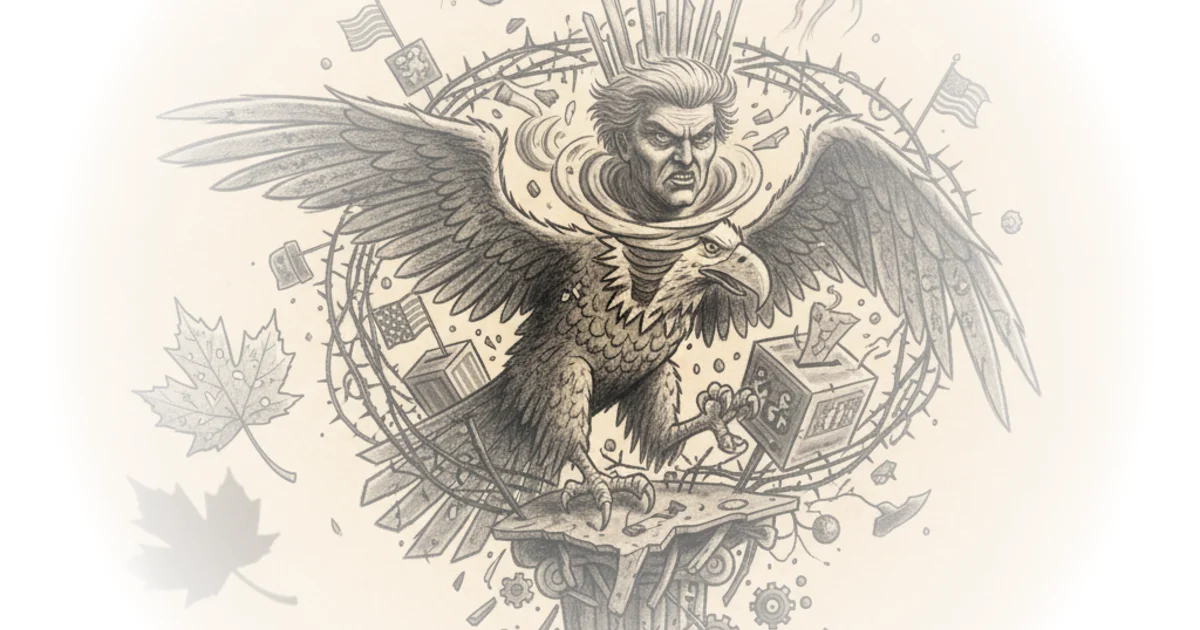
The argument suggests that the administration's actions are no longer accidental errors but a consistent pattern of selecting the "worst possible thing" in any given situation. As Reich writes, "It is not some isolated article or articles of the Constitution he has trampled... It is everything, everywhere, all at once." This framing moves the discussion from specific policy failures to a totalizing assault on the norms of governance. The comparison to historical figures like Nero is not merely rhetorical flourish; it invokes the specific historical precedent of a ruler whose descent into megalomania was marked by a disconnect from reality and a reliance on sycophants, a parallel that deepens the analysis of the current psychological state of the executive.
"We are in a kind of hyperinflation of presidential derangement, an exponential curve asymptotically approaching Nero."
Critics might argue that such hyperbolic comparisons to ancient tyrants or failed states risk alienating moderate readers who still see the administration as a legitimate, if flawed, political force. However, Reich counters this by pointing to the sheer volume of institutional damage, suggesting that the "exponential" nature of the decline makes traditional political analysis insufficient.
The Architecture of Corruption and Incompetence
Reich details how the administration's psychological drivers—specifically a "malignant narcissism" and a "pathological lying"—have translated into tangible governance failures. The commentary highlights a disturbing shift in the Justice Department, which is described as having been turned "upside down and inside out" to pursue "complementary injustices" rather than justice. The evidence presented includes the personal pardoning of over 1,700 individuals, including those involved in the January 6 insurrection, and the alleged sale of state favors through unregistered cryptocurrency donations.
The piece argues that the administration's incompetence is not a bug but a feature of its desire to dominate and offend. Reich cites the chaotic "DOGE exercise" under Elon Musk, which promised trillions in savings but yielded negligible results, and the catastrophic deterioration of the air traffic control system. These are not isolated incidents but symptoms of a broader policy illiteracy. The administration is accused of driving the deficit to peacetime highs and threatening the independence of the Federal Reserve, actions that economists across the spectrum view as deeply damaging.
As Reich puts it, "The destruction is total, omnidirectional and indiscriminate, absolute and unbending." This sweeping indictment suggests that the administration is not merely mismanaging the country but actively dismantling the machinery of the state. The inclusion of the "Signalgate" fiasco, where national security matters were discussed on unsecured lines, reinforces the argument that the executive branch has become a liability to national security.
The Global Consequence and the Ukraine Surrender
Perhaps the most chilling section of the commentary addresses the administration's foreign policy, specifically regarding the war in Ukraine. Reich argues that the administration's deference to Vladimir Putin is not a diplomatic strategy but a form of treason, driven by a desire to emulate dictators. The article details a 28-point "peace plan" that was reportedly written in the Kremlin and adopted by the U.S. envoy, which would force Ukraine to yield territory it has not lost and forswear NATO membership.
Reich writes, "Mr. Trump is not merely an unreliable mediator... He is on his side." This assertion reframes the administration's foreign policy from a series of miscalculations to a deliberate alignment with authoritarian interests. The human cost of this alignment is implicit but heavy; by buying time for Russia to regroup, the plan effectively condemns Ukrainian civilians to further suffering and potential annihilation. The commentary does not shy away from the brutality of the administration's domestic actions either, noting the order to "shoot the survivors" of boat attacks in the Caribbean, an act described as "murder in cold blood, followed by murder in colder blood."
The argument here is that the administration's internal rot has exported itself, turning the United States into an obstacle to democracy and a facilitator of global authoritarianism. The comparison to post-Soviet Russia and post-colonial Africa regarding the level of corruption underscores the severity of the institutional breakdown. Reich suggests that the administration is actively rigging the midterm elections and preparing to use the National Guard and Immigration and Customs Enforcement (ICE) as a personal security force against dissent.
"The destruction is total, omnidirectional and indiscriminate, absolute and unbending."
A counterargument worth considering is whether the administration's actions are truly a coordinated strategy or a chaotic series of reactions that happen to align with authoritarian outcomes. However, the sheer consistency of the administration's opposition to every norm of democratic governance suggests a level of intent that goes beyond mere incompetence.
Bottom Line
Reich's commentary is at its strongest when it connects the psychological profile of the executive to the systemic collapse of American institutions, offering a terrifyingly coherent explanation for the chaos. The argument's greatest vulnerability lies in its reliance on the assumption that the administration's behavior is purely pathological rather than politically strategic, potentially underestimating the calculated nature of its authoritarian drift. Readers should watch for how the administration navigates the upcoming midterms, as the text predicts a move toward using state force to suppress dissent, which will serve as the ultimate test of whether the "exponential curve" of derangement has reached its breaking point.