Jordan Schneider delivers a startling diagnosis: the crisis facing Chinese illustrators isn't just about machines stealing jobs, but about an education system that trained humans to think and create exactly like machines. While the world fixates on the technology of artificial intelligence, Schneider argues we are witnessing the collapse of a specific human infrastructure—one that prioritized standardized, replicable output over genuine originality. This piece is essential because it shifts the blame from the algorithm to the curriculum, suggesting that the "proof of humanity" has become so difficult to give because we spent decades building a pipeline that made us indistinguishable from the software we are now fighting.
The Legal Trap
Schneider opens by highlighting a fundamental asymmetry in the regulatory landscape. In December 2023, four illustrators sued Xiaohongshu, the popular social platform, for using their work to train its Trik AI service. The artists argued that the machine had learned their specific brushstrokes and floral motifs without consent. "All the brushes I used in my art, the way that I portray flowers, they are all from me and with my individual characteristics," one artist told the court. Yet, the platform defended itself under "fair use," a legal shield that remains potent in China.
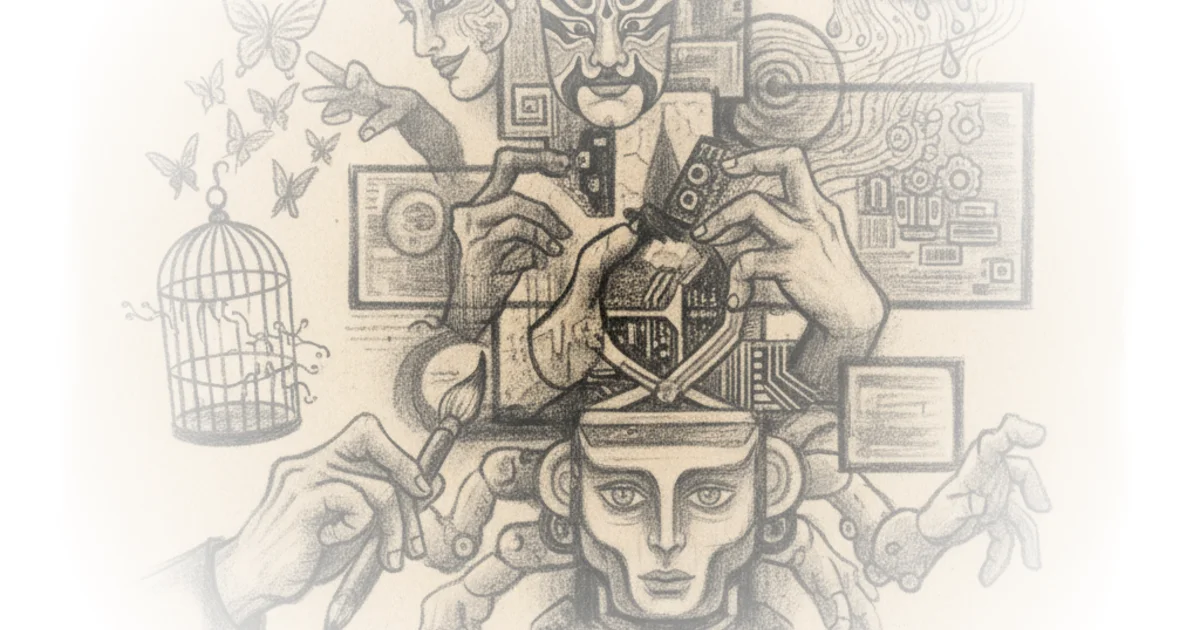
The author points out that Chinese regulators have adopted a strategy of "moderate leniency." They strictly police what comes out of the AI (downstream content) but remain permissive about what goes in (upstream training data). This creates a perverse incentive structure where creators have no legal recourse against the theft of their style, yet face immediate punishment if their own work is flagged as synthetic. Schneider notes that this regulatory gap has forced artists into a defensive posture where the burden of proof is entirely on them.
The answer, I will argue, lies less in what AI learned from humans than in what humans built long before it arrived: an exam system that trains young artists through standardized metrics and repetitive practice, which looks unsettlingly like an AI training pipeline.
This framing is the piece's intellectual anchor. It connects the legal struggle to a deeper structural failure. Critics might argue that the legal system simply hasn't caught up to technology anywhere in the world, not just in China. However, Schneider's specific focus on the input side of the equation—how the art is made before it ever hits the server—offers a more nuanced explanation for why the artists are losing.
The Witch Hunt
When the law fails, the community takes over, often with chaotic results. Schneider details a bizarre phenomenon emerging on platforms like Xiaohongshu: "bet-on agreements." In these livestreams, accused artists must draw in real-time to prove they are not using AI. The stakes are high, and the skepticism is rampant. One illustrator, known as "Angel from Mercury," was flagged by an algorithm and forced to perform a live drawing session to clear her name, only to remain unconvinced by her accusers.
"Proving you are a human has become a norm among illustrators, and showing the process of human hands drawing a picture line by line seems to be the last piece of evidence that humans can use to prove themselves as human," Schneider writes. This performative aspect of creativity is a direct response to the "witch hunt" mentality that has taken hold. The irony is palpable: to prove they are human, artists must strip away the very stylistic flourishes that make their work unique, adhering to a rigid, mechanical demonstration of skill.
This dynamic echoes the historical pressures of the Gaokao, China's national college entrance exam. Just as the Gaokao trains millions of students to produce standardized answers under extreme time pressure, the current art education system has conditioned illustrators to produce consistent, replicable outputs. When AI arrived, it didn't just mimic human art; it mimicked the result of an education system designed to eliminate human variance. The "witch hunt" is essentially a panic attack within a system that no longer knows how to value the messy, unpredictable nature of human creation.
The witch hunt was supposed to defend a boundary of human vs. AI, but ends up forcing humans to write less like themselves so they won't be mistaken for the machines they are trying to distinguish themselves from.
Displacement and State Policy
The economic reality behind these cultural battles is stark. Schneider cites reports from May 2023 indicating that illustrators were among the first wave of workers laid off due to AI integration. The state, rather than protecting these workers, has aggressively promoted "AIGC creation" as a new frontier. Universities are cutting majors; the Communication University of China eliminated illustration, photography, and visual communication design in 2025. "I guess now teachers from academies of arts can not figure out whether they should still select students based on how well they sketch," one interviewee noted.
The author argues that this displacement is not an accident but a policy choice. By positioning AI as the future of creativity, the government has effectively signaled that mid-level and junior illustrators are obsolete. The state is encouraging a shift where "humans won't be displaced by AI, but by other humans who can use AI." This creates a bifurcated market: a small elite of "AIGC artists" who can leverage the tools, and a vast majority of traditional illustrators who are being squeezed out.
This perspective challenges the optimistic narrative that AI is merely a tool for democratization. While some celebrated artists like Jia Zhangke are using AI to explore new genres, Schneider suggests this is a luxury few can afford. For the average illustrator, the "democratization" of art tools has meant the devaluation of their labor. The state's push for AIGC competitions and campaigns accelerates this trend, turning the art market into a race to the bottom where speed and cost-efficiency trump human expression.
The Limits of Proof
Schneider concludes by examining the three main responses to this crisis: regulation, stigmatization, and embracing the technology. He is skeptical of all three. Regulation is too slow and often protects the wrong things (specific expressions rather than styles). Stigmatization forces humans to alter their natural creative processes to avoid detection, which ironically makes them less human. Embracing the technology, while economically necessary for survival, risks erasing the very definition of human artistry.
The author draws a parallel to the writing community, where figures like Sam Kriss claim they can "always tell" when AI is used. Schneider counters that this reliance on intuition is fragile. "To avoid being judged as AI, humans start to change their naturally human creative process... which ironically invalidates what they hold as humans having genuinely and inherently different judgment from AI." This is a profound insight: the attempt to distinguish ourselves from machines is forcing us to become more machine-like.
In the end, behind Chinese illustrators' attempt to combat AI lies the broader educational infrastructure that makes humans indistinguishable from machines.
Bottom Line
Schneider's most compelling argument is that the "human vs. AI" conflict is actually a mirror reflecting our own educational failures. By training generations to optimize for consistency and speed, we built a workforce that AI could easily replicate. The strongest part of this piece is its refusal to treat AI as an external invader, instead identifying the internal structures that made us vulnerable. Its biggest vulnerability is a slight underestimation of how quickly human creativity can adapt to new constraints, but the warning remains urgent: if we do not rethink how we teach and value human expression, the "proof of humanity" may become impossible to give. The reader should watch for how these dynamics play out in Western art schools, where similar pressures toward standardization are already evident.