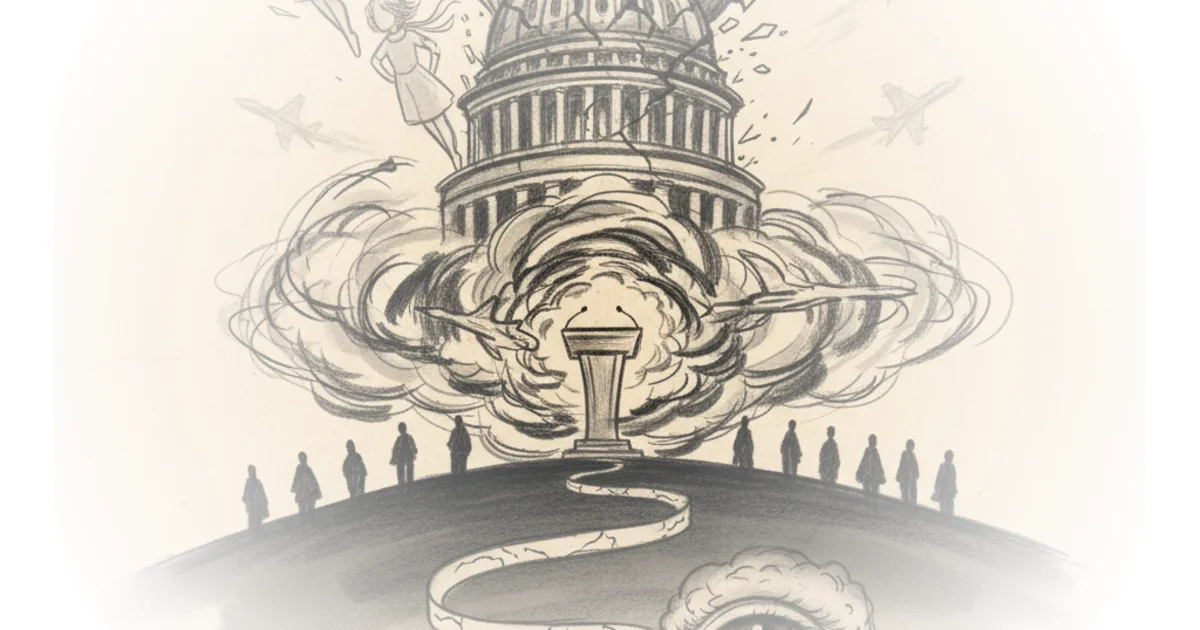
A Congressional memorial honoring over 160 children allegedly killed by US strikes on Iran drew only nine members of Congress out of 532. That's the most telling detail in Mehdi Hasan's dispatch from Capitol Hill -- a scene so empty it almost perfectly captured what many lawmakers consider acceptable.
On March 18, 2026, organizers placed 168 pairs of shoes and backpacks at the memorial symbolizing the children killed in the bombing of Minab elementary school. Some shoes were donated by families who wanted their children's old items to become something more than used goods. One thrift store slashed prices when they learned what the shoes would represent.
Hasan spoke with several members of Congress who attended. Representative Jim McGovern slammed the Trump administration for carrying out a war that Americans would have to bear through cost, participation, lives lost, and spirit.
"The bottom line is, young school girls got blown up by a US bomb -- that's a war crime," McGovern said, appearing shocked. "Republican members are afraid of Trump; they're afraid to say anything. Quietly, they're stunned by the cost of this war. Trump told them it was going to be over in a day or two, and it's been weeks now, there's no end in sight."
Arizona Representative Yassamin Ansari -- the only Iranian-American Democrat in Congress -- shared an inside look at Republican behavior during briefings: "Even when we're in the context of briefings on this issue, there seems to be a lot of enthusiasm, a lot of clapping for the administration that takes place when we're getting responses that are incoherent and do not actually even reference intelligence."
Illinois Representative Jesus "Chuy" Garcia described the Republican response plainly: "Shameful. Painful. History will not be kind to us."
The gravity of the memorial was jarring precisely because it wasn't widely attended -- about 30 people in total. That absence, Hasan argues, honestly characterized the attack itself.
After the House finished voting for the day, Hasan encountered Utah Republican Representative Burgess Owens and asked how Congress was responding to the strike.
"I don't know," Owens said plainly.
Hasan then asked how the US should respond. Owens responded by asking a journalist about how the Iranian government is killing what he said was 40,000 people -- deflecting accountability back toward Iran.
War Numbers
Senator Lindsey Graham took to the Senate floor shortly after to speak in support of continuing the war. He said the best way to support service members was to have them "finish the job" regardless of cost.
"American people: there's going to be some pain," Graham said. "The region: you're going to get hit again. We've lost soldiers. God bless them. God bless the wounded, couple hundred. And casualties may increase."
Shortly after, news broke: Pete Hegseth's Pentagon requested $200 billion more for the war.
Iranian officials reported at least 1,444 people killed and nearly 20,000 injured in US-Israeli strikes as of last week. The US-based Human Rights Activists News Agency put the death toll at more than 3,000, including over 1,369 civilian deaths.
The attacks on Gulf oil facilities sent Brent crude prices soaring to $117 a barrel before settling around $107.
Mullin Hearing
Oklahoma Republican Markwayne Mullin testified before the Homeland Security and Governmental Affairs Committee on Wednesday as he seeks to become the next Secretary of the Department of Homeland Security. It did not go well.
Committee chair Rand Paul, a Kentucky Republican, pressed Mullin on calling him a "freaking snake" in the past, why Mullin could side with Paul's neighbor who assaulted him years ago leaving him with broken ribs, and how Americans could trust him.
"Explain to the American people why they should trust a man with anger issues to set the proper example for ICE and border patrol agents," Paul said.
Paul also questioned Mullin on past comments praising an episode in 1856 when pro-slavery Representative Preston Brooks caned Senator Charles Sumner, crushing his skull and knocking him unconscious. Mullin responded by saying that "dueling with two consenting adults" is still a rule that applies to Congress -- a response Paul called both false and an incredible retort.
Mullin refused to apologize for saying the killing of Renee Good was justified and did not apologize for calling Alex Pretti a "deranged individual," only going as far as to say he regretted saying it.
While Mullin may not count on Paul's support, he will need just one Democrat to save his bid out of committee. He may be in luck: shortly after Mullin's nomination was announced, Senator Fetterman said he planned to vote in favor.
Other News
Director of National Intelligence Tulsi Gabbard placed herself at odds with Trump in a statement released before a Senate hearing, saying strikes last year "obliterated" Iran's nuclear enrichment program with no efforts made to rebuild. But when she spoke before the intelligence committee, she left that part out, later claiming to have "skipped" it to save time.
FBI Director Kash Patel told senators his agency is purchasing information used to track people's movement and location history -- a practice he said was both lawful and producing "valuable intelligence." Senator Ron Wyden accused Patel of an "outrageous end run" around constitutional privacy protections.
The New York Times reported extensive allegations that labor activist Cesar Chavez, who died in 1993, sexually abused women and girls. Dolores Huerta, 95 and a revered labor leader, described being "manipulated and pressured" by Chavez and "forced against my will."
Maine Democratic Senate candidate Graham Platner responded to attacks from opponent Governor Janet Mills concerning comments about rape he made on online forums. In a 30-second ad, Platner asked voters "not to judge me for the worst thing I said on the internet on my worst day 14 years ago."
Nine members of Congress out of 532. 168 pairs of children's shoes. The absence at the memorial said more than any speech on the floor.
Bottom Line
Hasan's piece exposes a moral vacuum at the heart of Congressional response to what multiple lawmakers called a war crime. His strongest argument is the stark contrast between empty shoes at a memorial and the empty chambers where votes continue to fund the war. His biggest vulnerability: this piece relies heavily on quotes from Democratic legislators rather than hard data on actual congressional positions or military outcomes. The most telling silence belongs to the Republicans -- zero put their name on a letter calling for investigation.