In a literary landscape often obsessed with tidy resolutions and triumphant recoveries, Sarah Bessey offers a radical alternative by hosting K.J. Ramsey for a conversation that refuses to look away from the middle of the mess. This interview is notable not for its promise of healing, but for its defiant insistence that joy can exist alongside unhealed wounds, challenging the standard "before and after" narrative arc that dominates both secular self-help and religious testimony. For readers navigating chronic illness or trauma, Bessey's curation provides a rare validation: the idea that one does not need to be fixed to be whole.
The Architecture of Unfinished Stories
Bessey frames the conversation around Ramsey's refusal to provide a manufactured happy ending, a choice that Bessey describes as "incredibly brave but also beautiful." Ramsey pushes back against the cultural conditioning that demands our stories resolve like mystery novels, arguing instead for the authenticity of living in the unresolved present. As Ramsey explains, "None of us are traveling through tidy storylines, even though HGTV and most bestselling books have trained us to trace the shape of our stories and their worth by the trajectory of the almighty Before and After." This critique of narrative perfectionism is potent because it dismantles the shame many feel when their lives do not follow a linear path toward improvement.
The interview draws a sharp distinction between writing from "scars" versus "scabs," a concept Bessey previously explored with theologian Nadia Bolz-Weber. Ramsey admits she feared judgment for writing while her wounds were still open, yet concludes that waiting for perspective would have been fatal to her survival. She writes, "I needed to see someone else's shards to trust that something beautiful could still be made from mine." This framing is effective because it shifts the purpose of storytelling from instruction to connection; the value lies not in the lesson learned but in the bridge built between isolated sufferers.
Brokenness this encompassing demands either a burial or a bridge. I defiantly wrote from my wounds because we all struggle to see the most shattered, scared parts of ourselves as beloved and our crumbling lives as still sacred, unless we see our stories reflected back to us in someone else's.
Critics might argue that an unrelenting focus on suffering risks romanticizing pain or discouraging active pursuit of medical cures. However, Ramsey carefully navigates this by distinguishing between the absence of healing and the presence of joy, refusing to let one negate the other.
Joy as a Woven Web, Not a Prize
Bessey guides the discussion toward the visual metaphors in Ramsey's work, particularly the book cover which features embroidery. This choice is not merely aesthetic but theological; it reimagines joy not as a trophy won after overcoming pain, but as a thread that holds us together during the unraveling. Ramsey notes, "Too many of us have had 'rejoice always' used against us, aimed like a sword against our sorrow, cutting us off from the grief that is actually a gate into joy." This reframing aligns with principles found in narrative exposure therapy, where integrating fragmented traumatic memories is essential for recovery, suggesting that joy emerges when we stop fighting the reality of our pain.
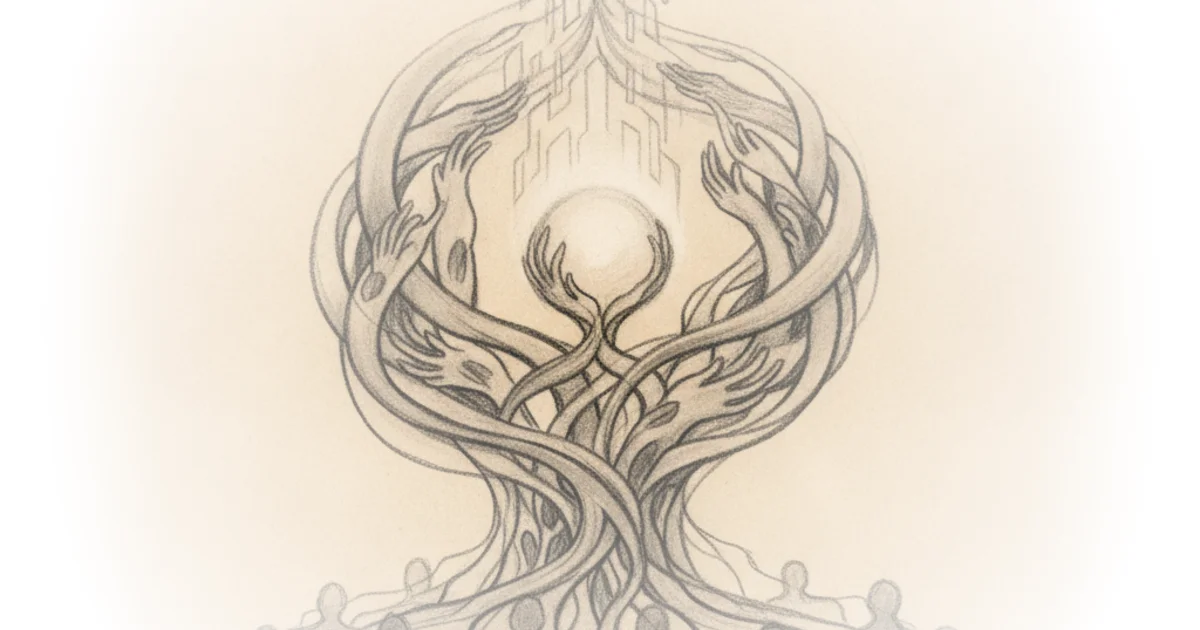
The conversation deepens as Ramsey connects this weaving metaphor to mycelium—the fungal network beneath forests that nourishes trees from below. She posits that joy is simply the human perception of this underlying web of connection. "Joy is not the opposite of sorrow nor the absence of grief, but the surprise, sensed over and over, that the truest fact about who we are is that we are connected," Ramsey asserts. This biological analogy grounds abstract spiritual concepts in tangible reality, offering a structural argument for interdependence rather than self-sufficiency.
Bessey highlights how this perspective challenges the autonomy often prized in modern wellness culture. By suggesting that pain is actually a "prompt into connection," Ramsey flips the script on isolation. The title of her memoir, The Place Between Our Pains, is revealed to be an alliterative nod to this interdependence: the space between two people's suffering is where love lives.
Hope as a Collective Effort
The most striking turn in the interview occurs when Bessey asks about the line "hope is a team sport." Ramsey reveals that she wrote these words while facing a new, aggressive tumor diagnosis just one month before her book launch. The irony of promoting a message of communal support while being physically unable to attend to her own needs underscores the argument's urgency. She describes how strangers and friends stepped in to form a literal care team: "Yesterday my in-laws left after five days of my mother-in-law quite literally dressing my surgical sites... This morning, one of my readers who lives here in Rochester picked me up at 6:20am... She offered to be on my team. And I let her play."
This anecdote serves as powerful evidence for Ramsey's thesis that hope is too heavy for a single person to carry alone. It moves the concept from metaphor to practical necessity, illustrating how vulnerability can catalyze community action. Bessey notes that this dynamic allows those with chronic illness to reject the "self-sufficient" ideal in favor of a more sustainable model of mutual aid.
Both hope and joy are too heavy for any singular person to hold. We cannot hold them on our own, nor do we have to.
A counterpoint worth considering is that not everyone has access to such a robust support network; the privilege of having a "team" is not universal. Ramsey anticipates this, acknowledging that seeking connection carries the risk of rejection and pain, yet she maintains that "your joy is worth the pain of seeking and risking connection." While this advice may feel daunting for those without existing community structures, it challenges readers to view therapy and intentional relationship-building as vital infrastructure rather than optional extras.
Bottom Line
Sarah Bessey's interview with K.J. Ramsey succeeds by refusing to sanitize the reality of chronic suffering, instead offering a robust framework where joy and pain coexist through radical interdependence. The piece's greatest strength is its ability to transform abstract theological concepts into actionable, embodied practices of care, though it risks assuming a level of community access that not all readers possess. Ultimately, this conversation serves as a vital reminder that in the face of unending pain, our shared vulnerability is not a weakness but the very foundation of survival.