In an era where digital platforms often deepen isolation, a surprising counter-narrative is emerging from the most unlikely of places: a viral TikTok account run by a father who admits he has no answers. Two Truths reports on Jon Gustin, the man behind "The Tired Dad," who leveraged his own mental health crisis to dismantle the stoic stereotypes of modern fatherhood, proving that vulnerability can be the most effective form of connection.
The Myth of the Stoic Provider
The piece argues that the traditional image of the "clueless dad"—one who cannot find the doctor's name or the teacher's contact—is not just outdated, but actively harmful to men's well-being. Gustin, whose accounts now command over a million followers, notes that while humor brought people in, the retention came from shared pain. "I hear a lot of the same stuff, like guilt," Gustin tells the editors. "Dads express themselves differently; sometimes, they express themselves not at all. There's a fear of expressing themselves."
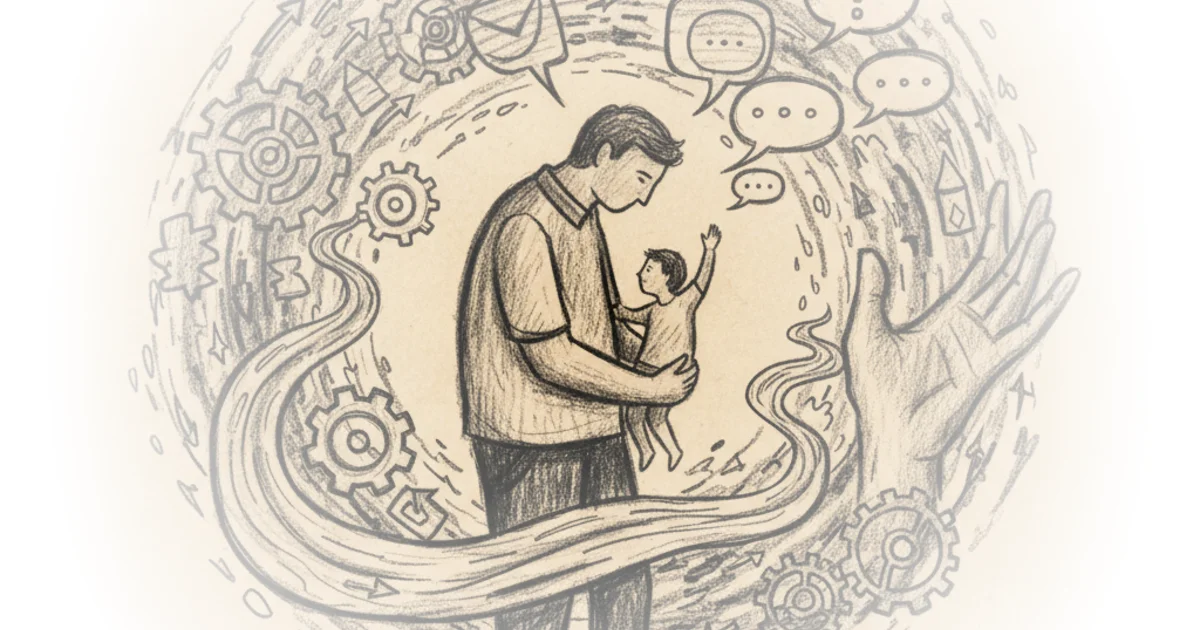
This observation lands with particular weight when viewed through the lens of historical mental health discourse. Just as the concept of "matrescence" was coined to describe the profound identity shift of becoming a mother, Gustin's work highlights a parallel, yet unspoken, transformation for fathers. The article suggests that the silence surrounding this transition is not a lack of feeling, but a cultural barrier. Gustin explains, "I think men also think they're alone in feeling the things they feel." This sentiment echoes the foundational mission of Postpartum Support International, which has long operated under the tagline "You are not alone," a message that has historically centered mothers but is now critically needed by fathers facing similar perinatal mental health struggles.
Critics might argue that social media influencers cannot replace clinical therapy, and that the "viral" nature of these conversations risks oversimplifying complex psychiatric disorders. However, the piece effectively counters this by framing Gustin not as a clinician, but as a peer navigator. "My vulnerability can create freedom for someone else by making them feel less alone," Gustin says. The value here is not in medical expertise, but in breaking the isolation that often precedes a crisis.
Breaking the Generational Cycle
The coverage delves deeper into the specific mechanisms of this isolation, particularly regarding the intergenerational transmission of trauma. Gustin recounts how the birth of his children forced a confrontation with his own past, noting, "When you have children, there's stuff that you don't want to emulate." He describes a panic that set in when he realized no one had taught him how to parent, compounded by the minimization of his wife's postpartum depression. "They just kind of said, 'Oh yeah, she might be a little blue, but it's no big deal,'" he recalls. "Well, it seemed like a pretty big deal at the time."
This anecdote underscores a systemic failure in how the healthcare system and society at large frame the perinatal period. The article suggests that the dismissal of maternal mental health inevitably leaves fathers adrift, unable to support their partners or process their own shifting roles. Gustin admits to using alcohol to cope with this dissonance, a common but rarely discussed response among new fathers. "I realized I was drinking too much, running from my problems, and my childhood," he states. By naming these behaviors, the piece challenges the notion that fatherhood is merely a biological event rather than a psychological reconstruction.
"If the mental health of our fathers is not in good shape, we're in trouble. That's a lonely place for moms, and it's a very dark place for dads."
The editors of Two Truths highlight the urgency of this issue, noting that suicide rates are rising and that the loss of fathers to untreated mental health issues has a cascading effect on the entire family unit. The argument is compelling because it reframes male mental health not as a "men's issue," but as a critical component of family stability.
Redefining Nurturing for Boys
Perhaps the most provocative section of the interview addresses the specific challenges of raising boys in a culture that still equates masculinity with emotional suppression. Gustin contrasts the "soft" narrative of "girl-dad" with the "roughhousing" often expected of "boy-dad," arguing that this dichotomy is a false choice. "My dad was a military dad... There was a lot of discipline and not a lot of expressing emotions," Gustin reflects. "When my son was born, I felt an immediate need to nurture him, just like I did with my daughter."
This distinction is crucial. The piece suggests that society is uncomfortable with the idea of fathers providing emotional nurturing to sons, often viewing it as a weakness rather than a strength. Gustin insists, "There's also this emotional connection and nurturing aspect that fathers can provide, which I think society is either uncomfortable talking about, is just missing, or isn't recognizing as important as it is." This aligns with emerging research on the long-term benefits of secure attachment for boys, yet it remains a radical departure from the "tough love" models of previous generations.
A counterargument worth considering is whether social media, even with good intentions, can inadvertently create a new performance pressure where fathers feel they must be "perfectly vulnerable" to be good dads. However, Gustin explicitly rejects the label of expert, stating, "I don't ever want to come off as an expert. I can't label myself that because I'm still figuring it out day by day." This humility serves as a safeguard against the very perfectionism the piece critiques.
Bottom Line
Two Truths succeeds in shifting the conversation from a deficit model of fatherhood to one of potential and shared humanity, effectively using Gustin's personal narrative to expose the cracks in the "stoic dad" archetype. The piece's greatest strength is its refusal to offer easy fixes, instead emphasizing that the act of speaking up is itself the solution. The biggest vulnerability remains the reliance on social media algorithms to sustain these difficult conversations, a platform that can be as isolating as it is connecting, but the human connection forged here offers a necessary antidote to the silence that has long plagued modern fatherhood.