Andy Masley cuts through the noise of a contentious Boston City Council meeting with a stark, data-driven reality check: the fear of autonomous vehicles is often a mask for protecting outdated business models, while the actual cost of inaction is measured in thousands of preventable human deaths. While council members fret over job losses and theoretical dangers, Masley presents a terrifyingly simple equation where the status quo of human driving is the true emergency, not the technology trying to fix it.
The Safety Imperative
Masley opens by dismantling the emotional arguments heard in the council chamber, where speakers dismissed the notion that cities are unsafe because of human drivers as "crazy." He counters this with a brutal statistic that reframes the entire debate: "40,000 people die in car accidents in America each year. This is as many deaths as 9/11 every single month." By treating traffic fatalities as an ongoing national emergency rather than an unfortunate inevitability, Masley shifts the burden of proof. He argues that any transition to a new mode of transit will involve tragedy, but the metric that matters is the rate of death, not the mere existence of it.
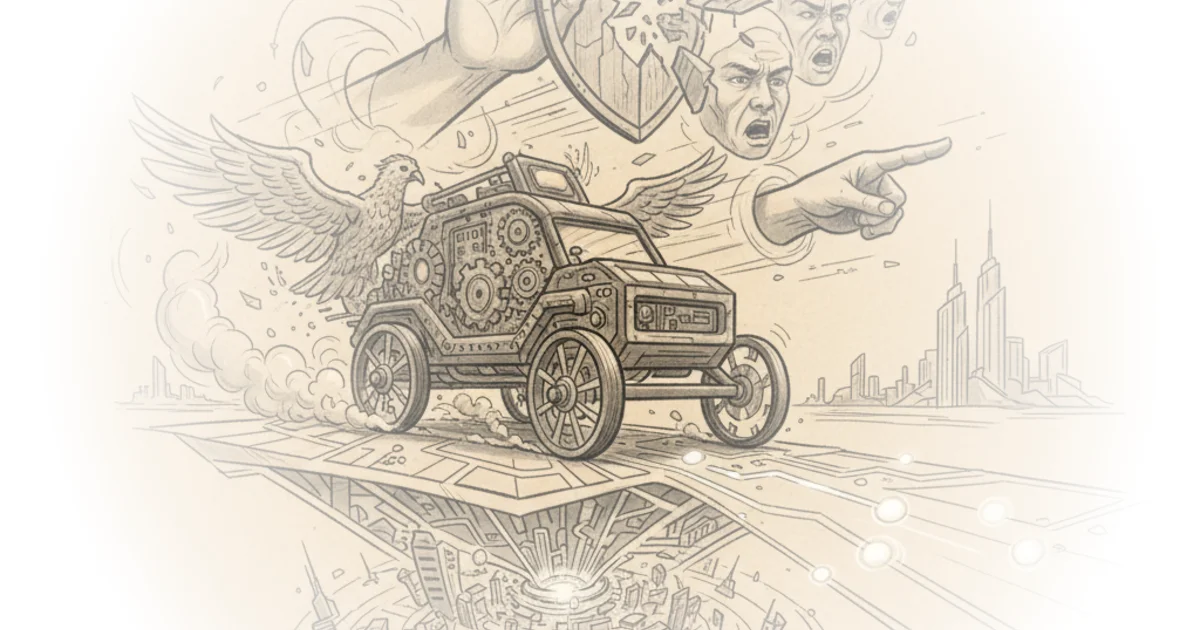
The author's comparison of autonomous vehicles (AVs) to human drivers is particularly damning. He notes that while Waymo has logged over 100 million miles with only a handful of crashes where the vehicle was at fault, human drivers kill pets at a rate roughly 75 times higher. Masley writes, "If a vehicle is safe, the default should be legalization." This framing is effective because it forces policymakers to confront the hypocrisy of rejecting a technology that is statistically superior to the current standard. Critics might argue that a single AV error feels more alarming than the daily, normalized carnage of human driving, but Masley insists that policy must be driven by aggregate safety, not by the visceral reaction to a novel incident.
"If we refuse to move to a safer mode of transit because it's not perfectly, 100% safe in all cases, tens of thousands of additional people will continue to die for no reason."
The Economic Fallacy
The piece takes a sharp turn into the economics of labor, challenging the idea that preserving ride-share driver jobs is a valid reason to ban AVs. Masley draws a parallel to the Luddite movement, reminding readers that resisting technological progress to save specific jobs often harms the broader economy and safety. He asks a provocative question: "Should we build fewer bike lanes to save Uber jobs?" The logic is that improving public transit or bike infrastructure inevitably reduces demand for ride-shares, yet no one suggests halting those improvements to protect driver income.
Masley does not shy away from the harsh reality of the gig economy. He describes ride-share work as often "predatory," noting that drivers bear the costs of vehicle depreciation, fuel, and maintenance while facing opaque pay structures and algorithmic management. "Policy should focus on getting workers access to high-quality well-paying jobs, not preserving Uber and Lyft's pretty shady business model," he argues. This is a crucial distinction; the author isn't celebrating the loss of jobs, but rather arguing that we should not sacrifice human safety to prop up a business model that already exploits its workforce. He suggests that if one believes these jobs are essential for low-skilled workers, they must also be willing to open up other similar, imperfect opportunities rather than banning a safer alternative.
Elitism and Access
Perhaps the most counter-intuitive argument Masley makes is that banning AVs is actually the more elitist position. He flips the script on the idea that paying a human driver is a premium service. "It is more elitist to use a personal chauffeur (a ride share driver) than to ride in an AV," he posits. In a world where AVs are the norm, paying for a human to drive you would be a luxury for the wealthy, while the rest of the population relies on the safer, cheaper robot fleet.
He also highlights the transformative potential for accessibility, noting that AVs "can open up opportunities for disabled riders" who are currently underserved by human-driven services. The argument here is that the city's role is to maximize mobility for the most people, not to protect the specific interests of a subset of drivers. Masley concludes that the only real difference between an AV fleet and a cheap rental car service is the safety profile, and since we don't ban rental services, we shouldn't ban AVs either.
Bottom Line
Masley's strongest asset is his refusal to let emotional arguments about job loss or the "uncanny valley" of new technology obscure the overwhelming data on human safety. His biggest vulnerability, however, is the assumption that the transition will be smooth; he acknowledges cybersecurity and traffic congestion as real risks but treats them as manageable engineering challenges rather than existential threats. The reader should watch for how cities balance the immediate political pressure to protect local jobs against the long-term, statistical imperative to save lives. The administration's role in setting federal safety standards will be critical, but as Masley shows, local bans based on fear are a dangerous luxury we cannot afford.