This week's dispatch from Jack Clark cuts through the hype to reveal a quiet revolution: the shift from AI that merely chats to AI that dreams, experiments, and polices itself. The most startling claim isn't that machines are getting smarter, but that they are finally learning to simulate the physical world well enough to train without breaking a single piece of hardware. For those watching the economy, this suggests the bottleneck of robotics isn't intelligence, but the sheer slowness of real-world trial and error.
The Dreaming Machine
Clark introduces Ctrl-World, a system developed by researchers at Stanford and Tsinghua University, which allows robots to "imagine" tasks before executing them. The core insight is that physical testing is "grindingly slow and painful," so the solution is to build a digital twin that is responsive enough to be a valid proxy. Clark explains that a world model is "basically a way to help AI systems dream about a specific environment, turning a learned data distribution into a dynamic and responsive interactive world."
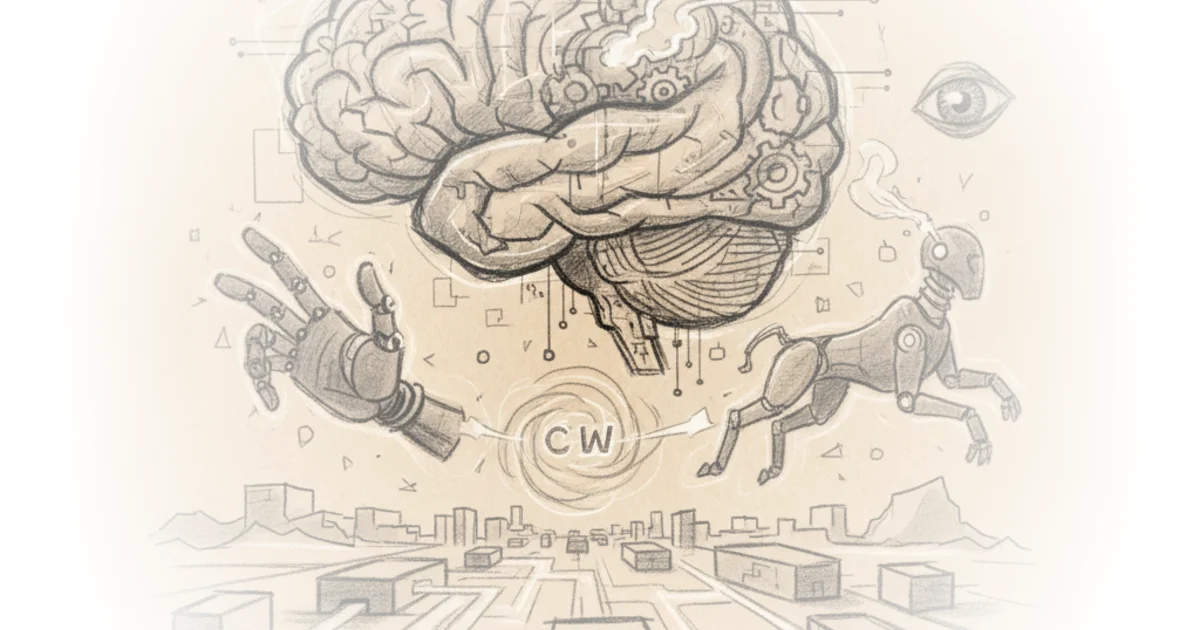
This is a significant departure from standard simulation. Rather than just rendering graphics, Ctrl-World uses a memory retrieval mechanism to "re-anchor predictions to similar past states," ensuring the robot's imagination remains consistent over time. The results are compelling: "Posttraining on [Ctrl-World] synthetic data improves policy instruction-following by 44.7% on average."
"We believe generative world models can transform how robots acquire new skills, enabling scalable policy evaluation and allowing them to learn not just from real world experience, but also safely and efficiently from generated experience."
The argument here is that we are moving toward an era where the majority of robotic learning happens in the cloud, not the factory. This is a crucial efficiency gain. However, a counterargument worth considering is whether these "dreams" can ever fully capture the chaotic unpredictability of the real world, such as a slippery floor or a broken gripper. If the simulation is too perfect, the robot might fail spectacularly when deployed in the messy reality it was designed to navigate.
The AI Co-Scientist
The narrative shifts from robots moving objects to AI conducting science. Clark details LabOS, a framework that links "agentic AI systems for dry-lab reasoning with extended reality(XR)-enabled, multimodal interfaces for human-in-the-loop wetlab execution." In plain terms, this is software that lets an AI design an experiment, then guide a human wearing smart glasses through the physical steps.
The system relies on a new dataset, LSV, which records human scientists performing lab work to train the AI to spot errors. Clark notes that existing models struggled with this, with leading systems scoring only "moderately better" than open-source alternatives on protocol alignment. But the custom LabOS-VLM model, trained on this specific data, achieved "greater than 90% accuracy on error detection performance."
"LabOS prototypes what an AI co-scientist can be: a system that sees, reasons, and helps run the lab. By pairing AI agents with real-time, XR-guided human–AI interaction and data-driven reasoning, it enables faster discovery, reproducible training, and precise operation."
This framing is powerful because it positions AI not as a replacement for scientists, but as a force multiplier that handles the tedious verification of protocols. Yet, the piece hints at a darker, more speculative future: "systems like LabOS point to a future where AI systems will augment and extend the capabilities of human scientists... combined with appropriate hardware, might one day let a superintelligence run its own laboratory, paying human workers to conduct experiments for it which they may only dimly understand."
"More speculatively, LabOS is the kind of software stack that, combined with appropriate hardware, might one day let a superintelligence run its own laboratory, paying human workers to conduct experiments for it which they may only dimly understand."
This raises profound ethical questions about agency and understanding. If a human is following instructions from an AI they cannot fully comprehend, are they a scientist or merely a biological actuator? The technology is impressive, but the human cost of such a "co-scientist" relationship remains unaddressed.
The Cat and Mouse Game of Safety
The final technical segment addresses the growing risk of "adversarial fine-tuning," where bad actors tweak powerful models to bypass safety filters. Clark describes a new approach where an AI auditor, equipped with tools to inspect datasets and run benchmarks, attempts to catch these sneaky attacks.
The researchers found that while the auditor isn't perfect, it works better than traditional classifiers. "Our detector achieves a 56.2% detection rate at a 1% false positive rate across 260 audits." Clark argues that this is "merely a coinflip" but still promising, suggesting that "bootstrapping autonomous paranoid investigators out of frontier models might be how to win this cat and mouse game."
"The fact it works ~50% of the time out of the box with essentially no tuning is impressive - my sense is bootstrapping autonomous paranoid investigators out of frontier models might be how to win this cat and mouse game."
The logic is sound: you need a smart adversary to catch a smart adversary. However, the 56% detection rate is a vulnerability. In a high-stakes environment like bioweapon research, missing half the threats is unacceptable. The reliance on an AI to police other AIs creates a recursive loop where the safety of the system depends entirely on the superiority of the auditor, which itself could be compromised.
The Creative Destruction of Editing
Briefly, Clark touches on Apple's Pico-Banana-400k dataset, created using Google's tools to train image editors. The implication is that "Photoshop is facing creative destruction." As these tools become "instructable," the need for manual pixel manipulation may vanish.
"It's not yet perfect... but it is, at least for me, obviating the need for much in the way of traditional image editing software."
This is a stark prediction for the creative economy. If the barrier to entry for high-quality editing drops to a text prompt, the value of specialized design skills could plummet.
Bottom Line
Clark's coverage effectively argues that the next leap in AI isn't about bigger models, but about better integration with the physical world and the scientific method. The strongest part of the analysis is the demonstration that "dreaming" in simulation can yield real-world performance gains, fundamentally changing the economics of robotics. The biggest vulnerability, however, lies in the speculative leap toward autonomous labs; while the technology to run experiments is advancing, the governance of who controls these systems and how humans fit into the loop remains dangerously vague. Readers should watch for how quickly these "world models" move from research papers to industrial deployment, as that is where the real disruption will begin.