Gergely Orosz delivers a counter-intuitive verdict: the era of the remote-first tech giant may be ending, replaced by a resurgence of the physical hub. While the narrative for the last three years has been one of digital dispersion, Orosz argues that the specific, high-velocity demands of the artificial intelligence revolution are pulling talent back to San Francisco. This is not a nostalgic look at the past, but a data-driven observation that the "agglomeration effects" of the pre-pandemic era are returning with greater force, driven by the unique needs of AI development.
The Return of the Physical Hub
Orosz opens by contrasting the 2020 exodus with the current reality. He notes that while companies like Tesla and Oracle fled for Texas, a new wave of AI startups is making San Francisco "most definitely back – and it's more important than ever." The author's evidence is observational but compelling: he visited headquarters and found "ever more startups launching in the city, the AI meetup scene is energetic, and it's easy for people to collaborate with one another in person." This framing is significant because it challenges the assumption that remote work is a permanent structural shift for all industries. Orosz suggests that for AI, the friction of digital collaboration is simply too high.
"The tech hub model is proving its value all over again in SF, and might even be one reason for the incredible growth and adoption of AI products and services."
This argument resonates because it aligns with historical precedents. Just as the Dot-com bubble saw a massive concentration of capital and talent in the Bay Area before the correction, we are seeing a similar density of activity now. However, the current iteration is different; it is less about speculative hype and more about the tangible, rapid iteration required to build foundational models. Orosz posits that the "location, location, location" advantage is no longer just about networking, but about the speed of innovation itself.
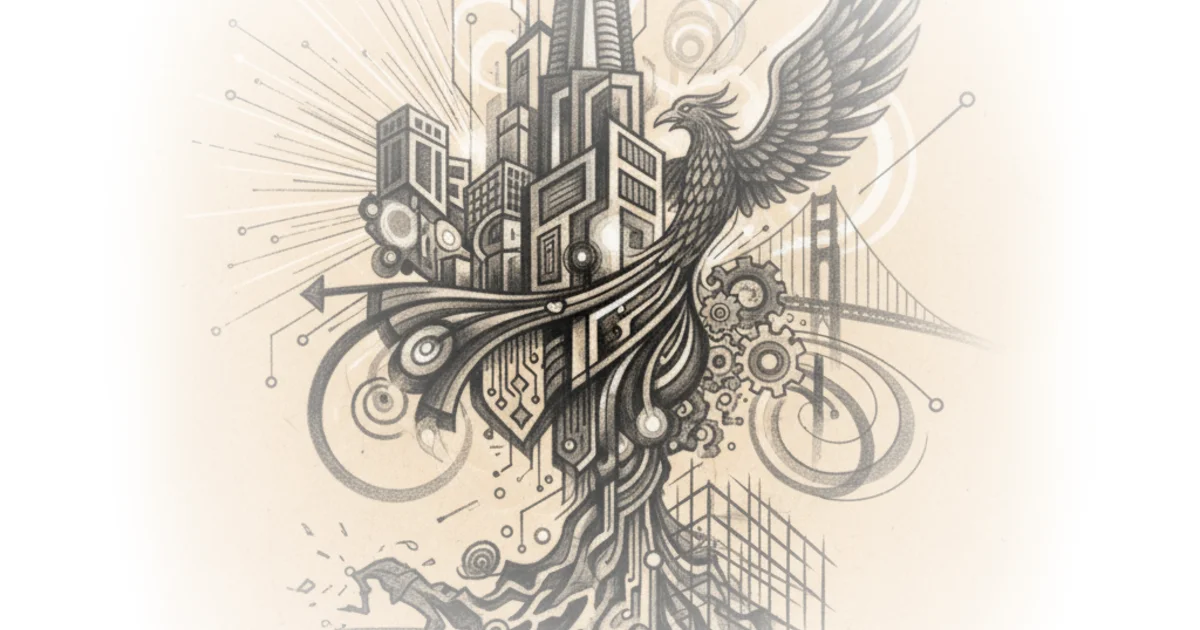
Critics might note that this resurgence could be limited to the AI sector, leaving other tech verticals in a remote-first limbo. Yet, the author's on-the-ground reporting suggests a broader cultural shift where the "builder energy" of the city is becoming a self-fulfilling prophecy for growth.
New Tools, New Workflows
The piece shines when detailing the specific companies driving this renaissance. Orosz visits Cursor, a developer tool company, and describes an environment where "people swap their shoes for slippers" but remain intensely focused on shipping. The efficiency gains are staggering: the company uses its own product to automatically resolve tickets, with engineers using "500K agent sessions" in a single month. This is not just about having an office; it is about the synergy that occurs when the creators and users of a tool are in the same room.
"Many are now using multiple agents in parallel in their workflows."
Orosz then pivots to Wispr Flow, a startup enabling voice-to-code interaction. The detail here is striking: developers are whispering into microphones to write code, a modality shift that Orosz calls "a new modality for programming." The startup achieved 90% month-on-month growth organically, suggesting a product-market fit that is rare in the current climate. The author highlights the technical challenge of latency, noting that "response time must be below 700ms, globally, in order for users to stay engaged." This constraint forces a level of engineering rigor that is best solved through close, in-person collaboration.
"I was surprised by how well Wispr picks up quiet whispering! This – together with the dedicated microphones – makes it feasible even in open-plan offices."
The commentary on Factory AI further reinforces the theme of team acceleration over individual output. Orosz observes that while many tools focus on the individual engineer, Factory focuses on "accelerating teams" by digitizing meetings, design docs, and code reviews. The author notes a crucial insight from the Factory team: "the 'quality' of an AI agent is less important than following best practices that help agents (and humans!) to build better software." This suggests that the human element of software engineering—discipline, specification, and verification—remains the bottleneck, even in an AI-driven world.
Scaling at OpenAI
Perhaps the most significant observation comes from OpenAI, where Orosz meets with Sulman Choudhry. The company is scaling infrastructure at a rate Orosz describes as "faster than any company ever," with "10x infra growth for two years straight." Yet, the cultural shift is even more telling. OpenAI is actively hiring "super juniors"—early-career engineers who are "AI-native" and often trained at accelerators like Y Combinator.
"It's a little insulting that you ask if I used Codex for it. Of course, Codex by itself couldn't build software of this complexity, and you probably also know it. It's why I had to use many instances of Codexes to build it, setting up communication channels between instances, so they can take on the task, one of them validating it, and others implementing the spe..."
This anecdote illustrates a generational shift in engineering. The "super juniors" are not just using AI as a crutch; they are orchestrating multiple AI instances to solve complex problems, a skill set that thrives in a collaborative, in-person environment. Orosz notes that this mix of "super senior + super junior" talent is a key driver of OpenAI's velocity. The author's observation that the office is "largely absent" of corporate branding but full of intense work underscores a culture where output matters more than optics.
"If we work silly long hours, it's mainly because we are already excited about the solution we are shipping, not because there's some unwritten expectation to stay late at the office."
This quote, attributed to the team at Continue.dev, challenges the narrative of burnout. Orosz frames the long hours not as exploitation, but as a byproduct of genuine excitement and the high stakes of the AI race. While some may argue that this culture is unsustainable, the author presents it as a temporary, high-energy phase of a new industrial revolution.
"San Francisco-based AI startups seem like they're getting more traction, faster. Location may play a role as it's easy to network, sell to other startups, and hire engineers working on cutting-edge technologies."
Bottom Line
Orosz makes a persuasive case that the physical tech hub is not dead, but rather evolving to meet the specific, high-velocity demands of the AI revolution. The strongest part of the argument is the evidence that in-person collaboration is accelerating the development of complex AI tools in ways remote work cannot match. However, the piece's biggest vulnerability is its reliance on the assumption that this "AI wave" will sustain its current explosive growth without a correction. Readers should watch whether this resurgence of the physical hub proves to be a durable structural shift or a temporary bubble fueled by the current AI frenzy.