Robert Reich delivers a provocative political memo that refuses to treat the cost-of-living crisis as an isolated economic glitch, instead framing it as the direct output of a corrupted political machine. The piece's most striking claim is that the current administration's economic failures are not accidental but engineered, designed to siphon wealth from the middle class to a coalition of oligarchs and political insiders. For busy listeners trying to understand why inflation feels intractable, Reich offers a narrative that connects the dots between soaring gas prices, stagnant wages, and the personal enrichment of the executive branch.
The Architecture of Extraction
Reich opens by urging Democrats to stop treating affordability and corruption as separate campaign issues. He argues, "The economy is lousy for most Americans because Trump Republicans are enabling super-rich oligarchs to siphon off most of its gains while exerting increasing control over it." This framing is powerful because it shifts the blame from abstract market forces to specific, identifiable actors making deliberate choices. The author contends that the administration has allowed the White House to become a venue for self-dealing, noting that leaders have "gilded [the] White House in gold leaf... at a time when most Americans can't afford gas or groceries."
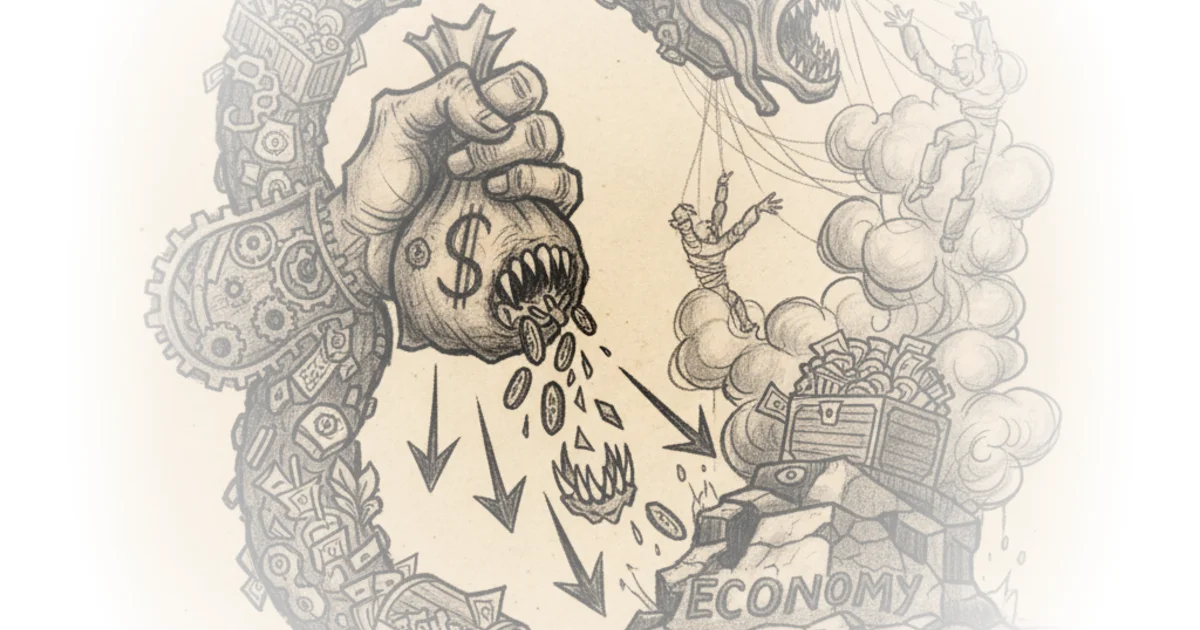
The commentary here is sharp, but it relies heavily on the premise that legislative priorities are driven solely by personal gain rather than ideological conviction. Critics might argue that tax cuts are a long-standing Republican policy goal independent of any single leader's enrichment, yet Reich insists the mechanism of delivery has changed. He points to the erosion of the social safety net as a funding source for these policies, stating that legislative efforts have "targeted up to $2 trillion in federal health care cuts, forcing millions of Americans off Medicaid rolls to pay for these tax reductions." This connection between Medicaid cuts and tax breaks for the wealthy is a recurring theme in fiscal debates, but Reich's specific focus on the motivation—paying for a "Billionaire's Ballroom" rather than public need—adds a layer of moral urgency often missing from dry budget analysis.
Greed and payoffs replace trust. It's happened before, after America's first Gilded Age.
The Oligarchic Bargain
The piece moves into a detailed catalog of alleged quid pro quos between the administration and Big Tech, crypto, and energy sectors. Reich writes, "Big Tech oligarchs — centi-billionaires Bezos, Musk, Zuckerberg, Ellison, and other robber barons — paid for Trump's 2024 election... In return, these oligarchs have been allowed to monopolize and drive up the prices we pay and silence Trump critics." He cites specific examples, such as Amazon's pricing restrictions and the sanitization of news coverage, to illustrate a system where media independence is bought and sold. This section draws a parallel to the historical concept of the "revolving door," where regulatory capture allows industries to write the rules that govern them, effectively turning the government into a service provider for the highest bidder.
Reich extends this logic to the energy sector, claiming that "Big Oil and aerospace oligarchs have bribed congressional Republicans to allow Trump to go to war in Iran, resulting in massive profits for Big Oil — while the rest of us pay $1.50 more per gallon of gas." Here, the human cost of geopolitical maneuvering is centered. The argument suggests that military conflict is being leveraged not for national security, but to inflate oil prices and boost contractor profits, with the average family bearing the burden through higher mortgage rates and inflation. While the direct link between a specific war and the enrichment of a specific family's crypto holdings is a bold assertion, it serves to unify disparate economic grievances under a single narrative of systemic theft.
The author highlights the sheer scale of the alleged financial windfall for the executive family, noting that in his first year of a second term, the former president "increased his net worth by almost $4 billion to $7.8 billion." This rapid accumulation of wealth, Reich argues, is facilitated by a Justice Department agreement that created a "$1.8 billion slush fund and immunity to all future IRS audits." This claim, if true, represents a fundamental breakdown of the rule of law, transforming the executive branch into a vehicle for personal asset protection. However, the piece does not fully address the legal complexities of such an agreement or the counter-arguments regarding executive privilege, which a more balanced analysis might explore.
A Global Precedent for Resistance
Reich concludes by looking abroad for a blueprint on how to fight this specific type of corruption. He points to the political victory of Péter Magyar in Hungary, arguing that his success came from "connecting the economic problems of ordinary Hungarians with Orbán's corruption." Reich writes, "Magyar showed how Hungary's soaring cost of living and crumbling public services were linked to the illicit enrichment of Hungary's ruling elite." This historical reference is crucial; it suggests that the path to restoring trust isn't just better economic policy, but a relentless exposure of the link between elite graft and public suffering. The author asserts that "Democrats should do the same," proposing a platform of aggressive anti-monopoly enforcement and a wealth tax to fund universal social programs.
The twin issues of an economy that's unaffordable for most Americans and a system overwhelmed with corruption are closely linked, and Trump and his Republican Congress are largely responsible.
This international comparison adds depth to the argument, moving it beyond domestic partisan bickering to a broader struggle against the "mafia state" model of governance. It implies that the current economic malaise is not a temporary downturn but a structural feature of a system designed to extract wealth. While the analogy to Hungary is compelling, it risks oversimplifying the unique institutional checks and balances of the American system, which may respond differently to such pressures.
Bottom Line
Reich's strongest contribution is his refusal to separate economic pain from political corruption, forcing listeners to see inflation and wage stagnation as symptoms of a rigged system rather than inevitable market outcomes. The argument's greatest vulnerability lies in its reliance on specific, high-stakes allegations of bribery and slush funds that, while framed as established facts in the text, remain subjects of intense legal and political debate. The reader should watch for how this narrative of "corruptonomics" gains traction in the upcoming election cycle and whether it successfully reframes the conversation from policy details to the integrity of the system itself.