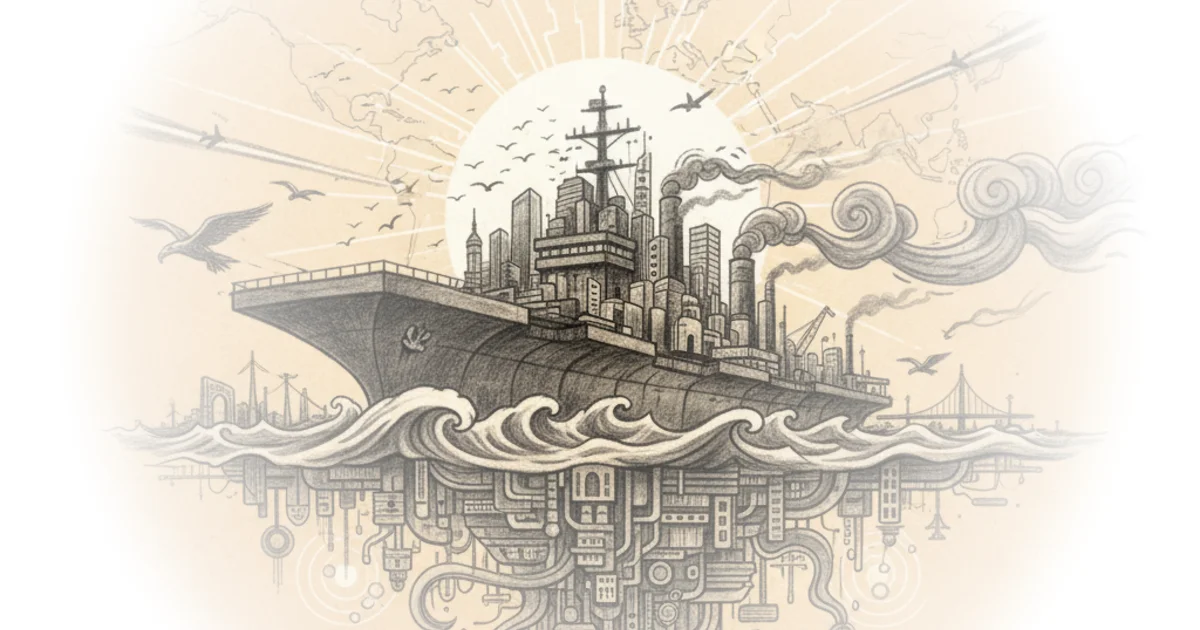
Sam Denby doesn't just explain how aircraft carriers work; he reveals them as the ultimate paradox of modern warfare: floating cities that are simultaneously the most powerful tools of global influence and the most vulnerable targets on the planet. In a field often dominated by dry technical specs, Denby's framing of these vessels as "fully fledged cities at sea" offers a startling human scale to a machine of war, forcing the listener to confront the sheer logistical impossibility of sustaining 6,000 people in the middle of an ocean.
The Logistics of Power
Denby begins by dismantling the common misconception that these ships are solitary predators. He argues that an aircraft carrier is merely the centerpiece of a complex ecosystem, noting that "carriers never travel alone." The core of his argument here is that the true power lies not in the ship itself, but in the "Carrier Strike Group"—a formation including guided missile cruisers, destroyers, submarines, and supply ships. This distinction is crucial; it shifts the narrative from a single weapon to a mobile, integrated military system.
He highlights the sheer endurance of these nuclear-powered giants, writing, "All 11 American carriers and the French one are nuclear-powered meaning they can sail an unlimited distance for 25 years without refueling." Yet, he immediately pivots to the bottleneck: food and aviation fuel. This is where Denby's analysis shines. He explains that while the reactor provides infinite energy, the ship cannot carry infinite sustenance. The solution is a high-wire act of maritime logistics he describes as "maneuver longside the carrier" to transfer supplies via zip-line dollies or helicopters.
"The supply ships that move as part of the strike group will sail off to a nearby port to take on fuel ammunition food and mail sail back to the Strike Group then match speed and maneuver longside the carrier."
This description of "matching speed" while transferring hazardous materials underscores the precision required. Critics might note that Denby glosses over the extreme danger of these replenishment-at-sea operations, which historically account for a significant number of naval accidents, but his focus remains on the operational ingenuity rather than the casualty risk.
The Choreography of Chaos
The most vivid section of the piece is Denby's breakdown of the flight deck, which he aptly terms "carefully choreographed chaos." He uses the color-coded shirt system to humanize the 6,000-person crew, turning a confusing mess of activity into a readable visual language. "On American carriers everyone's job is easily identifiable by the color shirt they wear," he writes, detailing how yellow shirts navigate, red shirts handle ammunition, and purple shirts manage fuel.
This visual framing is effective because it demystifies the violence of the deck, replacing it with a sense of organized industrial labor. Denby points out the spatial constraints, noting that the flight deck is so small that "all the carrier's aircraft can't fit on it," necessitating massive elevators to move planes to the hangar below. He contrasts the 1,100-foot runway of a carrier with the 10,000-foot runways of commercial airports to illustrate the engineering marvel of the catapult system.
"They don't they take off with just 325 feet or 99 metres of space all US and French carriers use a system of catapults to get aircraft up to takeoff speed within three to four seconds."
The speed of this launch—three to four seconds—is a testament to the physical forces at play. Denby's choice to compare the launch rate of the French carrier Charles de Gaulle to the traffic at Paris's main airport is a brilliant rhetorical move, grounding abstract military capability in a relatable civilian experience.
The Obsolescence Question
As the piece progresses, Denby tackles the elephant in the room: are these floating cities becoming obsolete? He acknowledges the rise of stealthy drones and precise missiles, stating, "the sinking of a single US aircraft carrier could result in more American military deaths than the entire Iraq war." This is a sobering admission of the stakes involved. He supports this with evidence from war games, citing incidents where Swedish and French submarines successfully "approach close enough to the carrier's where they could have if they were an enemy in real combat launch torpedoes."
"This in essence proves that aircraft carriers with all their defense are not as unsinkable as some may say."
Despite this vulnerability, Denby argues that the strategic value of power projection keeps them relevant. He notes that the US uses carriers for "power projection at any given moment," citing the ability to reach the Korean Peninsula in 29 hours from Japan. The argument here is that while the carrier is a target, its presence is a deterrent that no other asset can replicate. A counterargument worth considering is that the cost of building and maintaining these fleets might eventually outweigh their utility in an era of asymmetric warfare, a point Denby hints at but does not fully explore.
Bottom Line
Sam Denby's piece succeeds by treating the aircraft carrier not just as a weapon, but as a complex logistical and human ecosystem that defies the laws of physics and economics. The strongest part of the argument is the vivid depiction of the "choreographed chaos" on the flight deck, which makes the abstract concept of naval power tangible. However, the analysis stumbles slightly by underplaying the existential threat posed by modern anti-ship missiles, leaving the reader with a sense of awe that perhaps overshadows the strategic fragility of these floating cities. As nations continue to build new classes of carriers, the world will be watching to see if these giants remain the kings of the ocean or become the next great white elephants of military strategy.