Azeem Azhar arrives from Davos with a startling thesis: the global elite are not merely reacting to a crisis, but finally waking up to the fact that the foundational rules of the last eighty years have ceased to function. While previous gatherings felt like parodies of inaction, this year's forum served as a stark confirmation that the "Scarcity OS"—the operating system of our civilization built on limited resources and gatekept expertise—is crashing. This is not a story about political maneuvering; it is a structural analysis of why the institutions we rely on for jobs, credentials, and authority are dissolving in real-time.
The End of the Pleasant Fiction
Azhar anchors his argument in a speech by Canadian Prime Minister Mark Carney, who declared that the world has reached "the end of a pleasant fiction and the beginning of a harsh reality." Azhar uses this moment to frame the unraveling of the post-war geopolitical settlement, noting that the rules-based order and multilateral institutions designed for a slower, more stable world are fading. The author argues that this is not a temporary glitch but a fundamental shift in how power and resources are distributed.
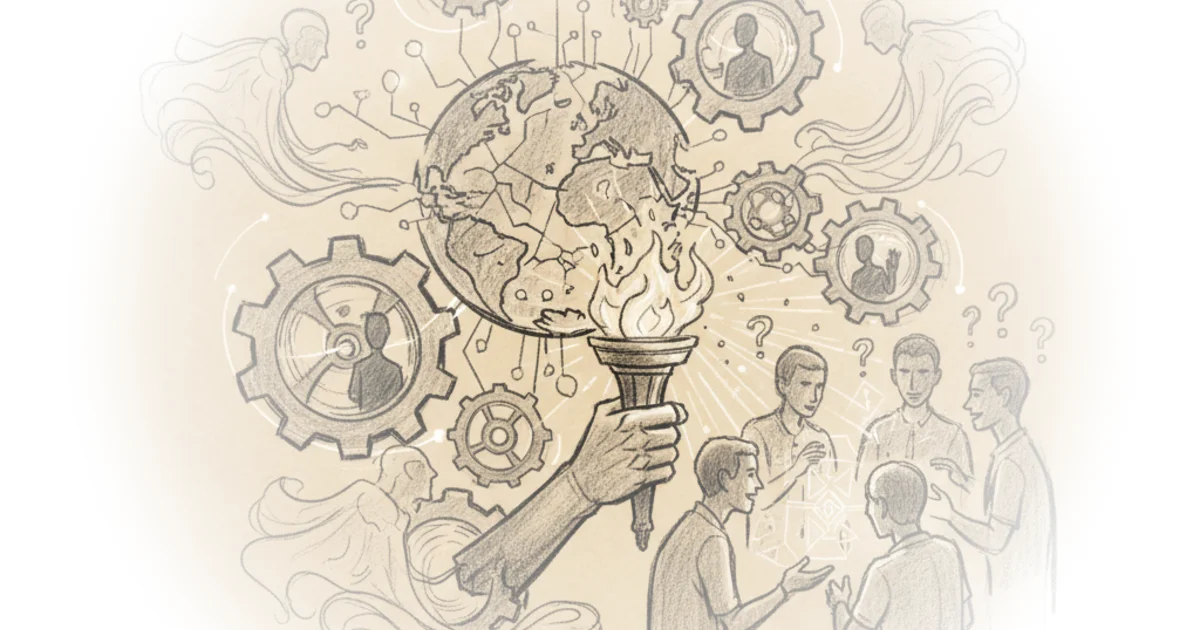
The commentary is particularly effective in distinguishing between the feeling of chaos and the reality of a system upgrade. Azhar writes, "Davos showed why it matters, why it is necessary in a world that is fraying rather than cohering." This reframing is crucial; it suggests that the gathering of global leaders was not a retreat into isolationism, but a necessary collision of minds trying to navigate a world where the old map no longer matches the territory. The author posits that the fragmentation of the old order is not a failure of leadership, but a symptom of the underlying economic and technological shifts that have rendered the old models obsolete.
The Three Crossings
The core of Azhar's analysis rests on a historical pivot point between 2010 and 2017, where three fundamental inputs to human progress crossed a threshold. He argues that energy, intelligence, and biology moved from a regime of "extraction" to one of "learning." For centuries, energy was about finding finite resources in the ground; now, as Azhar notes, "Energy became a technology." He points to the relentless cost drops in solar power, driven by Wright's Law, where every doubling of production drops costs by roughly 20%.
Similarly, intelligence shifted from an unpredictable research curiosity to a predictable engineering problem. Azhar highlights the 2017 publication of "Attention Is All You Need" by Google researchers as the moment "AI became a predictable engineering problem." He writes, "For the first time, there was a reliable scaling law for intelligence: more compute and more data yielded more capability, predictably." This is a profound observation for busy professionals: the uncertainty that once defined the tech sector has been replaced by a reliable curve of improvement, changing how businesses must plan for the future.
Finally, biology moved from evolutionary timescales to engineering timescales. Azhar explains that the human genome, once a $3 billion, thirteen-year project, is now readable and editable at a fraction of the cost. "For the first time in the history of life on Earth, a species could read and begin to edit its own source code," he writes. This transition from scarcity to abundance in these three domains is what Azhar calls an "upgrade to the operating system of civilization."
The fictions are decaying because the constraints that created them are gone. This is not a crisis. It is not the end of meaning or value or human contribution. It is the end of a particular set of social technologies that were brilliant adaptations to a world of scarcity.
The Decay of Social Fictions
With the underlying constraints of the world changing, Azhar argues that the social structures built to manage scarcity are now decaying. He provocatively labels jobs, credentials, and expertise as "fictions." He clarifies that these were not lies, but rather "social technologies, coordination mechanisms that worked brilliantly in a world of genuine constraint." The job, for instance, was a solution to the problem of distributing resources when information was expensive. The credential was a "compression algorithm for trust" when evaluating capability directly was too costly.
Now, however, the cost of direct evaluation is collapsing. Azhar writes, "When knowledge was locked in libraries... expertise was a genuine bottleneck. The expert was a bridge between the uninformed and the truth. That bridge is being bypassed." This is a challenging idea for many readers who have built their identities on these very pillars. The author suggests that the fear people feel is not about losing value, but about losing the "fiction that protected me from having to prove my value directly."
Critics might note that this framing risks underestimating the human need for structure and the real economic pain of transition. While the logic of abundance is compelling, the immediate reality for millions of workers is not liberation, but displacement. Azhar acknowledges the terror of this moment, admitting that "if you built a career as a gatekeeper... that's an existential threat." Yet, he maintains that the fear is pointing at the wrong object; the real threat is clinging to a system that no longer exists.
The Hoarder, The Manager, and The Builder
Azhar categorizes the global response to this decay into three distinct archetypes. The "Hoarder" sees a zero-sum game and reacts by building walls and imposing tariffs. Azhar describes this as "applying legacy software to a changed environment." The "Manager" tries to patch the old system, redistributing wealth within the existing framework, but still assumes the pie is fixed. Azhar identifies this as the instinct of leaders like Mark Carney, who seek to "optimize the Scarcity OS, not replace it."
The third archetype, the "Builder," sees the opportunity in the new abundance. For the builder, the question is not "how do I get my share?" but "how do I help make more?" Azhar writes, "The tragedy of this moment is that the loudest voices are the hoarders, the most respectable voices are the managers, and the builders are too busy building to fight the political battle." This distinction offers a clear path forward for the reader: stop trying to optimize a dying system and start building for the new one.
The author illustrates this shift with a personal anecdote about software development. A task that once cost $10,000 and took weeks now costs $1.50 and takes an evening. "The gap between those two numbers – $10,000 and $1.50 – is the distance between the old world and the new one," Azhar writes. This concrete example grounds the abstract theory in a tangible reality that any professional can understand.
Bottom Line
Azeem Azhar's most powerful contribution is the reframing of the current global instability not as a failure of leadership, but as the inevitable decay of social technologies that no longer fit the physical reality of the world. The argument's greatest strength is its ability to translate complex technological shifts into a clear narrative about jobs, credentials, and power. However, the piece's biggest vulnerability lies in its optimism; it assumes that the transition to abundance will be a liberation for the individual, potentially underestimating the profound social friction and political backlash that will accompany the collapse of the old order. The reader should watch for how the "Builders" can gain political traction against the entrenched "Hoarders" and "Managers" in the coming decade. The cage isn't just open; it's gone, but the question remains: who will build the new house?