Ryan Grim and Jeremy Scahill deliver a harrowing dispatch that refuses to let the global news cycle normalize the ongoing catastrophe in Gaza, framing the latest violence not as a sidebar to diplomatic maneuvering but as the central reality of a collapsing ceasefire. The piece is notable for its unflinching juxtaposition of human suffering—specifically an infant dying of hypothermia and families killed collecting firewood—against the cold, bureaucratic machinery of U.S. sanctions and military aid increases. This is essential listening for anyone seeking to understand the stark disconnect between Washington's stated goals of peace and the lethal reality on the ground.
The Human Cost Amidst Diplomatic Theater
Grim and Scahill anchor their reporting in the immediate, visceral tragedy unfolding in Gaza, noting that "In the past 48 hours, the Gaza Health Ministry reported 11 people killed and seven injured arriving at hospitals." They do not treat these numbers as abstract statistics but as a continuation of a documented toll that has now reached over 71,000 deaths. The authors highlight the grim specificity of recent attacks, writing, "On Thursday, Israeli tank fire hit the Zeitoun neighborhood in eastern Gaza City, killing four people," while simultaneously noting that "The Palestinian Civil Defense reported the death of an infant from hypothermia in the central Gaza Strip during the ongoing cold snap."
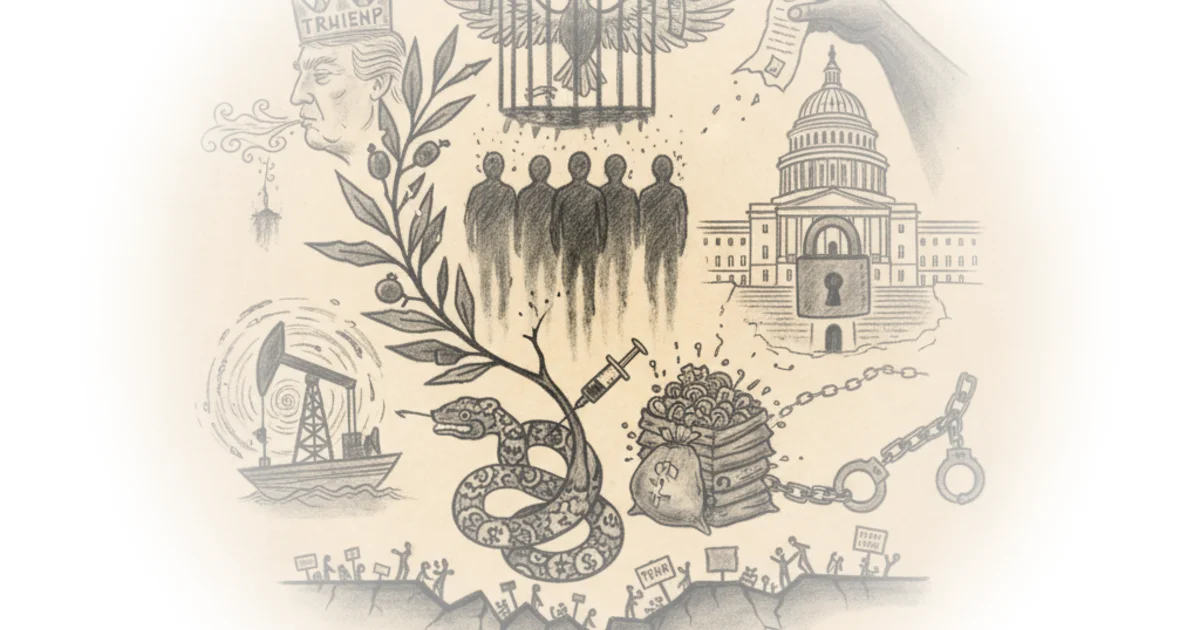
This framing is effective because it strips away the euphemisms often used in official briefings. By placing the death of an infant from exposure alongside tank fire, the authors force the reader to confront the total collapse of basic infrastructure and the lethal consequences of the siege. Critics might argue that focusing on individual tragedies obscures the broader geopolitical strategy, but Grim and Scahill's approach suggests that without centering the human cost, any discussion of "strategy" is morally bankrupt.
Sanctions as a Weapon of War
The commentary shifts to the aggressive role of the U.S. Treasury, which Grim and Scahill describe as actively deepening the humanitarian crisis. They report that the Treasury Department "sanctioned on Wednesday six Gaza-based medical organizations and the Popular Conference for Palestinians Abroad, accusing them of covertly supporting the military wing of Hamas." The authors note that these sanctioned groups include critical entities like the Waed Society Gaza and Al-Nur Society Gaza, effectively freezing their assets and barring all dealings.
The authors argue that this move is not merely a legal enforcement action but a strategic escalation. As Grim and Scahill put it, "Hamas attributed the move to Israeli influence on Washington and said it would deepen suffering in the Gaza Strip." This is a crucial point: the sanctions are framed not as a counter-terrorism measure but as a mechanism that directly impedes medical care and aid delivery. The evidence presented suggests that the U.S. is prioritizing political alignment with Israel over the survival of the civilian population, a choice that carries profound ethical weight.
The U.S. is not just funding the war; it is actively dismantling the only infrastructure left to sustain life in Gaza.
The Disparity in Aid and the Rise of Domestic Repression
The piece draws a sharp, damning contrast between the billions flowing to Israel and the restrictions placed on Palestinian assistance. Grim and Scahill write, "New 2026 State Department and Pentagon bills allocate $4.02 billion in additional U.S. aid to Israel... despite Israel's GDP per capita exceeding that of roughly 80% of U.S. congressional districts." They further note that by 2026, total U.S. aid to Israel will reach an estimated $352 billion since the state's inception.
This financial reality is set against a backdrop of domestic repression within the United States, where the authors detail the House passing a spending package that funds the Department of Homeland Security despite fierce opposition. The authors highlight the testimony of Majority Leader Hakeem Jeffries, who stated, "ICE is out of control and operating, in far too many ways, in a lawless fashion," and accused the agency of "using taxpayer dollars to inflict brutality on the American people." The piece connects this domestic brutality to international policy through the story of Nasra Ahmed, a U.S. citizen who was "violently detained by federal Immigration and Customs Enforcement agents... held for two days without explanation, during which she suffered a concussion and other injuries."
The argument here is that the same executive branch authorizing the sanctions in Gaza is simultaneously deploying a militarized police force against its own citizens. This parallel suggests a broader shift toward authoritarian governance that transcends borders. A counterargument might suggest that the funding for DHS is necessary for border security and that the sanctions on medical groups are standard counter-terrorism protocol, but the authors' evidence of indiscriminate violence and the specific targeting of aid organizations undermines the claim of proportionality.
Global Shifts and the Erosion of Sovereignty
Beyond the immediate conflict zones, Grim and Scahill trace a pattern of U.S. interventionism that seeks to control resources and dictate political outcomes globally. In Venezuela, the authors report that the U.S. "maintains control over Venezuela oil sales," noting that Washington "now claims control over Venezuela's oil exports and intends to direct most of the country's crude oil to the United States." Similarly, in Cuba, the Supreme Court is advancing corporate claims that could "allow corporations to seek hundreds of millions of dollars over decades-old expropriations," a move the authors warn could "chill normalization efforts with Cuba, and channel the spoils of U.S. foreign policy to corporate profiteers."
The authors also touch on the shifting dynamics in Syria, where the U.S. is "reportedly considering a complete withdrawal of roughly 1,000 U.S. troops," a move that reflects "doubts about the viability of U.S.-backing for the SDF." This withdrawal comes as Iraq accepts the transfer of thousands of ISIS detainees, highlighting the fragility of the security architecture the U.S. has built. The narrative suggests a U.S. foreign policy that is increasingly transactional, willing to abandon allies like the SDF when convenient while aggressively pursuing resource control in Venezuela and legal leverage in Cuba.
Bottom Line
The strongest element of this piece is its refusal to separate the humanitarian crisis in Gaza from the domestic and global policies of the U.S. executive branch, revealing a coherent strategy of coercion that targets both foreign populations and American citizens. Its biggest vulnerability lies in the sheer density of global events covered, which risks overwhelming the reader with the scale of the chaos. However, the central verdict remains clear: the current trajectory of U.S. policy is accelerating human suffering while eroding democratic norms at home, and the only way to stop it is to recognize the interconnectedness of these struggles. Watch for the implementation of the new sanctions on Gaza's medical groups, as this will likely serve as the next flashpoint for international condemnation.