Sabine Hossenfelder delivers a rare and necessary correction to a fundamental misunderstanding that persists even among scientists: the idea that gravity is a force. In a piece that cuts through decades of classroom simplification, she argues that what we feel as weight is actually the result of the Earth pushing us upward, while true gravity is merely the curvature of spacetime. This isn't just semantic nitpicking; it is the key to understanding why an accelerometer reads upward acceleration when you are standing perfectly still.
The Upward Push
Hossenfelder begins by dismantling the intuitive sense that gravity pulls us down. She points to a device many readers likely own in their phones: an accelerometer. "If you'd hold an accelerometer steadily in your hand it'll tell you it's accelerated upwards," she writes. This counterintuitive fact is the cornerstone of her argument. The device isn't broken; it is correctly identifying that a force from the floor is pushing you up against the natural tendency of your body to follow the curvature of spacetime.
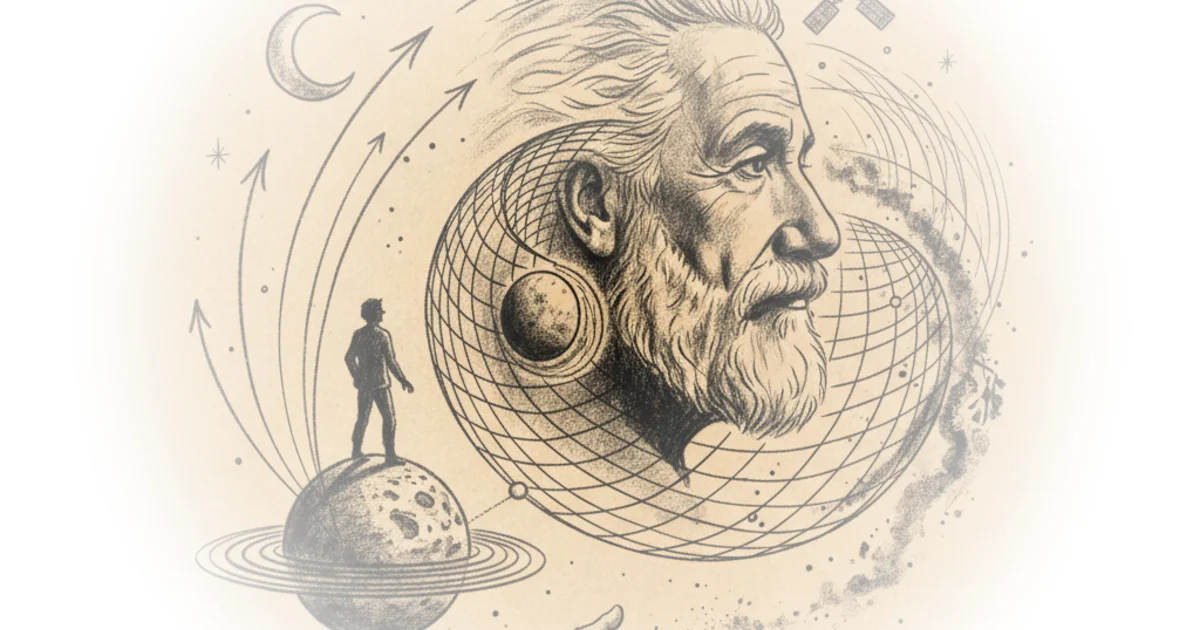
The author explains that the sensation of weight comes from the atomic bonds in the ground resisting your fall. "The pressure of Earth creates a force which accelerates you on the surface," Hossenfelder notes. This reframing is powerful because it shifts the burden of action from the planet to the ground beneath your feet. It forces the reader to accept that if the floor vanished, you wouldn't be "pulled" down; you would simply stop accelerating and fall freely, experiencing zero force.
Critics might argue that this distinction is purely academic for daily life, where Newton's laws work perfectly fine. However, Hossenfelder insists that clinging to the "force" model prevents us from grasping how the universe actually functions at a fundamental level. The distinction becomes critical when considering extreme environments where Newtonian physics fails completely.
The Equivalence Principle and the Spring
To illustrate why gravity cannot be a force, Hossenfelder turns to Einstein's famous thought experiment involving a spring and a box. She describes a scenario where an observer cannot see outside a sealed room. "Einstein said that if you're in the Box you can't tell whether you're being accelerated or whether you're sitting still on the surface of a planet," she writes. This is the Equivalence Principle: locally, the effects of gravity and acceleration are indistinguishable.
The argument hinges on the nature of measurement. In deep space, a spring attached to a rocket stretches only when the rocket accelerates. On Earth, that same spring stretches while you stand still. "The point where people usually go wrong is to conclude that because gravity is indistinguishable from acceleration that means gravity accelerates you but that isn't so," Hossenfelder clarifies. The acceleration comes from the floor, not the gravity. This is a subtle but profound shift in causality.
"If you are only exposed to the gravitational interaction you fall and that is measurably not an acceleration."
This quote encapsulates the entire piece. Hossenfelder uses it to define "free fall" not as a state of weightlessness caused by the absence of gravity, but as the only state where no force is acting on an object. Whether you are in a zero-g flight or falling toward a black hole, you are following the natural path of spacetime. The "force" you feel only appears when something stops you from following that path.
Redefining Zero
The piece concludes by addressing the confusion around velocity and acceleration. Hossenfelder explains that velocity is relative, but acceleration is absolute. "You can measure how much you're accelerated for example with that spring and you can tell when you're not accelerated," she states. This absolute nature of acceleration is why the Newtonian definition of "standing still" as zero acceleration is technically incorrect in a relativistic universe.
She acknowledges that physicists often slip up, calling gravity a force simply because it starts with the letter 'F' and fits into the "four fundamental forces" shorthand. "Physicists are no linguistic Saints and they are sometimes refer to gravity as a force even though it isn't," Hossenfelder admits. This linguistic laziness, she suggests, perpetuates the misunderstanding that the public and even students of physics carry into adulthood.
The argument holds up well against the counterpoint that Newtonian gravity is "good enough" for engineering. While true for building bridges, it fails to explain why time moves slower near massive objects or how light bends around stars. Hossenfelder's insistence on the correct model is not just about precision; it is about aligning our intuition with the actual geometry of the cosmos.
Bottom Line
Hossenfelder's strongest move is using the accelerometer to prove that standing still on Earth is an act of acceleration, effectively inverting our entire sensory experience of the world. The argument's vulnerability lies in its reliance on the reader accepting that spacetime curvature is a physical reality rather than a mathematical abstraction, a leap that remains difficult for many. However, for anyone willing to suspend their intuition, the piece offers a clear, evidence-based path to understanding why gravity is not a force.
"The entire point of Einstein's theory of relativity is that velocity is not absolute... acceleration is not a relative quantity."
This piece succeeds because it doesn't just correct a fact; it corrects a way of thinking. It challenges the reader to trust the data from their own phone over the feeling in their bones, a lesson that is as applicable to navigating the modern world as it is to understanding the universe.