Steve Vladeck uncovers a quiet legal earthquake: hundreds of federal judges, across the political spectrum, are systematically dismantling a massive, secretive expansion of immigration detention that the executive branch attempted to implement without fanfare. This isn't just about policy disagreement; it is a rare moment where the judiciary is acting as a unified brake on executive overreach, rejecting a radical reinterpretation of a 29-year-old statute that threatens to lock up millions of people without bond. For the busy professional tracking the rule of law, the sheer volume of this judicial pushback—over 700 cases in months—offers a startling counter-narrative to the idea of a rubber-stamp system.
The Quiet Flood of Judicial Pushback
Vladeck frames the core conflict as a battle over statutory interpretation with profound human consequences. The executive branch has attempted to stretch the definition of "arriving alien" to include individuals who have lived in the United States for years, subjecting them to mandatory detention without the right to a bond hearing. "The executive branch has radically expanded its interpretation of which non-citizens can be arrested and detained without bond pending their removal proceedings," Vladeck writes, noting that this move "exposed hundreds of thousands (if not millions) of individuals already living inside the United States to immigration arrest and detention to which they would not realistically have been subject prior to this summer."
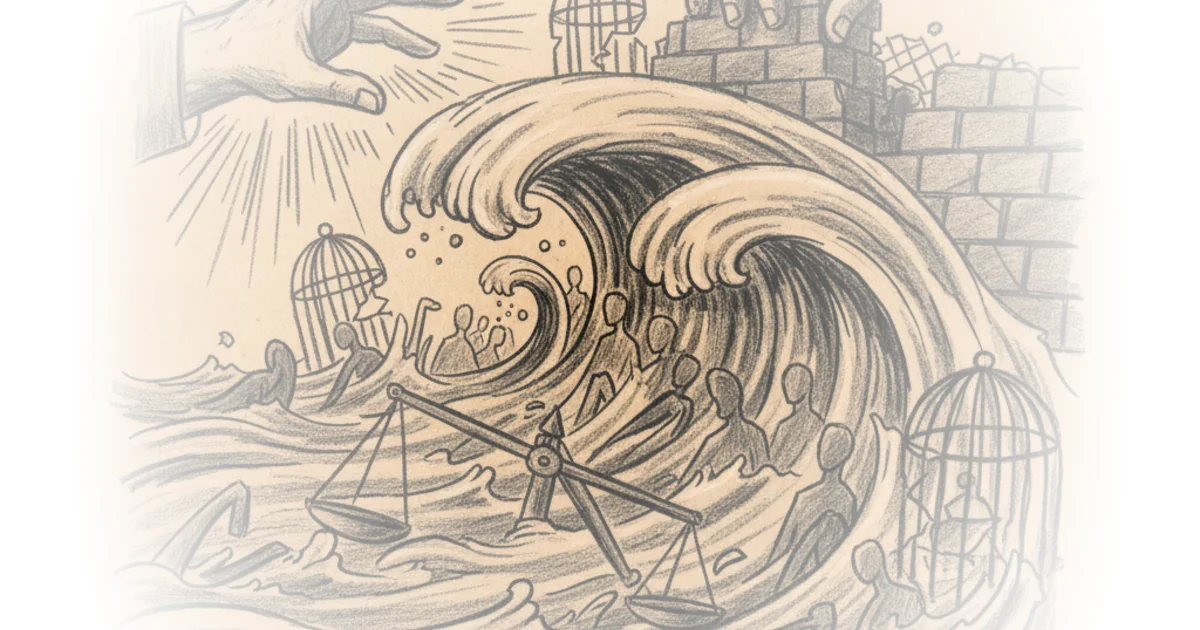
This is not a partisan flare-up; the data suggests a broad consensus on the law. Vladeck highlights a staggering statistic: "At least 225 judges have ruled in more than 700 cases that the administration's new policy... is a likely violation of law and the right to due process." These judges were appointed by every modern president, including 23 by the administration in question. The sheer breadth of this rejection is the story's most compelling element. It suggests that the legal argument against the policy is so strong that it transcends the usual ideological divides of the bench.
"What is striking about this pattern is not just its volume or the scorecard; it's that the judges in many of these cases are writing thorough, persuasive opinions explaining why the Trump administration is utterly wrong on the law."
The author points to Judge Lewis Kaplan's recent ruling as a prime example of this judicial clarity. Kaplan didn't just rule; he appended a list of over 350 similar rulings from his colleagues, creating a visual map of the judicial consensus. This retail, case-by-case litigation has now coalesced into a class action certified by Judge Sunshine Sykes, which Vladeck argues "may accelerate how quickly this issue moves to the courts of appeals and, inevitably it seems, to the Supreme Court." Critics might argue that this flood of litigation indicates a failure of the executive branch to follow clear statutory boundaries from the start, rather than a sudden judicial awakening. However, Vladeck's evidence suggests the executive branch was actively testing the limits of the law, betting that the courts would not intervene with such speed or unanimity.
The Shadow Docket and the Feres Doctrine
Shifting to the Supreme Court's own docket, Vladeck contrasts the lower courts' vigorous defense of due process with the high court's current reliance on "summary reversals" and procedural delays. He notes the Court's recent unsigned opinions in Pitts v. Mississippi and Clark v. Sweeney as potential signs of a return to the "shadow docket"—rulings made without oral argument or full briefing. "When Will Baude coined the term 'shadow docket' in 2015, he was specifically responding to a significant uptick at that moment in these kinds of certiorari-stage 'summary' rulings," Vladeck observes, questioning whether the recent activity signals a new trend.
The commentary also touches on the Feres doctrine, a 1950 precedent that bars military servicemembers from suing the government for injuries "arising out of, or incident to" their service. Vladeck notes that Justice Thomas has long been a "staunch critic" of this rule, yet the Court declined to revisit it in Beck v. United States. Justice Sotomayor's separate opinion suggested Congress should fix the issue, but Vladeck offers a sobering reality check: "It's hard to imagine any Congress, let alone the current one, making it easier for servicemembers to sue the federal government." This highlights a recurring theme in the piece: the judiciary often steps in to fill gaps left by legislative inaction, yet the Court itself sometimes hesitates to overturn its own precedents.
"I can't recall any other example of a federal policy that provoked quite so much litigation in such a short period of time—or litigation in which so many judges from across the geographical and ideological spectrum so overwhelmingly rejected the executive branch's new interpretation of the relevant statutes."
The piece also critiques the Court's handling of the Perlmutter case regarding the Register of Copyrights. The Court deferred action, linking it to unrelated cases, a move Vladeck finds puzzling given the specific statutory nature of the dispute. "Frankly, I don't get it," he writes, noting that the underlying question is narrow and the deferral effectively delays a resolution that seems straightforward. This hesitation contrasts sharply with the lower courts' willingness to issue immediate, coercive relief against the detention policy.
The Human Cost of Legal Technicalities
The underlying tension in Vladeck's analysis is the disconnect between legal technicalities and human reality. The executive branch's interpretation of the immigration statute effectively removes the right to a bond hearing for a vast category of people. Historically, the norm has been to release individuals on bond unless they pose a flight risk or danger. "Section 236, since a 1996 amendment, has given immigration authorities essentially two options at the outset of removal proceedings," Vladeck explains. "One option is to keep the noncitizen in custody throughout the proceedings. The other option is to release the noncitizen on bond or parole."
By reclassifying long-term residents as "arriving aliens," the administration has stripped them of this second option. This is not just a procedural shift; it is a fundamental change in the liberty interests of people who have built lives in the country. The reference to the Feres doctrine and the Confrontation Clause in the Pitts case serves as a reminder that these legal battles often determine whether individuals can access justice or are left without recourse. The human cost is implicit in the statistics: hundreds of thousands of people facing indefinite detention without a hearing.
"This is a striking story not just about the Trump administration's zealotry when it comes to immigration policy, but about the critical role hundreds of federal judges have played in steadfastly holding the executive branch to the law."
Bottom Line
Vladeck's strongest argument is the empirical evidence of a unified judicial front rejecting executive overreach, a rare and significant development in an era of polarized legal interpretation. The piece's vulnerability lies in its reliance on the assumption that this lower-court consensus will hold up if and when the Supreme Court takes the case, given the Court's recent tendency toward deference to executive authority in immigration matters. Readers should watch for the upcoming Supreme Court arguments in Trump v. Slaughter and Trump v. Cook, as the outcome there could determine whether the lower courts' robust defense of due process becomes the law of the land or is overturned by a majority that prioritizes administrative power.