Justin E. H. Smith delivers a startling diagnosis for the humanities: they are not dying because of culture wars or critical theory, but because machines have simply become better at producing the "research results" that universities demand. In an era where artificial intelligence is reshaping epistemology, Smith argues that the current panic over academic integrity misses the forest for the trees, suggesting instead that we are witnessing a fundamental shift in how reality itself is conceptualized—from physical particles to information bits.
The Usurpation of Physics
Smith begins by dismantling the popular "simulation argument" often championed by tech figures. He contends that the idea that reality is more "bit-like than it-like" is not a profound new discovery, but rather the inevitable cultural echo of physics losing its status as the supreme science. "Perhaps the greatest propaganda coup of scientific modernity has been to convince a good number of us that such a claim is nothing more than right common sense," Smith writes, noting how quickly we accept that atoms anchor reality while dismissing hesitation as superstition.
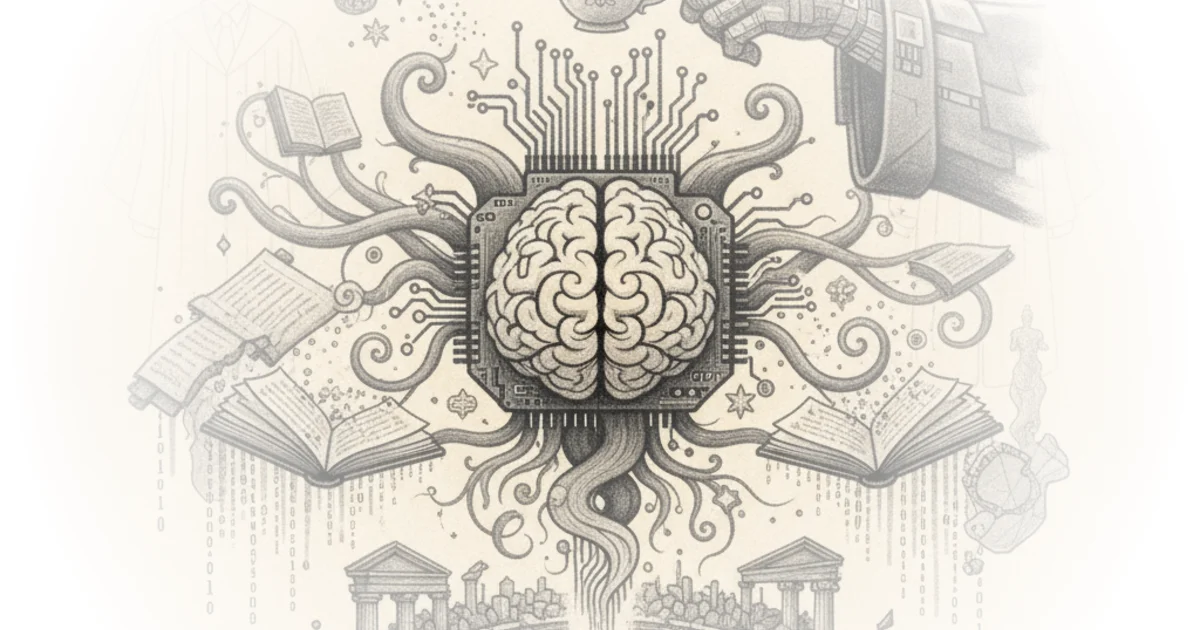
The author points to the 2024 Nobel Prize in Physics, awarded to computer scientists Geoffrey Hinton and John Hopfield for work on artificial neural networks, as a definitive marker of this transition. This event signaled that the highest distinction in physics can now be earned by decoupling from the "real" world of particles. Smith observes that we are transitioning out of a 400-year reign of physics as Prima Scientia, with information science taking the throne.
This historical framing is bolstered by a reference to ancient traditions that predate our current materialist obsession. Smith notes that classical Indian schools, such as those influenced by the grammarian Pāṇini around 400 BCE, took śabda or "speech" as the first principle of reality. Just as Pāṇini viewed linguistic particles as the constituents of the world, modern simulationists view digital bits. Smith argues that the naivety lies not in questioning materialism, but in assuming our new technologies are uniquely revealing the nature of the universe.
"It would be surprising indeed if the technologies that did so much to shape the adolescent minds of Musk, Bostrom, Chalmers... just happened also to be the clavis for unlocking the nature of the universe."
Smith draws a parallel to the 17th century, where the clockwork was the dominant metaphor for the cosmos. He suggests that declaring the universe a "clockwork" allowed natural philosophers to pursue "maker's knowledge," transforming nature into an instrument for human ends. Today, the computer has simply replaced the clock as the more impressive instrument. The claim "The cosmos is a computer" is true not because we have finally found objective truth, but because it licenses investigation in information-theoretical terms that yield remarkable practical results.
The Death of the Author and the Rise of Remainder Humanism
Turning to the immediate crisis in academia, Smith critiques a recent report by scholars like Paul Boghossian regarding the state of humanities scholarship. He argues that these critics fail to see that the primary threat to humanistic inquiry is not ideological bias, but the economic reality of machine-generated research. The core problem is that institutions still demand "positive research results," a metric that machines can now deliver far more efficiently than humans.
Smith warns that as long as humanities scholars conceive their work as "STEM lite" production of data, they are doomed to practice what Leif Weatherby calls "remainder humanism." He paints a stark picture for the future academic: "You can still get your Ph.D. on Kafka or Lucretius... but already you must prepare yourself for a life strung along on postdocs that are—if you're lucky!—only distally related to Kafka or Lucretius, while your actual work-tasks in fact look more like low-end data-entry."
The author suggests that the "critical humanists" have inadvertently aided this shift by adopting approaches that deny the primacy of scientific rigor, yet he insists the machine-dominated regime would have arrived regardless of their actions. The report Smith critiques is dismissed as a "power-move" that treats social media squabbles as the root cause of academic decline, ignoring the deeper technological displacement.
"Either way... you got the death of the author, and the death of the author precisely in his devourment by the machines his work served to train."
Critics might argue that Smith underestimates the unique value of human interpretation and ethical reasoning, which cannot be reduced to data entry or algorithmic output. However, Smith's point is not that AI can replicate human thought perfectly, but that the institutional incentives of modern academia are already aligned with machine efficiency rather than human cultivation.
Smith concludes that the report's proposed solution—a return to a naive theory of objective truth—is insufficient. The true defense for the humanities must lie elsewhere, in areas machines cannot easily penetrate: "ethical self-cultivation, or civic belonging, or discovery of meaning in tradition." These are the only anchors left when the production of positive results is no longer the exclusive domain of human scholars.
Bottom Line
Smith's most compelling insight is that the crisis in the humanities is not a failure of ideas, but a collapse of function; if machines can do the "research," the justification for the profession must shift from data production to meaning-making. The argument's vulnerability lies in its potential fatalism, assuming that institutions will inevitably prioritize machine efficiency over humanistic depth without significant resistance. Readers should watch for how universities adapt their funding and tenure models as AI tools become indistinguishable from traditional research output.