Dave Amos challenges a decades-old urban planning dogma with a counterintuitive premise: the very streets designed to speed up your commute are likely slowing down your city's economy and endangering its most vulnerable residents. By treating one-way streets not as traffic solutions but as artificial constructs of car culture, Amos exposes a hidden layer of urban design that prioritizes throughput over human connectivity. This is not just a traffic study; it is a reclamation of the public realm.
The Illusion of Efficiency
Amos begins by dismantling the primary justification for one-way streets: the promise of faster traffic flow. He notes that "just about all one-way streets are conversions of streets originally designed for two-way traffic," yet the speed gains are often an illusion for the average driver. The author argues that while these streets move cars faster once they are on them, they force drivers to take circuitous routes just to find the correct entry point, effectively negating any time saved.
"If you're making short trips or experiencing low traffic, two-way streets are the best. You can make direct trips really nicely without having to go out of your way."
This observation is crucial because it highlights a mismatch between engineering goals and actual human behavior. Amos points out that one-way systems only outperform two-way streets during absolute peak congestion, a narrow window that ignores the reality of daily life. Critics might argue that for high-volume corridors, the reduction in conflict points at intersections justifies the detour, but Amos suggests that the "route redundancy" of two-way streets often provides a better safety net when congestion hits.
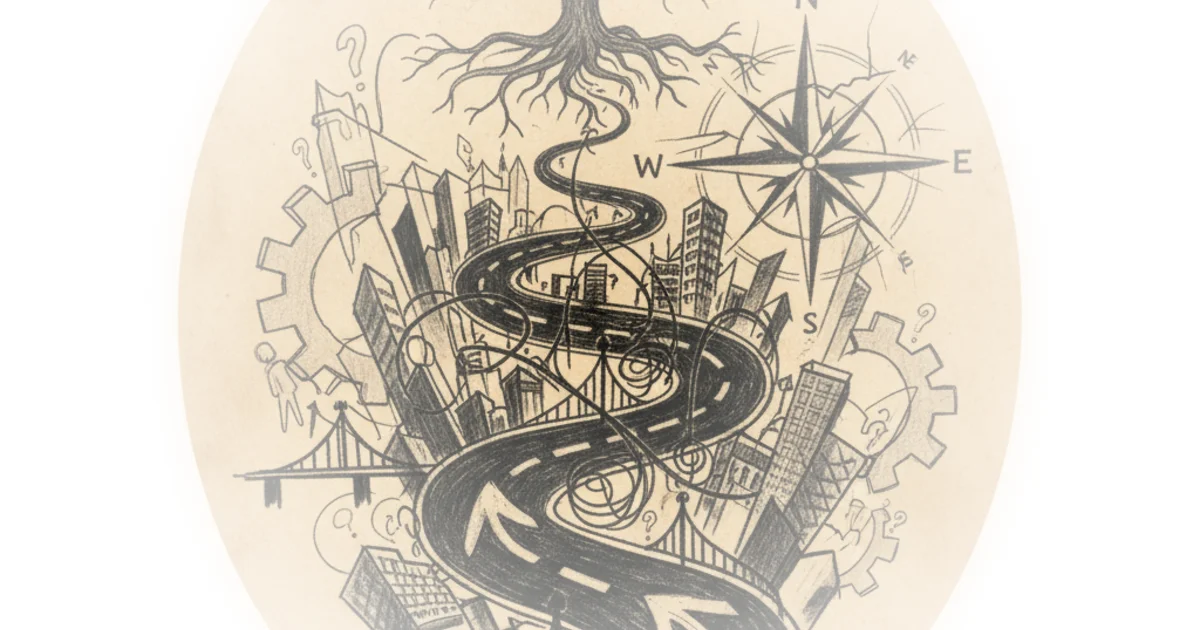
The author goes further, suggesting that one-way streets are fundamentally "super artificial." He contrasts modern roads with historic examples like Mulberry Street in New York City, which functioned as a shared space for people and horses without lane markings or directional mandates. "One-way streets are another example of car culture, one that's kind of hiding in plain sight," Amos writes, framing them as an extension of the highway system rather than a natural evolution of city planning.
The Human and Economic Cost
The commentary shifts from traffic mechanics to the tangible impact on neighborhoods. Amos draws a direct parallel between one-way streets and highways, noting that both tend to degrade the quality of life for adjacent residents. He cites research from Louisville, Kentucky, which found that one-way couplets are disproportionately located in low-income areas with higher crime rates and lower property values.
"One-way streets reduce connectivity in favor of traffic speed."
This reduction in connectivity is the core of the economic argument. By prioritizing the speed of through-traffic, cities inadvertently sever the local connections that drive neighborhood commerce and safety. The author argues that converting these streets back to two-way operation can trigger reinvestment, turning a place to "speed right through" into a place to be. This evidence holds up well against the broader trend of cities actively removing one-way systems to revitalize downtowns.
However, the argument is not without nuance. Amos acknowledges that in specific, space-constrained environments, one-way streets can be a neutral or even positive tool. He points to Garden Street in his own city, where a one-way conversion allowed for expanded cafe seating, angled parking, and a slower, more pedestrian-friendly environment. "In space constrained locations, one-way streets can be appropriate," he admits, showing that the solution is not a blanket ban but a context-sensitive redesign.
"The purported traffic flow benefits can be overblown, and they may even economically depress areas."
This distinction is vital. Amos does not claim one-way streets are universally evil; rather, he argues they are often misapplied as a default solution for traffic flow when they actually serve as barriers to community vitality. The strongest part of his coverage is the realization that these streets are not inevitable features of urban life but deliberate choices that can be unmade.
Bottom Line
Dave Amos delivers a compelling case that one-way streets are often a legacy of mid-century car-centric planning that no longer serves modern urban needs. While the argument occasionally glosses over the engineering complexities of converting high-volume arterial roads, its core insight—that connectivity trumps speed for neighborhood prosperity—is undeniable. The strongest takeaway is the call to view street design not as a fixed constraint, but as a flexible tool that can be adjusted to prioritize people over vehicles.