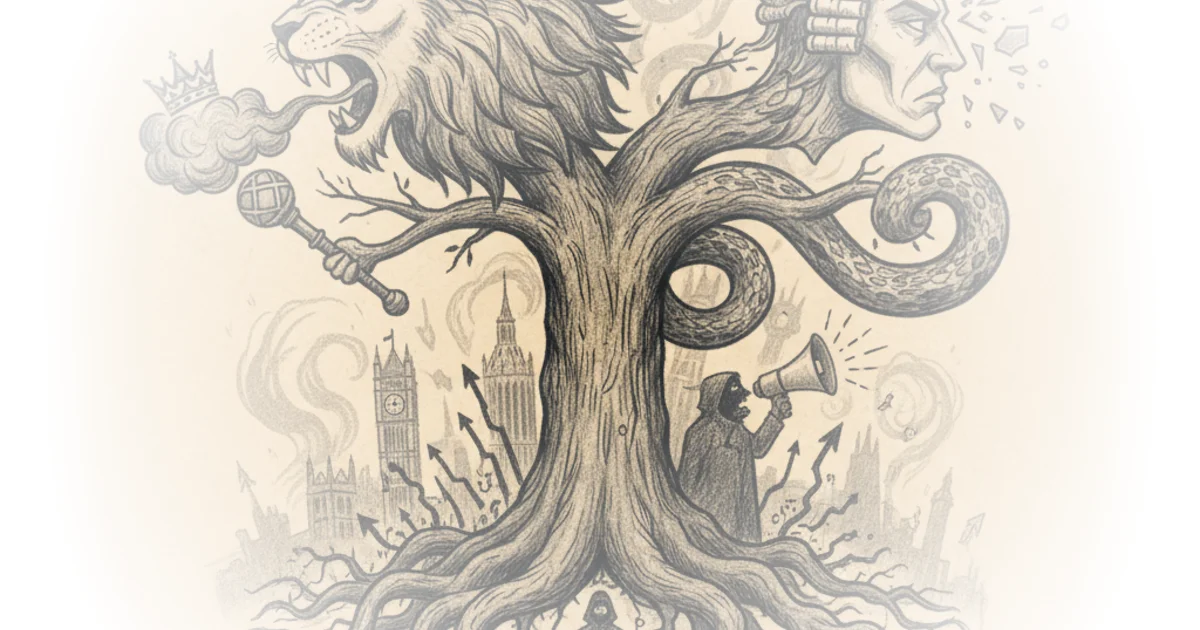
A Conservative MP just declared that Muslim prayer in public spaces is an "act of domination" — and the party leader is defending him. This isn't some fringe crank; it's the mainstream Conservative position, and it's being celebrated by figures like Nigel Farage.
The Shift Within the Tory Party
Nick Timothy is the Conservative MP for West Suffolk. Despite being newly elected, he's already serving as Shadow Lord Chancellor and Vice Chair of Conservative Friends of Israel. He rose to prominence in 2017 as Chief of Staff to then Prime Minister Theresa May — a role he lost after her election campaign saw the party lose their majority to Jeremy Corbyn's insurgent Labour Party.
But Timothy's latest controversy is far more sinister than staff reshuffles. Last week, Sadik Khan and fellow Muslims prayed together in Trafalga Square — an act of faith that many religious groups have performed in public spaces for years. It's a harmless act of worship in a location used by countless faith communities.
Timothy didn't see it that way. He posted on Twitter: "Too many are too polite to say this, but mass ritual prayer in public places is an act of domination." The shahada — the declaration "There is no god but Allah and Muhammad is his messenger" — Timothy called "a declaration of domination" when performed publicly.
Perform these rituals in mosques if you wish, but they are not welcome in our public places and shared institutions. And given their explicit repudiation of Christianity, they certainly do not belong in our churches and cathedrals.
The language is unmistakable: he's calling for restrictions on religious freedom specifically targeting one faith community.
The One Nation Conservative Crisis
For someone who was once Chief of Staff to Theresa May — an emblematic figure of the Tory left — to now openly calling for restricting Muslims' right to pray must be incredibly jarring for moderate Conservatives. The party has always marketed itself as prioritizing free speech and personal liberty. Now a front bencher is openly advocating limiting freedom to practice religion for one specific group.
This represents a broader trend across center-right parties in the global north. A thermostatic reaction to migration policy over thirty years has moved their voter bases significantly rightward — meaning they've been either outflanked by parties to their right or chasing the rhetoric of those same parties.
Farage's Applause
If Timothy's comments weren't alarming enough, Nigel Farage himself echoed these sentiments in a recent intervention. Speaking about what happened at Trafalga Square, Farage said: "What we witnessed was a group of people headed up by the ghastly Sadik Khan attempting dominance over our capital city and over our culture."
The Prime Minister's Questions session became a battleground. The PM defended what happened at Trafalga Square, stating that anyone who speaks against it is a bigot.
I'm sorry, Prime Minister. I'm sorry, the Conservative Party that let most of these people in. We are not going to surrender everything that was built over centuries, defended at a cost of great blood in two world wars for us to be a free independent nation. We will not put up with this anymore.
Farage's rhetoric is genuinely frightening. He's employing talk of "surrender" and references to World Wars while defending restrictions on liberty — essentially arguing that fighting for freedom means banning others' freedom when he perceives it as offending Christian values.
Judeo-Christian Values and the Real Agenda
The term "Judeo-Christian" is invoked by the right specifically to counter Islam, perceiving Islam as a new threat. It's a rhetorical reframing of the West versus East dynamic that's existed since American unipolarity emerged after the Cold War — essentially dividing the world between what they see as the civilized West and the Muslim East.
The UK historically operated on Christian values, but that has degraded as society became more humanist and secular. The term is being used specifically to scapegoat Muslims once you hear "Judeo-Christian" invoked.
It's also telling that Nick Timothy singled out Islam for claiming their god is the one true god — most religions believe their god or gods represent the truth. This idea that monotheism is specific to Islam is simply false. And therefore, you can see they're singling out this group in particular.
The Political Context
Timothy's endorsement from Farage was concerning enough. But he found an even more damning ally: the supporters themselves. One commentator congratulated and thanked every patriot who "stood up," refused to be silenced, and shifted the Overton Window so far that a Conservative MP now feels comfortable stating these facts.
Twelve months ago, no MP would have said anything like this. The left had the monopoly and would have absolutely crucified any colleague expressing such views. The party would have expelled them.
Why can they say it now? Because supporters took to the streets in millions, giving confidence to people to speak the truth — there's support for that feeling, for that pride, for that courage. It's there now because of these rallies and demonstrations.
The scary part is Farage isn't wrong. The Overton Window has shifted, deliberately, by politicians who refuse to repudiate latent Islamophobia on the right of politics, and by billionaires backing the far right cynically to scapegoat minorities for problems they caused.
Party Leadership's Failure
Tory leader Kemi Badenoch has let this slide so far, refusing to sack Timothy despite calls from the Prime Minister to do so. The Tory Chair Kevin Hodellara has backed him too — though his defense seemed unconvincing even to LBC's Nick Ferrari.
When Ferrari asked why Muslims are not welcome in their view of public spaces, Hodellara insisted: "That's not to say Muslims are not welcome in our country." But the contradiction is stark. He then said: "We completely tolerate the Muslim faith. We support the Muslim faith. All moderate Muslims we should support in this country."
The cognitive dissonance of calling out someone else for engaging in restrictions on free speech — while saying Muslims should be allowed to pray — shows how far the political landscape has shifted. The swivel-loons are now running the asylum.
Not New — But Now They're Leaning Into It
This kind of Islamophobia in the Conservative Party isn't new. We've seen this before. In previous iterations, there was at least some artifice that they would come down on people engaging in this stuff — even if only symbolically.
What changed? The party is no longer in denial about the problem; they're leaning into it.
It's also interesting to watch Labour go on the attack, given they've lost so many Muslim voters over the war in Gaza. There's a debate in the Commons about Labour's new social cohesion plan that explicitly calls out Islamophobia — and now both parties see this as fertile attack lines.
The Tory party is rampantly Islamophobic, and it's dangerous the way they're talking. But for Reform UK and Farage, it's working: people like the original flavor don't like New Coke; they like reform. They've set the table for Farage to make grandstanding speeches. He's opened the door to frame the conversation entirely.
The Historical Parallel
Usually when racist tropes are invoked, the framing treats other races as inferior. What's interesting here is that it mirrors how right-wingers of old talked about Jewish people — not feeling superior, but the idea of a plot, the idea of threat. It's treating them as subversive entities trying to undermine society.
This was the trope about Judeo-Bullechism: the idea there was subversion of society happening from this particular ethnic minority. And it's the way they're talking about Muslims now — that society is being undermined and overturned by people practicing faith.
Critics might note that framing this purely as a religious issue obscures the deeper economic and political dynamics at play — the billionaire backers, the strategic timing around electoral pressures, and the deliberate scapegoating of minorities for problems caused by those same elites. The Islamophobia framing, while accurate, risks minimizing these structural forces.