Nietzsche's Beyond Good and Evil contains one of philosophy's strangest warnings: most people should probably turn back. In chapters 22 and 23, he advances his radical case that hatred, envy, and covetousness aren't moral failures—they're actually essential to life itself.
The Attack on Natural Law
Nietzsche begins by dismantling the idea of natural law—the notion that certain truths are self-evident, universal, and unchanging. He calls himself an old philologist, someone who studies how language shapes meaning, and he uses this lens to expose what he sees as a fundamental error: we read the world not as it is, but as we want it to be.
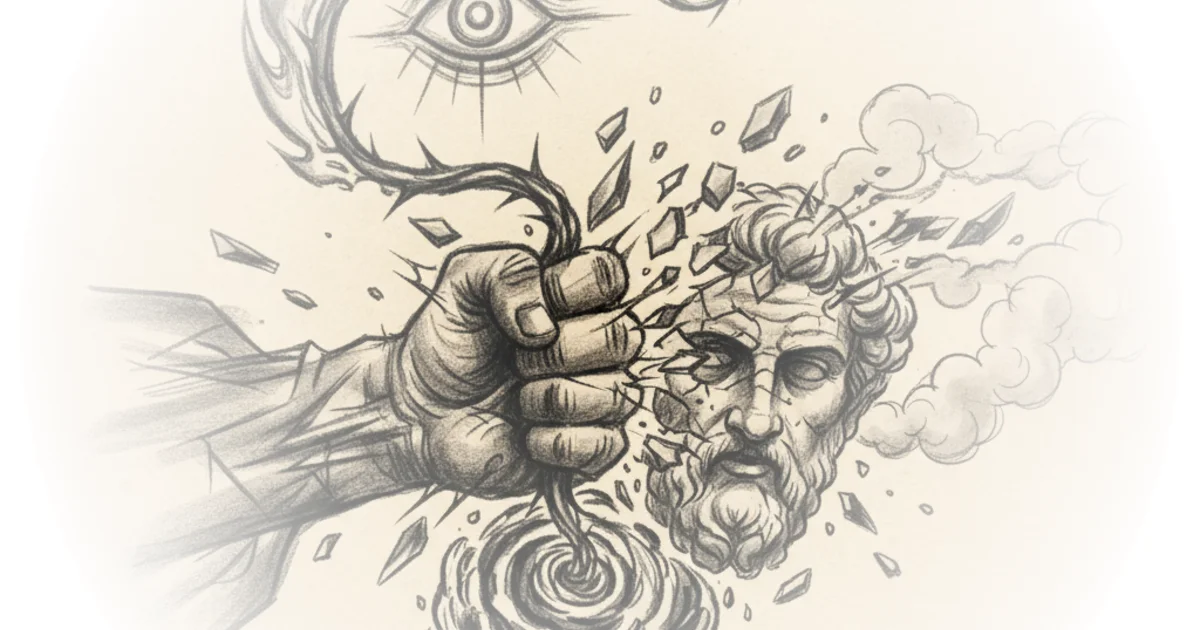
When we claim "all men are created equal" or insist on natural justice, Nietzsche argues we're not uncovering facts about the world; we're simply projecting what we wish were true onto nature itself. He calls this "bad philology"—the act of reading meaning into things that simply isn't there.
The concept of equality before the law and universal rights was very much in the air during the American and French Revolutions, but Nietzsche rejects this framework entirely. He sees these as interpretations we've constructed rather than objective truths waiting to be found.
The Will to Power
Nietzsche's central argument shifts toward what he calls "will to power"—the idea that nature itself lacks any inherent laws or moral order. Instead, there's only constant striving between powers, with no universal principles governing how they interact.
This represents a fundamental shift: we can't assume natural laws exist because nature has none. Nietzsche invites us to examine what's actually unfolding rather than what we wish were true.
The Problem of Moral Prejudice
Nietzsche challenges psychology itself, arguing that our moral preconceptions have prevented us from seeing what's genuinely happening in the world. We've looked at reality and immediately applied judgments about what should or shouldn't be—this is why "Beyond Good and Evil" matters: these moral assumptions blind us to understanding how things actually function.
What we've missed is recognizing that all impulses—whether considered good or bad—interconnect and mutually inform each other. The good derives from the bad, and vice versa; we simply pass judgments back and forth without truly grasping what's occurring.
The Life-Enhancing Value of Hatred
Nietzsche makes an unsettling claim: hatred might actually be necessary for life's flourishing. He uses a vivid metaphor—feeling seasick—to describe how uncomfortable this perspective becomes when you start examining it seriously.
We tend to view air as essential rather than good or bad; we simply need it. Similarly, hatred could serve as something required for life itself. The provocative suggestion that hatred has intrinsic value disturbs us even now.
Nietzsche acknowledges the danger of these ideas, noting most people should avoid them if possible—almost like a horror movie warning you not to enter the house. Yet he also claims psychology deserves recognition as the fundamental science from which all others derive their meaning and purpose.
"We sell right over morality. We crush out, we destroy perhaps the remains of our own morality by daring to make our voyage thither."
Critics might note that Nietzsche's provocative framing—particularly his celebration of hatred as life-enhancing—reads more like deliberate provocation than rigorous philosophy. His claim that psychology should be recognized as the "queen of sciences" also feels less like a defended thesis and more like aesthetic preference.
Bottom Line
Nietzsche's core argument remains powerful: we misunderstand reality when we filter it through moral judgments before observing what's actually happening. The radical move isn't abandoning morality but recognizing how our moral preconceptions blind us. His biggest vulnerability is strategic—much of what he presents as critique reads more like provocation, which undermines the rigor of his case.