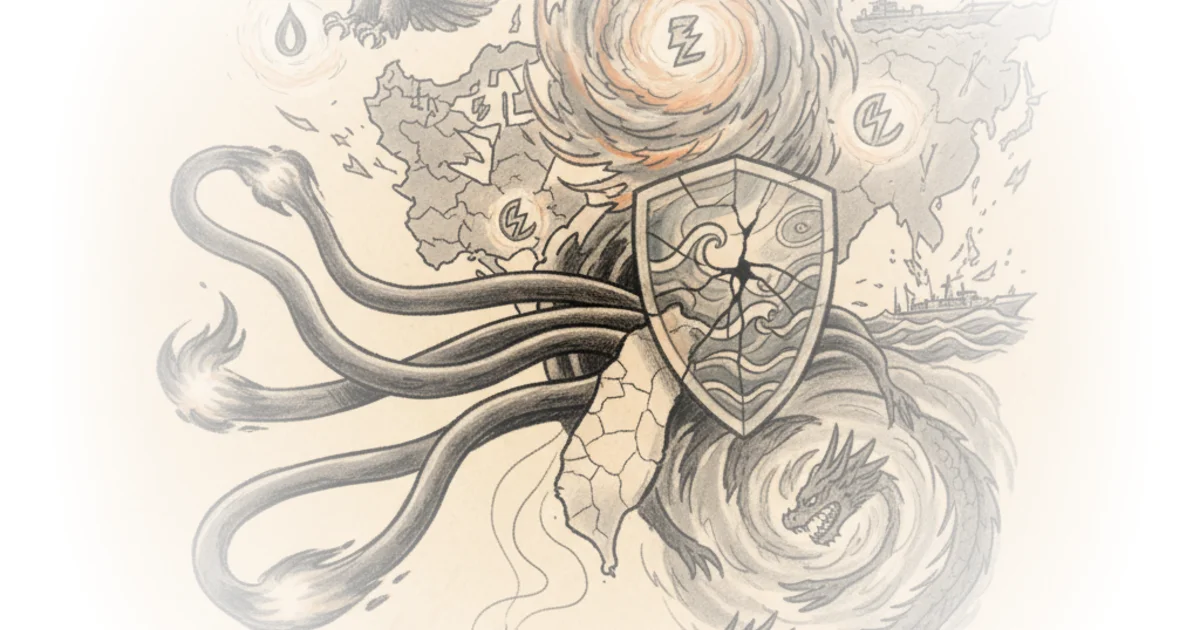
Joseph Webster presents a startling thesis: that Taiwan's greatest vulnerability in a potential conflict isn't just military, but its exposure to a global energy shockwave triggered by war in the Middle East. While most analysts focus on missile ranges or naval blockades, Webster forces a reckoning with the economics of survival, arguing that the island's ability to outbid competitors for fuel may be its only shield against a PRC-imposed quarantine. This is not a story about inevitable defeat, but about the precarious arithmetic of energy markets where a single geopolitical spark could ignite a crisis for the world's most critical semiconductor supply chain.
The Economic Shield
Webster's central claim rests on a counterintuitive assessment of Taiwan's fiscal health. He writes, "Taiwan is in a good position to import LNG by outbidding alternative buyers and switching to alternative fuel sources." This argument pivots on the island's explosive economic growth, which Webster cites as being driven by the semiconductor boom. He notes that while the IMF projected growth under 4 percent, actual figures suggest an "eye-popping 23.6 percent annualized rate" in late 2025. This economic velocity, he argues, provides the liquidity needed to secure energy even as prices spike.
The author further contends that Taiwan's low debt levels are a strategic asset rather than a sign of caution. "Its central government debt-to-GDP ratio stood at 23 percent in 2025," Webster observes, suggesting this is "alarmingly low" given the existential threats the island faces. He posits that the current legal cap on debt is "vastly unsuitable" for a nation under such pressure. This framing is compelling because it reframes fiscal conservatism as a strategic liability in a crisis. Critics might note, however, that rapidly expanding debt to buy fuel could trigger credit rating downgrades, potentially undermining the very purchasing power Webster relies on. Yet, the core logic holds: in a scramble for scarce resources, cash is king, and Taiwan has more of it than its neighbors.
"Taiwan's low financial leverage may leave it well-positioned to power through the crisis by tapping debt markets and expanding strategic investments, both in Taiwan and overseas."
The Infrastructure Bottleneck
Despite the financial strength, Webster is clear that money cannot instantly conjure physical infrastructure. He identifies a critical mismatch between Taiwan's purchasing power and its ability to receive and store fuel. "Taiwan suffers from important physical and infrastructure bottlenecks, such as limited LNG import terminal capacity, zero Floating Storage and Regasification Units (FSRUs), and — perhaps most concerningly — limited storage levels." The author points out that while LNG reserves are tight at 8-12 days, coal reserves sit at 49 days, forcing a difficult pivot to dirtier fuels. "If Taiwan cannot secure more LNG, it will burn coal instead," he states, acknowledging the environmental cost as a necessary trade-off for immediate survival.
This section underscores the fragility of the energy transition. Webster notes that the "2025 nuclear phaseout removed a dispatchable energy generation source that would have eased the current shock." The decision to restart coal-fired generators is presented not as a policy failure, but as a pragmatic emergency measure. However, this reliance on coal highlights a deeper vulnerability: the island's energy grid is not just a technical system but a geopolitical target. As Webster warns, "Taiwan will experience pain amid higher energy prices, its semiconductor production is unlikely to face direct energy shortages. That could change if the PRC leverages the Middle East energy crisis to launch a quarantine or blockade." The human cost of such a blockade would be immediate and severe, cutting off power to a densely populated island where energy is the lifeblood of daily life.
The Global Ripple Effect
The commentary extends beyond Taiwan to the broader implications for the global economy, particularly the artificial intelligence sector. Webster draws a direct line from Middle Eastern oil fields to the data centers of Silicon Valley. "Higher interest rates, in turn, will lift borrowing costs for capital expenditure-intensive industries, including the artificial intelligence companies purchasing Taiwan's semiconductor exports." He connects the disruption in the Strait of Hormuz to the potential rationing of helium, a critical byproduct of LNG production needed for chip manufacturing. "If the 45-day inventory clock runs out before Qatar restores output, TSMC faces the choice of rationing wafer starts," he writes, noting the direct implications for Nvidia and the global AI buildout.
This connection is vital. It moves the conversation from regional security to global technological stability. Webster argues that the "Iran war shows no signs of stopping" and that up to 20 percent of global oil production is at risk. The resulting inflation and interest rate hikes threaten to stall the very industries that drive Taiwan's economic resilience. The author suggests that while the U.S. has an interest in keeping Taiwan supplied, the market dynamics favor large state-owned enterprises like CNOOC or Sinopec, who can leverage sovereign credit to secure supplies. "Washington has an economic and strategic interest in ensuring Taiwan and other democracies are energy secure," Webster asserts, but the mechanism for this support remains unclear in a market driven by the highest bidder.
Bottom Line
Webster's analysis is strongest in its synthesis of fiscal data with energy logistics, revealing that Taiwan's survival depends on a delicate balance of economic firepower and infrastructure readiness. The argument's greatest vulnerability lies in its assumption that financial resources can always overcome physical bottlenecks in a total blockade scenario. Readers should watch closely for how Taipei navigates the tension between its low-debt legal framework and the urgent need for strategic borrowing to secure its energy future.