This piece from Natural Selections delivers a harrowing account of pandemic-era policy that transcends typical political debate to expose the visceral human cost of rigid lockdown enforcement. It is not merely a story about illness, but a searing indictment of how institutional inflexibility and the 'No Visitors' mandate severed the final connection between a dying young man and his grieving family. The narrative forces a reckoning with the emotional and logistical realities faced by multi-generational households when the state prioritizes containment protocols over human dignity.
The Architecture of Isolation
The article anchors its argument in the specific geography of the Northeast, noting that New Jersey was "hard hit by Covid-19" and governed by a "collective state policy" forged by Governor Phil Murphy alongside counterparts in New York and Connecticut. The piece argues that this regional alliance was less about scientific consensus and more about psychological coercion, stating that "the logic behind the 'collective state policy' seems to have been the bigger the stick, the more fear we would have in disobeying them." This framing draws a sharp parallel to historical authoritarian tactics, borrowing the wisdom of King Solomon that "a cord of three strands is not easily broken," only to note how that unity was "repurposed to keep the citizens of their triad in line."
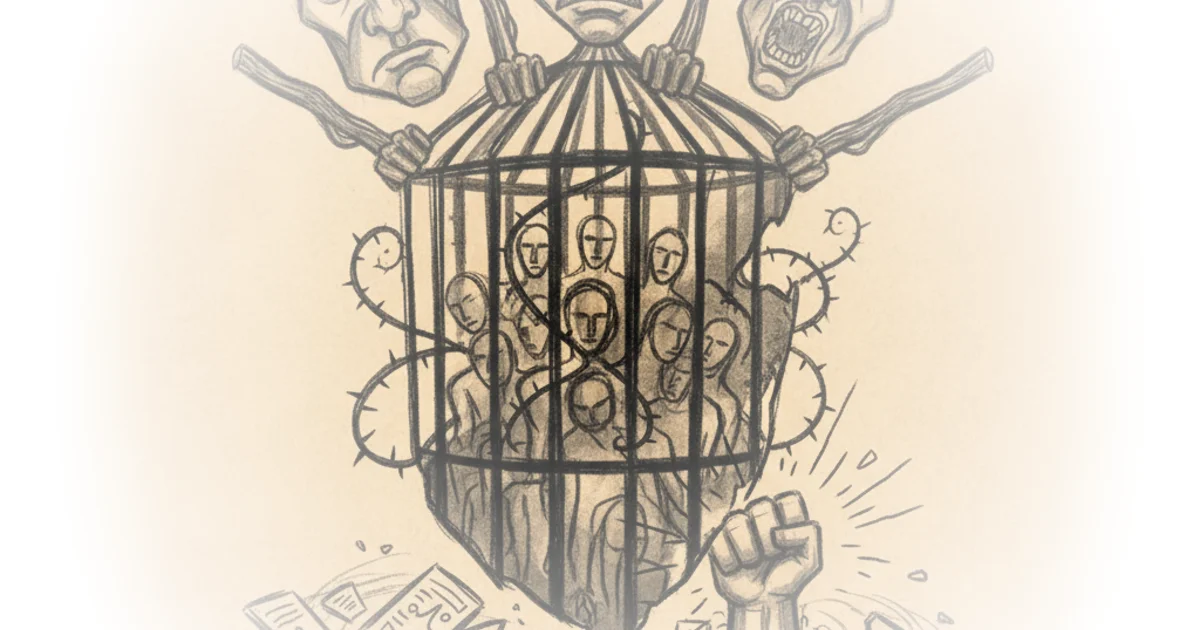
Critics might note that regional coordination was often necessary to prevent cross-border viral spread, yet the piece effectively highlights how the implementation of these rules ignored the nuances of individual family structures. The author describes a household where four grown children and a teenager lived under one roof, a reality that made standard distancing impossible. "We didn't expect that our grown children and teen grandchild would be living with us, or that we would live during a pandemic 'lock down', but life often goes in directions unforeseen," the text observes, underscoring the gap between policy assumptions and lived reality.
"For inpatient admissions, no visitors would be allowed."
This single sentence becomes the pivot point of the tragedy. The narrative details how the son, David, a high-achieving student and tutor, fell critically ill with an oxygen saturation level of 68 percent—a number the family had to verify twice because it seemed impossible. When he was admitted, the hospital enforced a strict ban on family presence. "That time, when David was an inpatient, felt like an emptiness. We were cut off from him and him from us, as if we were in separate caves, and couldn't be reached, or touched, or seen." The emotional weight of this separation is palpable; the family was forced to rely on a daughter who had already recovered to act as their proxy, a desperate workaround to a system that offered no flexibility.
The Failure of Protocol in the Face of Death
As David's condition deteriorated, the rigid adherence to rules clashed with the urgency of a life hanging in the balance. The piece recounts a harrowing phone call where the doctor explained that the son would not agree to intubation without his family's involvement. The administration's refusal to allow physical presence forced the family into a video call while their son lay on a bed surrounded by clinicians. "He was very short of breath, so didn't say much. But we encouraged him as best we could, told him we loved him, and he said 'I love you' too." This digital intimacy, while a technological miracle, could not substitute for the physical comfort of a mother's hand.
The narrative then shifts to the final, devastating moments. The doctor's call at 8 pm delivered the news that David had coded again and could not be resuscitated. The author describes the immediate aftermath with raw honesty: "I just remember ending the call and collapsing into a primal grief that felt like ruination. I felt ruined; a mother whose child has been plucked away." The piece does not shy away from the anger that followed, attributing the loss to a broader failure of leadership and a disregard for the sanctity of life. The author writes, "David lost that year, and then he lost his life," linking the loss of his potential career and social life directly to the conditions of the pandemic.
The conclusion of the piece is particularly striking in its attribution of blame. The author cites Richard Ebright of Rutgers University, who reportedly labeled certain public health officials as "psychopaths and sociopaths" and "monster makers." While this language is extreme and may alienate readers who view public health measures as necessary evils, it reflects the depth of the author's trauma. "My Covid story is this: my son died at age 25, after losing a year of not being able to work, to socialize, to attend classes, to be 'normal'." The argument here is that the cost of the pandemic was not just statistical but existential, stripping a generation of their future.
"People who live in fear of the virus are wrong and people who mock it are wrong."
The piece closes with a postscript quoting a stranger's wisdom: "People who live in fear of the virus are wrong and people who mock it are wrong." This sentiment serves as a bridge between the extremes of panic and denial, suggesting that the true tragedy lies in the inability of systems to adapt to the middle ground of human suffering. The author's hope for justice, even if not in their lifetime, remains a poignant reminder of the unresolved grief that lingers five years later.
Bottom Line
The strongest element of this commentary is its unflinching focus on the human cost of bureaucratic rigidity, transforming abstract policy debates into a tangible story of loss and separation. Its biggest vulnerability lies in its absolute attribution of the son's death to malicious intent rather than the complex, often chaotic nature of a novel pathogen, which may limit its persuasiveness to those seeking a more balanced view of public health decision-making. Readers should watch for how future public health crises are managed, specifically regarding the balance between infection control and the fundamental human need for connection during critical moments of illness.