Stephen West of Philosophize This! challenges the modern assumption that religion is merely a matter of private belief, arguing instead that this view is a historical accident that blinds us to the deeper, lived reality of human experience. By deploying the "duck-rabbit" optical illusion as a central metaphor, the piece suggests that our inability to see the spiritual dimension of life isn't a failure of logic, but a result of being conditioned to see only one side of a dualistic coin. This is a vital intervention for anyone feeling that the conversation around faith has become sterile, reducing centuries of complex practice to a simple checklist of assent.
The Illusion of Binary Vision
West begins by addressing the skepticism of the rational mind, acknowledging that for many, the idea of a "pre-theoretical" or embodied way of knowing feels like nonsense. He writes, "I don't even want to start with Nishitani or anyone from the Kyoto School for that matter. Today I want to start with something simple. I want to give some long-deserved attention to a very important cartoon character that's come to be known as the duck-rabbit." This framing is effective because it disarms the reader's intellectual defenses before introducing complex metaphysics.
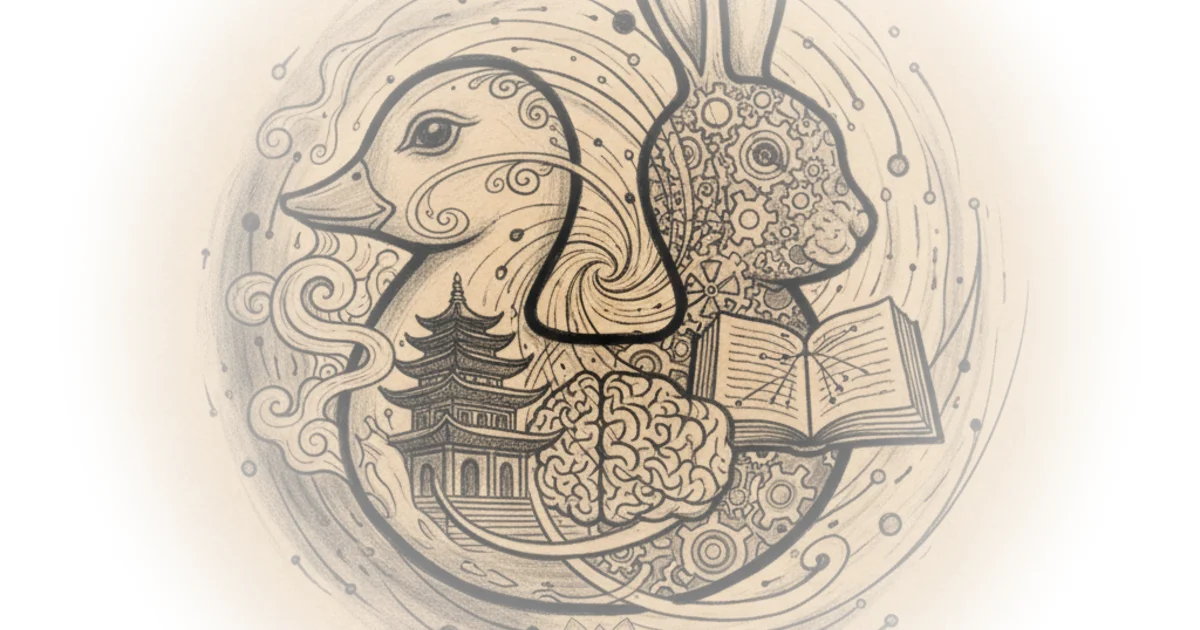
The core of the argument rests on the idea that our perception is malleable and often trapped by cultural incentives. Philosophize This! observes, "It could be that you're having a hard time seeing the rabbit, and it's not because you're a bad person, or a stupid person, or too smart of a person to see this delusional rabbit people are talking about. It's possible that it's hard for you to see the rabbit because you live in a world where you're surrounded by ducks." This is a powerful reframing of spiritual blindness; it shifts the blame from the individual's capacity to the environment's constraints. The piece argues that what we call "reality" is often just the version of the image we've been trained to recognize.
The duck co-constitutes the rabbit and vice versa. Maybe the biggest mystery of all here is what any of this has to do with the relationship between philosophy and religion.
The Historical Accident of Belief
The commentary then pivots to a historical critique of how the West defines religion. West points out that the modern focus on "belief" as the primary metric of faith is a relatively recent invention, largely stemming from the Protestant Reformation and the Enlightenment. He notes, "If you're born into the modern United States, something you might see around you a lot are people who say that if you want to be considered a religious person, all you have to do is believe in the divinity of Jesus Christ." This reductionism, he argues, strips religion of its moral and communal weight, turning it into a mental state rather than a way of life.
Philosophize This! contrasts this with the pre-modern understanding, where identity was not chosen but lived. "Your identity was not something that was determined by some belief you had; identity was something that exuded out of you as you lived a religious practice every day of your life." This distinction is crucial. It suggests that the current crisis of meaning in secular society isn't just about a lack of faith, but about the loss of a practice-based framework that once held communities together. Critics might note that this romanticizes pre-modern life, ignoring the coercion and lack of individual agency that often accompanied those eras, but the point about the shift from doing to believing remains a compelling historical observation.
The Kyoto School's Unified Vision
The piece culminates in the work of Keiji Nishitani and the Kyoto School, who recognized that the Western separation of philosophy and religion was an artificial divide. In early 20th-century Japan, the very concept of "religion" as a distinct category from philosophy didn't exist in the same way. West explains, "To Nishitani, whatever the Europeans have been calling separately philosophy and religion for so many years, he realizes that for the Japanese this has been more of a unified tradition." This insight challenges the reader to consider that the fragmentation of their own worldview might be a cultural artifact rather than an objective truth.
The argument is anchored by a quote from Hisamatsu Shin'ichi, which West presents as the thesis of the entire discussion: "Religion without philosophy is blind, and philosophy without religion is vacuous." This statement cuts through the noise of modern debates, suggesting that intellectual rigor without spiritual depth is empty, while spiritual practice without philosophical grounding is directionless. The piece argues that these two modes of being are not competitors but necessary partners in the full human experience.
Philosophy seeks to know the ultimate; religion seeks to live it. Yet for the whole human being, the two must be nondualistically of one body, and cannot be divided.
Bottom Line
The strongest element of this commentary is its refusal to treat "religion" as a static, modern category, instead revealing it as a fluid, historically contingent concept that has been narrowed to the point of uselessness. Its biggest vulnerability lies in the difficulty of translating this "unified tradition" back into a modern context where the separation of church and state, and the secularization of public life, is deeply entrenched. Readers should watch for how this framework might apply to non-religious spiritual practices, as the argument implies that the "rabbit" can be seen even without the traditional "duck" of institutional dogma.