Eric Topol uncovers a quiet but profound tension in David Hume's philosophy: the belief that all humans are fundamentally equal in capacity, yet the insistence that only a lucky few should ever cultivate the "nobler arts." This isn't just a historical footnote; it is a blueprint for how we still justify who gets to think deeply and who gets to toil, framing inequality not as a failure of nature, but as a necessary feature of a functioning society.
The Illusion of Equality
Topol begins by dismantling the modern assumption that Hume was a straightforward egalitarian. While Hume asserts that "the natural genius of mankind be the same in all ages, and in almost all countries," Topol points out that this universalism is immediately undercut by Hume's own admissions of hierarchy. The author argues that Hume creates a space where biological and social differences are accepted as inevitable, even if the raw potential for intelligence is shared. Topol writes, "To call Hume anti-egalitarian would simply be wrong, and yet that conspicuous word 'almost' in the latter quote gives the slightest hint that to call him an egalitarian would not be telling the whole truth either."
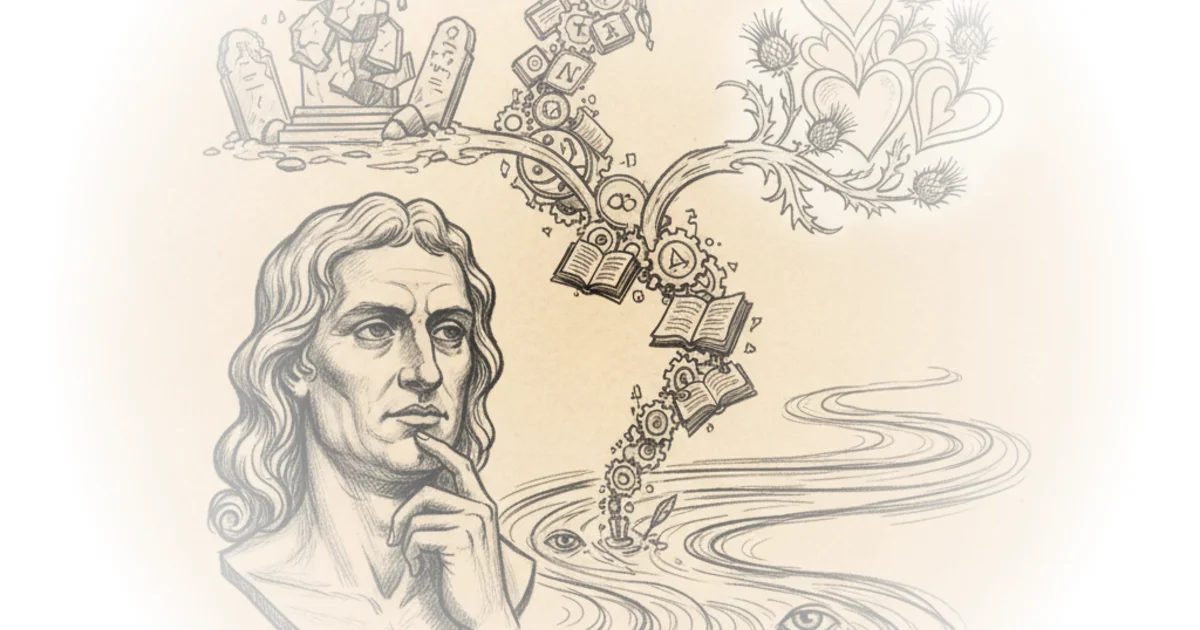
This distinction is crucial. Hume doesn't argue that some people are born smarter; he argues that the opportunity to develop that intelligence is structurally uneven. Topol notes that Hume explicitly links this inequality to gender and class, citing Hume's claim that "nature has given man the superiority above woman, by endowing him with greater strength both of mind and body." The commentary suggests that Hume's philosophy isn't about meritocracy in the modern sense, but about a natural order where the "bulk of every state"—husbandmen and manufacturers—exists to support a tiny minority of "artizans" and "improvers of liberal arts."
"The arts of luxury... are always relished by a few only, whose leisure, fortune, and genius fit them for such amusements."
Topol's analysis here is sharp: Hume admits that the ability to enjoy high culture is contingent on "fortune" and "leisure," yet he treats this exclusion as a virtue. The argument holds weight because it exposes how philosophical claims of universal potential often mask the reality of resource distribution. Critics might note that Hume's 18th-century context makes his exclusion of the working class seem less like a moral failing and more like a pragmatic observation of economic limits, but Topol rightly pushes back against accepting this as a neutral fact.
The Cultivation of Temperament
The piece takes a fascinating turn when Topol explores Hume's concept of "inclination." If everyone has the same potential, why do only a few become philosophers or artists? Hume's answer, according to Topol, is temperament. "Almost every one has a predominant inclination," Hume says, and some are simply wired to find joy in the life of the mind. But Topol highlights a contradiction: Hume also believes that this temperament can be cultivated through reading and exposure to beauty. "We are 'pretty much masters what books we shall read,'" Hume writes, suggesting that anyone could, in theory, develop a "delicacy of taste."
Yet, Topol argues, Hume never resolves the paradox of who gets to do the cultivating. The author points out that in an era of low literacy and rigid social stratification, the power to "master" one's reading was effectively reserved for the educated elite. Topol writes, "Though Hume's upbringing was somewhat modest, he was clearly not thinking of a blacksmith in the Hebrides when he imagined the man who might spend his time studying 'poetry, eloquence, music, or painting'." This is the core of Topol's critique: Hume offers a path to self-improvement that is theoretically open to all but practically closed to most.
The commentary suggests that this creates a self-fulfilling prophecy. If the "Aristocracy of Inclination" is defined by those who have the time and money to cultivate taste, then the system ensures that only the wealthy can ever join it. Topol notes that Hume seems to accept this, arguing that labor and industry are "unalloyed good" because they protect the state, while the liberal arts "draw off the mind from the hurry of business and interest." In Hume's view, the masses must work so the elite can think.
"It is best for everybody if we leave the business of the liberal arts to the Aristocracy of Inclination, or those who can build and construct their own inclinations."
This is where Topol's framing becomes most provocative. He suggests that Hume is an elitist not of description (saying some are born better) but of prescription (saying it's better if only some pursue the arts). The argument is compelling because it reframes the "Aristocracy of Inclination" not as a natural accident, but as a deliberate social arrangement. A counterargument worth considering is that Hume might have believed that the division of labor was simply the most efficient way to organize society, not a moral judgment on the worth of the laborer. However, Topol's reading of Hume's language—specifically the value judgments on "savage" states versus commercial ones—suggests a deeper hierarchy of human value.
The Cost of the Nobler Arts
Topol concludes by asking the uncomfortable question: what is the human cost of this arrangement? If the "greatness of a state" depends on commerce and manual labor, and the "happiness of its subjects" depends on the liberal arts, then the system is inherently unstable. Topol writes, "Are liberal arts, the study of beauty and the cultivation of taste, at odds with commerce, that binding, absolutely good force?" The answer, according to Hume, seems to be yes, and that's okay. The masses are kept in their place not just by economics, but by a philosophical belief that they lack the temperament for higher pursuits.
The commentary highlights the irony that Hume, who championed the "delicacy of taste," ultimately limits its reach to a privileged few. Topol notes that Hume's own life—his university education, his access to books—was the very thing that allowed him to become part of the "Aristocracy of Inclination." As Topol puts it, "It is only the temporally fortunate who form the slim elite capable of grappling with beauty and exercising agency over that which governs their internal lives — and that is for the best."
This final point is the most unsettling. Hume doesn't just describe an elite; he prescribes it as necessary for the stability of the state. Topol's analysis forces the reader to confront the idea that our modern belief in meritocracy might be just as much a fiction as Hume's 18th-century hierarchy. The "Aristocracy of Inclination" is not a relic; it is a pattern that repeats whenever we assume that the distribution of talent is the same as the distribution of opportunity.
Bottom Line
Topol's piece is a masterful excavation of the hidden assumptions in Hume's work, revealing how a philosophy of equality can coexist with a rigid social hierarchy. The strongest part of the argument is its exposure of the "Aristocracy of Inclination" as a prescriptive, not just descriptive, concept. The biggest vulnerability is the lack of engagement with how Hume's ideas might have been received by his contemporaries who were not part of the elite. Readers should watch for how this framework of "inclination" continues to shape our modern debates about education, class, and who gets to define what is "nobler."