The Five-Thousand-Year Pause
Brad DeLong has spent decades thinking about economic history. Now he is trying to teach it differently. His experimental course "Econ 196" uses data science tools—Python, Jupyter, simulation—to make the long run of human economics accessible to both humanists and quants. The centerpiece of his current module is a claim that stops most students mid-scroll: for five millennia, economic growth did not exist.
What Growth Was Not
DeLong makes a sharp distinction. Technology advanced. Art flourished. Empires expanded. But the typical human's material life stayed flat.
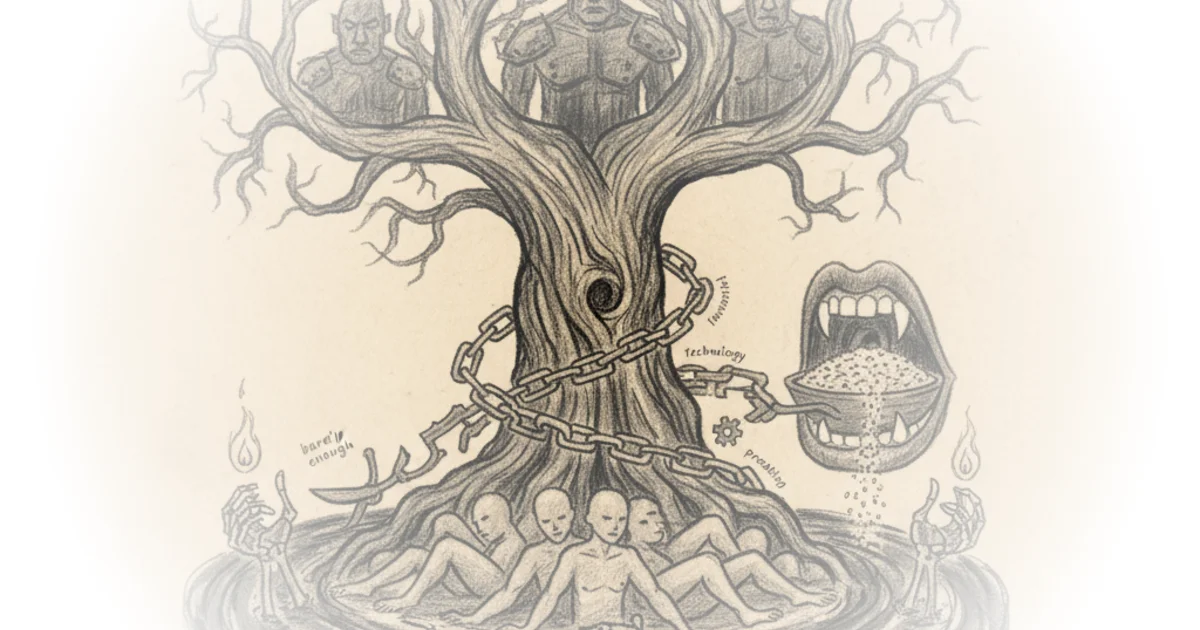
Brad DeLong writes, "For 5,000 years, from Gilgamesh to imperial-commercial age Britain, technology advanced, empires rose, and elites feasted—while the median human stayed stuck at 'barely enough', as population growth, patriarchy, and predation turned every gain in know‑how into more bodies alarmingly close to the edge of subsistence."
The Epic of Gilgamesh—one of humanity's oldest surviving texts—depicts a king who builds walls, fights monsters, and seeks immortality. It does not depict a world where ordinary people had more food, better shelter, or safer childbirth than their grandparents. DeLong's point is that Gilgamesh's Uruk and Narmer's Memphis looked the same at street level: peasant and craftsman living standards in 1500 were not much different from 3000 BCE.
Brad DeLong writes, "Up until at least 1500, there was essentially none—if 'economic growth' is taken to be a significant sustained improvement in the material living standards of a typical human."
Elites, by contrast, grew ever more luxurious. The divergence is the story.
The Malthusian Lock
Why no growth? DeLong's answer is Malthusian pressure. Technology improved at roughly 5% per century. Population grew at 10% per century. Every innovation created more people, not richer people.
Brad DeLong writes, "People really like to make love. People really, really like to make love."
The tone is playful, the mechanism is grim. In pre-modern patriarchal societies, reaching middle age without surviving sons was social death. When extra resources appeared, they were spent on more children, not better lives. Population expanded until it hit subsistence limits. Thomas Robert Malthus identified this dynamic in 1798. DeLong applies it across five thousand years.
Brad DeLong writes, "Patriarchy was to delay the age of female marriage, and so reduce female fertility without requiring women to be so skinny that ovulation was hit or miss. Monarchy was to reinforce patriarchy, as the king as father of the country figured the father as king of the household. Orthodoxy to threaten women who engaged in premarital sex with hell."
Social institutions locked the trap shut.
"In a world in which there cannot be enough for all, at the foundation politics and governance can be little more than an elite elbowing competitors out of the way, and running a force-and-fraud exploitation game on the rest of humanity."
Why Technology Stalled
DeLong does not stop at population mechanics. He asks why technological progress itself was so slow. The answer is partly demographic: not enough people, not enough educated people, not enough energy left after survival labor.
Brad DeLong writes, "Two heads are not twice as good as one, quite. But two heads are considerably better than one. And heads that are not exhausted by the combination of hard work and a scant diet have more energy to think, plan, experiment, and evaluate."
Communication across space and time matters. The modern "anthology intelligence"—humanity thinking together at scale—powers technological progress at 2% per year even after low-hanging fruit is gone. Pre-modern societies lacked the density, the literacy, the networks.
But DeLong adds a darker layer. In societies where resource deployment is mostly about grabbing from others, truth is not the promoted idea.
Brad DeLong writes, "In a society where the typical activity of those who deploy resources is to use them to grab enough for themselves from everybody else, the ideas that will be promoted will not be ideas that are true, but rather ideas that are useful for that grabbing process."
Inequality drags on technological possibility itself.
What Students Should Read
DeLong's proposed syllabus starts humanistic, then moves quantitative. His own 2024 piece "The Great Agrarian-Age Vine-&-Fig Tree Shortage" opens the door. Gregory Clark's 2007 book A Farewell to Alms provides the economic framework. DeLong's lecture notes walk through Malthusian simulation logic. Rafael Guthmann offers a dissenting view—DeLong claims victory in their debate. Shoumitro Chatterjee and Tom Vogl ask whether Malthusian dynamics still matter in today's developing world.
Nine required pieces. All short. All overlapping. DeLong admits the list is too long. Students' attention spans are not what he would wish.
Counterpoints
Critics might note that DeLong's "essentially none" claim flattens regional variation. The Song Dynasty, the Abbasid Caliphate, the Roman Empire—all had periods where typical living standards rose measurably. The Malthusian trap was not uniformly tight.
Critics might also challenge the patriarchy mechanism. Recent historical demography suggests fertility response to income was weaker than Malthusian models assume. Mortality, not fertility, drove population dynamics in many pre-modern settings.
Critics might finally ask whether the 2% per year modern rate is sustainable. DeLong treats post-1875 acceleration as a permanent escape. Climate constraints, resource depletion, and demographic decline could restore Malthusian pressure within the twenty-five year window his students are asked to consider.
Bottom Line
DeLong's core claim holds: pre-1500 economic growth, defined as sustained improvement in typical human material living standards, was effectively zero. The Malthusian mechanism—population absorbing technological gains—explains the stagnation. The darker insight is that inequality and predation slowed technology itself. The syllabus is overloaded but coherent. Students who work through it will understand why the Gilgamesh-era peasant and the 1500-era peasant lived the same life: barely enough.