Then & Now delivers a rare, lucid excavation of Karl Marx not as a distant architect of failed states, but as a relentless diagnostician of the modern condition. The piece's most striking claim is that Marx's true target was never communism, but the very mechanics of capitalism and the "alienation" that strips ordinary people of their humanity. In an era where political discourse often feels detached from material reality, this analysis forces a confrontation with the gritty physical forces that actually govern our lives.
From Idealism to Material Reality
The commentary begins by dismantling the common misconception that Marx was primarily a theorist of communism. Then & Now writes, "most would associate him with Communism of which he actually had very little to say what he sought to understand was capitalism Commerce markets industrialization and technological progress and the question importantly of what makes us truly human." This reframing is crucial; it shifts the focus from a specific political outcome to a systemic critique of how value and labor are organized. The author effectively positions Marx as a synthesizer who absorbed the intellectual currents of his time—particularly the work of G.W.F. Hegel—to challenge the status quo.
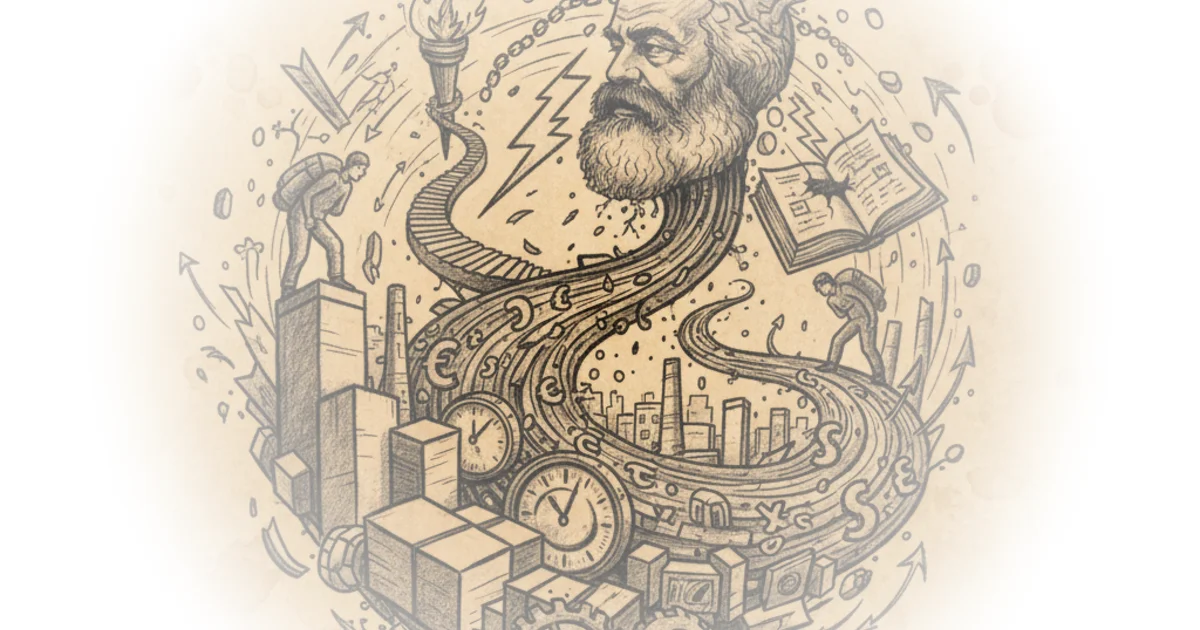
The piece traces Marx's intellectual evolution through the "Young Hegelians," a group who sought to remove religious and monarchical oppression but remained trapped in the belief that changing ideas could change the world. Then & Now notes that for these thinkers, "bad ideas were Spooks bad thoughts that haunt the mind." Marx, however, saw this as insufficient. He argued that simply swapping one set of ideas for another left the "real physical material lives of Ordinary People untouched." This is the pivot point of the entire argument: the move from the abstract to the concrete.
The criticism of Heaven is thus transformed into the criticism of Earth the criticism of religion into the criticism of law and the criticism of theology into the criticism of politics.
This transition is where the analysis shines. Then & Now explains that Marx believed political equality, such as the rights granted by the French and American Revolutions, was merely "partial emancipation." He argued that while individuals might be equal in the "heaven of their political world," they remained deeply unequal in their "Earthly existence of society." The author captures the enduring relevance of this distinction by noting, "all the inaccessibility of Politics the endless talking in parliaments and congresses... all pull away from the very real material issues in people's lives." A counterargument worth considering is that formal rights do provide a necessary, if incomplete, shield against tyranny; however, the piece correctly identifies that without material security, these rights often remain theoretical.
The Gravity of Material Conditions
Then & Now uses a powerful metaphor to illustrate Marx's rejection of idealism: the idea that drowning is not caused by the "idea of gravity" in one's head, but by the physical reality of water. As the author puts it, "gravity is very real it's material it's in the world it affects us rather than us affecting it." This analogy effectively demystifies Marx's insistence that human consciousness is shaped by material conditions, not the other way around. The commentary argues that Marx's famous dictum, "the point is to change [Music] it," was a direct rebuke to philosophers who believed they could alter the world solely through debate.
The piece then delves into the concept of alienation, describing it as a state where workers are "estranged" from the products of their labor, the labor process itself, and even their own species-nature. Then & Now writes, "money is quote men's estranged alienating and self disposing species nature money is the alienated ability of mankind." This is a profound observation: money becomes an external force that mediates human relationships, hiding the social reality behind a veil of commodities. The author suggests that in the modern factory line, this alienation manifests as a "zombie ified State," where workers perform tasks they do not control for reasons that feel disconnected from their own lives.
Critics might argue that this view of labor is overly deterministic, ignoring the agency workers can exercise even within rigid systems. Yet, the piece maintains that the structural division of labor ensures that "workers don't even work on or understand the entire product line," creating a fundamental disconnect between the worker and the final product. This fragmentation is presented not just as an economic inefficiency, but as a spiritual and psychological wound.
The philosoph ERS have only interpreted the world in various ways the point is to change it.
The Bottom Line
Then & Now succeeds in stripping away the ideological baggage surrounding Marx to reveal a thinker obsessed with human dignity and material reality. The strongest part of this argument is its relentless focus on how abstract concepts like "freedom" and "rights" fail when they ignore the physical constraints of poverty and labor. The piece's biggest vulnerability lies in its brief treatment of potential solutions, leaving the reader with a powerful diagnosis but fewer clear prescriptions for the "social Revolution" Marx envisioned. For the busy listener, the takeaway is clear: understanding the material forces that shape our lives is the first step toward reclaiming them.