While the Nobel Committee often rewards abstract mathematical elegance, this piece from Nominal News makes a strikingly concrete claim: the theoretical framework for today's generative AI boom was written thirty years ago. By linking the 2025 prize to the current explosion in artificial intelligence spending, the editors argue that we are not witnessing a unique anomaly, but rather a textbook case of "creative destruction" playing out in real-time.
The Engine of Obsolescence
The article anchors its analysis in the work of Philippe Aghion and Peter Howitt, whose 1992 model explains growth not as a smooth accumulation of knowledge, but as a violent replacement of the old by the new. Nominal News reports, "Many new technologies often fully replace former technologies – like email replacing the fax machine, or online streaming replacing DVDs. This type of technological development leads to economic gains – higher efficiency – but the process itself results in certain losers." This framing is crucial because it forces the reader to acknowledge that efficiency gains are not free; they come with the destruction of existing capital and jobs.
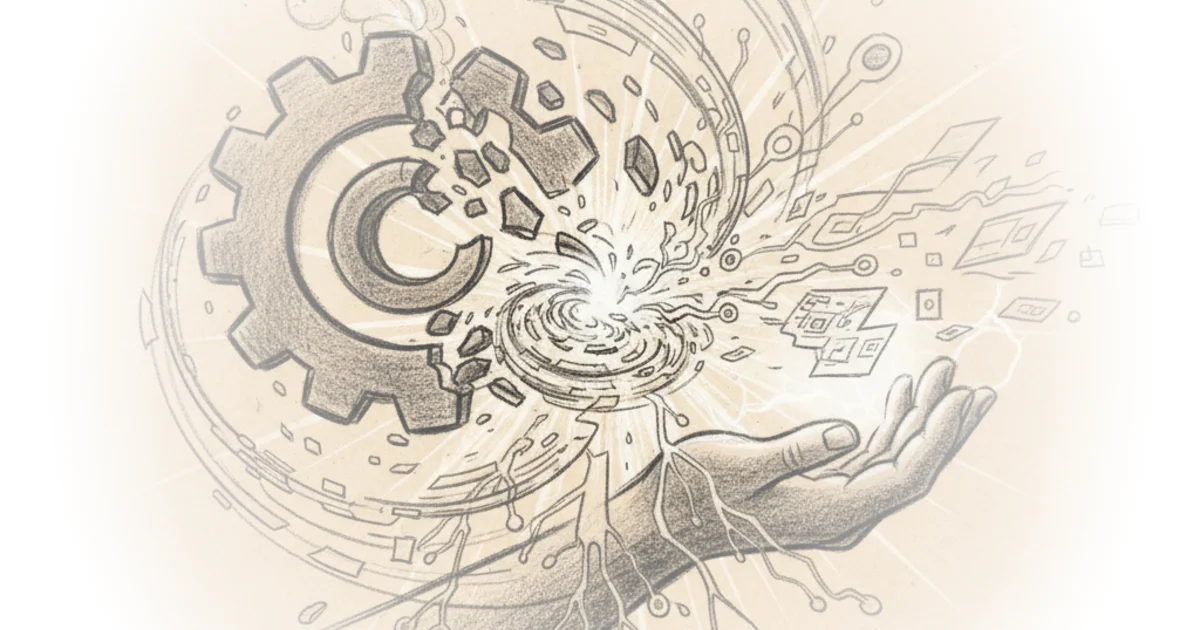
The piece leans heavily on the concept originally popularized by Joseph Schumpeter, noting that "The fundamental impulse that sets and keeps the capitalist engine in motion comes from the new consumers' goods, the new methods of production or transportation, the new markets... [This process] incessantly revolutionizes the economic structure from within, incessantly destroying the old one, incessantly creating a new one." This historical context, echoing Schumpeter's 1942 insights, adds necessary weight to the current frenzy. It suggests that the anxiety surrounding AI is not a sign of market failure, but a feature of the system's design.
"The process of Creative Destruction is the essential fact about capitalism."
The Race for Monopoly
The editors then dissect the mechanics of this race, describing a world where firms invest in research not for altruism, but for the temporary privilege of being a monopoly. The article explains that "research firms" compete to build a better machine than the current "IP firm," hoping to usurp its monopoly status and earn the resulting profits. Nominal News argues that "what motivates 'research' firms to develop a new technology is the hope that they will get to be a monopoly IP firm one day and earn monopoly profits."
This creates a fascinating paradox that the piece highlights with precision. As firms pour more resources into research to increase their odds of discovery, they inadvertently reduce the value of that discovery. The editors note, "The more a 'research' firm invests in trying to find a new technology, the less it will earn as an IP firm." Why? Because aggressive research drives up the wages of the skilled workers needed for production, and it shortens the window of time any single firm can enjoy monopoly profits before being dethroned again. This dynamic is particularly relevant to the current AI landscape, where the barrier to entry is high, but the pace of iteration is blindingly fast.
Critics might note that this model assumes a level of symmetry among firms that rarely exists in reality, where tech giants often have massive advantages in data and compute that smaller "research firms" cannot match. However, the core logic regarding the tension between innovation speed and profitability remains a powerful lens for understanding market behavior.
The Social Planner's Dilemma
Perhaps the most provocative section of the commentary addresses whether the market's level of innovation is actually optimal. The piece introduces the concept of a "social planner"—a hypothetical entity that could dictate resource allocation to maximize societal welfare. Surprisingly, the editors suggest that a social planner might actually reduce research compared to a free market. "The social planner realizes that a new innovation makes the old technology obsolete, destroying the value of the old technology," the article states. "To protect the old technology, the social planner may reduce the amount of research compared to a 'market' world."
This counterintuitive point challenges the standard narrative that "more innovation is always better." It suggests that the relentless churn of creative destruction might sometimes waste resources if the new technology offers only marginal gains while rendering previous investments worthless. Nominal News adds that "replacing old technology very often may be welfare decreasing, since we may end up using a lot of resources just on research, which, on its own, does not generate value." This is a vital nuance for policymakers and investors alike, reminding us that the race to innovate can sometimes be a race to the bottom if not properly calibrated.
The AI Application
The editors conclude by applying this 1992 framework to the generative AI revolution, arguing that the model explains the "meteoric rise in genAI expenditures." They posit that the release of ChatGPT in late 2022 acted as a catalyst that increased the probability of discovery, which in turn triggered a massive surge in investment. "Some have posited that the probability of new discoveries within a field of research can go up after a particular breakthrough," the piece observes, linking the theoretical model directly to the current market behavior.
However, the article also warns of a potential cliff. If discoveries become too easy to find, the incentive to research evaporates. "In the extreme, if new discoveries are too easy find, no research will be conducted!" the editors warn. "This is because you will never benefit from your discovery, since your technology will immediately be replaced by a better one." This suggests that the current gold rush in AI might be self-limiting; once the low-hanging fruit is picked and the monopoly window shrinks to near zero, investment could plummet.
Bottom Line
Nominal News successfully reframes the AI boom not as a speculative bubble, but as a predictable outcome of endogenous growth theory, grounding today's headlines in the rigorous work of Aghion and Howitt. While the model's assumption of perfect symmetry among firms may oversimplify the dominance of current tech giants, its core insight—that the speed of innovation can paradoxically erode the profits that drive it—offers a sobering check on the current optimism. The strongest takeaway is the warning that if the pace of replacement accelerates too much, the very engine of growth could stall, leaving the economy with high costs but diminishing returns.