Margaret Killjoy delivers a jarring but necessary correction to modern activist culture: the pursuit of moral purity is not a strength, but a strategic weakness that fractures movements before they can begin. While many contemporary analyses focus on ideological alignment or policy minutiae, Killjoy turns the lens inward, arguing that the most effective revolutionary force is not an army of saints, but an army of flawed humans who refuse to abandon one another.
The Myth of the Perfect Revolutionary
Killjoy anchors her argument in the gritty, unvarnished history of the Haymarket Martyrs, specifically the complex life of Albert Parsons. She writes, "Albert Parsons, through both his work and his martyrdom, is one of the most important figures in not just anarchist history but labor history. He also, as people conveniently forget, spent years of his life as a Confederate soldier." This admission is not used to discredit him, but to dismantle the expectation that historical heroes must be spotless. The author reframes Parsons' past not as a stain, but as evidence of a profound redemption arc, noting that "he was literally a child when he went to war, and perhaps the single defining characteristic that separates childhood from adulthood is that we don't hold children morally culpable for their actions."
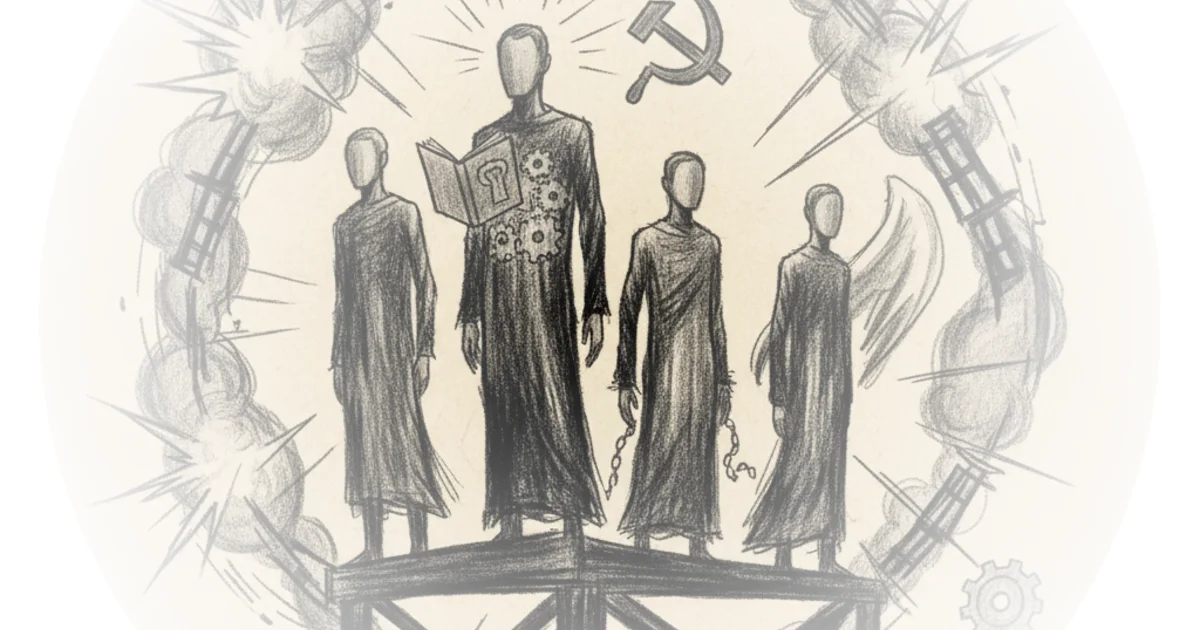
The piece suggests that the modern Left has lost the ability to hold this complexity. Killjoy observes that "the Left has spent decades now analyzing every aspect of how power functions... but it's left us better equipped at pointing out flaws than pointing out virtues." This is a sharp critique of a culture that often prioritizes ideological vetting over collective action. By highlighting how the state executed men who "hated each other over petty bullshit," she illustrates that solidarity does not require personal affection or moral perfection. As she puts it, "We don't have to like each other to stand in solidarity, because the state has no problem standing us side by side on the gallows."
We can try to build a better society with a dwindling cadre of angels, of perfect anarchists who have harmed no one who did not deserve it, or we can have an army of fuckups.
Critics might argue that this "army of fuckups" rhetoric risks normalizing harmful behavior or lowering the bar for accountability within movements. However, Killjoy anticipates this, clarifying that understanding human flaw does not mean accepting harm. She writes, "This doesn't mean that we need to accept when people hurt each other, or that we shouldn't look to interrupt harm. It just means that we need to understand that each of us are fuckups." The distinction is crucial: the goal is to build a system capable of handling human error without resorting to the punitive logic of the state.
The Architecture of Forgiveness
Killjoy draws a surprising parallel between her Catholic upbringing and anarchist theory to explain why forgiveness is a political necessity. She notes, "I'm frustrated, more frustrated than words can convey, that I am left explaining my point of view by saying 'I'm Catholic' instead of 'I'm an anarchist.'" Her argument is that anarchism should inherently contain the wisdom that "every single person is deeply and permanently flawed simply because every single person is a human." This framing challenges the reader to see the rejection of institutional punishment not just as a policy preference, but as a recognition of shared human fallibility.
She illustrates this with a personal anecdote about supporting prisoners, stating, "We didn't ask what they were in for. We just sent people books, because prisons should not exist." This radical inclusivity is presented as the only viable path forward. The author argues that if we wait for a cadre of perfect people, "your cadre of angels will grow ever smaller, as one by one each of you is cast out for failing to meet some standard or another." The alternative is a movement that builds each other up rather than tearing each other down.
From Rigidity to Resilience
The piece concludes by returning to the execution of George Engel, whose final words serve as a testament to living with imperfection. Killjoy quotes Engel's reflection: "I have not done everything right during my life, but I have endeavored to live so that I need not fear to die." This sentiment encapsulates the article's core thesis: a life of trying, failing, and trying again is superior to a life of rigid, brittle perfectionism. She uses a powerful metaphor to describe this dynamic: "The brittle sword has no use in battle. We temper blades so that they flex instead of break, because that which is rigid will shatter."
The author suggests that the future of liberation depends on this flexibility. "We also don't fight with noodles—a blade needs to flex, not give way completely," she writes, urging movements to find the "glimmer of beauty" in imperfect people and media alike. The ultimate message is one of hope rooted in reality: "An army of fuckups cannot lose." This is not a dismissal of justice, but a redefinition of it—one that allows for growth, redemption, and the messy, unglamorous work of building a new world.
Bottom Line
Killjoy's most compelling contribution is the reframing of human flaw from a liability into a strategic asset for social movements, arguing that the demand for moral purity is a tool of division used by the status quo. The piece's greatest vulnerability lies in the practical difficulty of applying this "army of fuckups" philosophy to cases of severe, repeated harm, though the author attempts to bridge this by distinguishing between accountability and exclusion. Readers should watch for how this argument influences current debates on community accountability and the future of leftist organizing in an era of intense polarization.