In an era where self-help gurus treat attention like a muscle to be flexed, Wayfare offers a startlingly different diagnosis: our inability to focus is not a failure of discipline, but a crisis of embodiment. This piece argues that the modern obsession with "deep work" ignores the messy, physical reality of being human, suggesting that true attention arrives not through force of will, but through a surrender to the body's needs.
The Myth of the Disciplined Mind
Wayfare begins by dismantling the prevailing narrative found in bestsellers by Johann Hari, Jennie Odell, and Cal Newport. These authors, the piece notes, treat attention as a "muscle that we build up through sustained, consistent exertion." The editors argue this framing is fundamentally flawed because it reduces a complex human experience to a matter of productivity. "But fractured attention is not only an intellectual problem with economic consequences; it is also a bodily problem with spiritual consequences," the article asserts. This shift in perspective is crucial. It moves the conversation away from the guilt of scrolling too much and toward the reality that our bodies are constantly demanding to be heard.
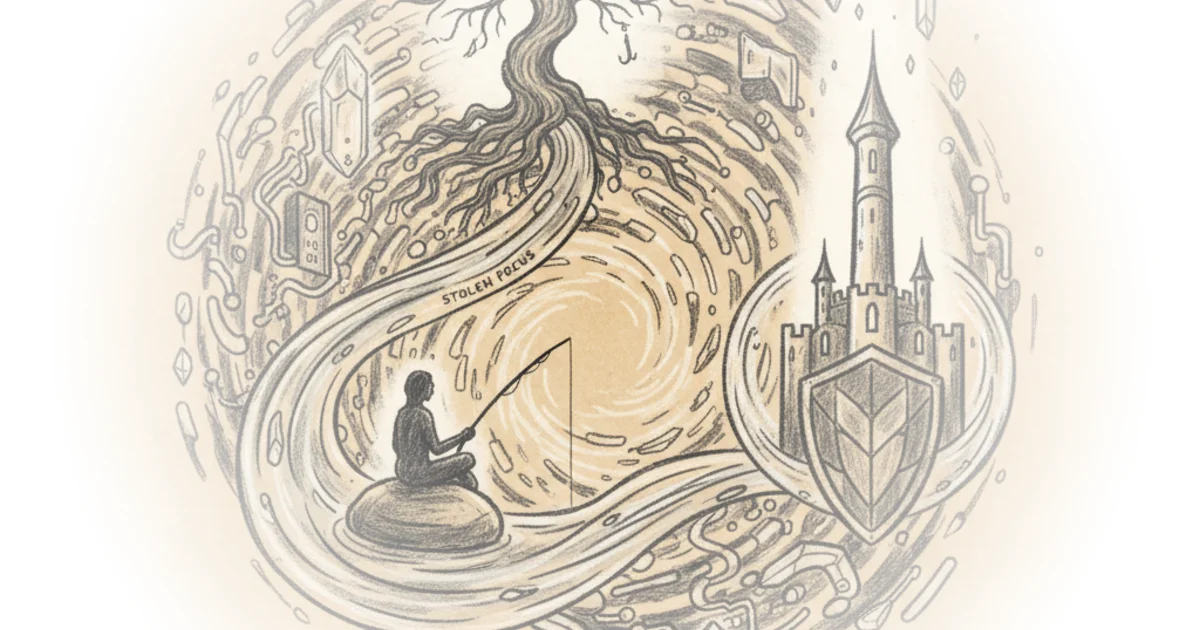
The piece leans heavily on the poetry of Lance Larsen to illustrate this point. In his poem "In a Room with Seventeen Rembrandts," the narrator visits the Louvre hoping to experience "Renaissance luminosity." Instead, he is pinned to the moment by a bored child sketching herself on a whiteboard. The child's distraction becomes the narrator's distraction. Wayfare highlights the irony that the poet, seeking to focus on the masterpieces, is instead captivated by the "erasable face" and the "little girl feet, squirming, as if she had to pee."
"Yet what pins me to this moment is an erasable face. And little girl feet, squirming, as if she had to pee, as if we all did, as if our sentence, even in the most storied of European cities, remains unchanged: keep the body happy."
This observation is the piece's most potent insight. It suggests that no amount of mental discipline can override the biological imperative to eat, sleep, or use the restroom. The editors note that we "build salons to store the destruction of time, then pretend to float above it all," ignoring that "some days beauty wears me out." This is a necessary corrective to the "attention economy" which demands we treat our minds as separate from our physical selves.
The Paradox of Will and Grace
The commentary then pivots to a deeper philosophical question: Is attention an act of will, or a gift? Wayfare explores the "first paradox" of attention: "the more we try to pay attention, the more we get in the way of paying attention to anything but our own attention." The piece draws on literature scholar David Marno's work on prayer, noting that "vocal prayer's challenge is that the very words it contains threaten to scatter the attention that may have existed in the original intention to pray."
This historical context adds weight to the argument. Just as medieval theologians debated the efficacy of vocal versus mental prayer, modern readers struggle with the mechanics of focus. The editors suggest that the modern conception of the self, rooted in the mind-body dualism of Descartes and Locke, has led us to view attention failures as "failures to properly exercise the capacity of instrumental reason."
"Attention, which seems like an act of will, often comes to us by grace, a divine gift of opening our eyes to something in the world we did not perceive clearly before."
This reframing is radical. It implies that the solution to distraction isn't a better app or a stricter schedule, but an openness to the unexpected. The poem's narrator, unable to focus on the Rembrandts, finds a "serendipitous, ecstatic encounter" with the bored child. The child's boredom, initially a barrier to art, becomes the very thing that grounds the poet in reality. Wayfare argues that this "mischievous, joyful" encounter is more valuable than the "dime-a-dozen" masterpieces on the wall.
Critics might argue that this romanticization of distraction undermines the very real need for deep focus in a complex world. If we surrender agency to the "grace" of the moment, do we risk becoming passive observers in our own lives? The piece acknowledges this tension but suggests that the "impossibility of action becomes a norm of action" when we seek genuine connection rather than control.
"Look at her," the poem begins, but it could just as easily have begun, "Ignore her. Focus on the paintings." The paintings are what the poet is there for, after all. Why should he turn his attention to anything else?
The editors answer this by pointing to the "embodied empathy" found in certain theological traditions, where the body is seen as essential to perceiving truth. "Art depends on the notion that the body is deeply involved in processing, perceiving, and apprehending any object that its senses can perceive," the piece notes. This aligns with the historical reality of the Louvre, where millions of visitors, much like the Rembrandts themselves, are subject to the same physical constraints of fatigue and hunger.
The Bottom Line
Wayfare's argument is a compelling antidote to the productivity porn that dominates our cultural conversation. Its strongest move is reframing attention not as a scarce resource to be hoarded, but as a relational act that requires us to acknowledge our shared physical vulnerability. The piece's biggest vulnerability lies in its reliance on poetic abstraction; while the metaphor of the bored child is powerful, it offers little practical guidance for those trying to navigate a world designed to fragment their focus. Nevertheless, the core insight remains vital: we cannot think deeply if we refuse to feel our feet squirming.