L. M. Sacasas offers a diagnosis for our current cultural stagnation that most observers miss entirely: we are not secularizing away from Christianity, but rather undergoing a painful secularization of a different faith entirely—the religion of technology. This is not a metaphorical observation about people loving their gadgets; it is a historical argument that the technological enterprise has absorbed the theological ambitions of the West, promising salvation not in the afterlife, but in the next software update.
The Hidden Faith
The standard narrative suggests that modernity simply subtracted religion from public life. Sacasas rejects this "subtraction story," arguing instead that the underlying engine of our culture has shifted. "The most consequential form of secularism has been almost altogether ignored because the underlying religion has not been recognized as such," Sacasas writes. This reframing is crucial because it explains why techno-optimists often speak with the fervor of zealots rather than engineers. They are not merely solving problems; they are fulfilling a religious mandate.
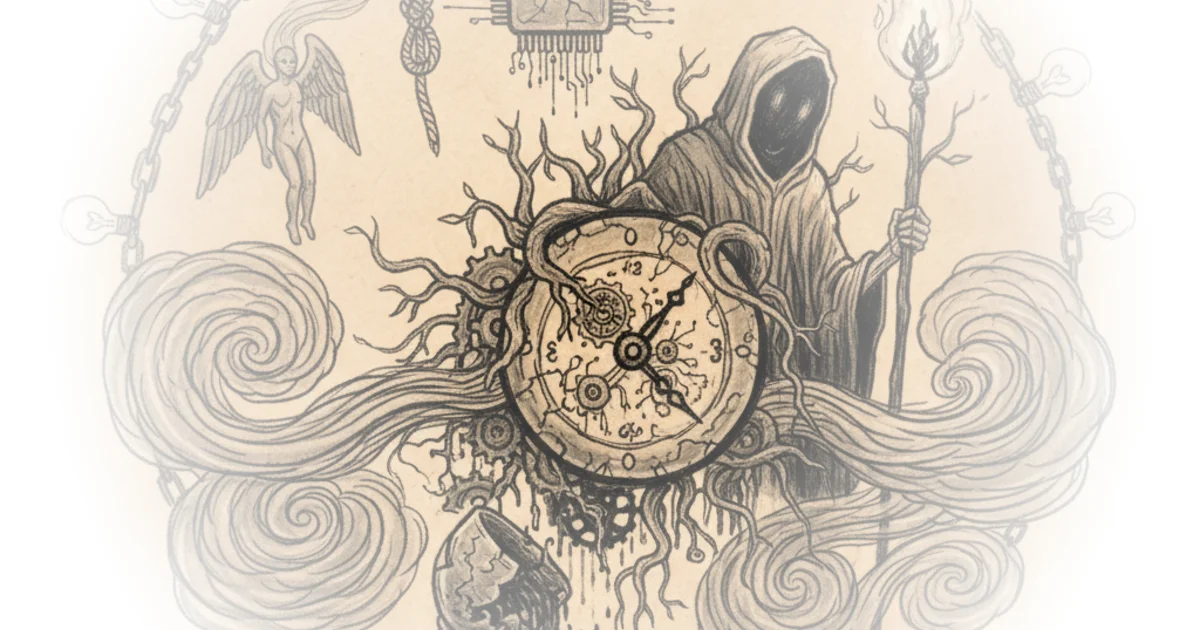
Sacasas draws heavily on historian David Noble to ground this claim, noting that Noble was explicit about the literal, not metaphorical, nature of this entanglement. "This is not meant in a merely metaphorical sense... Rather, it is meant literally and historically, to indicate that modern technology and religion have evolved together and that, as a result, the technological enterprise has been and remains suffused with religious belief." The author effectively uses this to dismantle the idea that science and faith are separate spheres; historically, they were fused from the start, with technological progress serving as the vehicle for divine will.
"Those given to such imaginings are in the vanguard of technological development... offering salvation by technical fix... all the while making the world over to conform to their vision of perfection."
This observation holds significant weight when examining modern movements like effective accelerationism. The drive to transcend human limitations, to escape the "fallen condition" of the flesh, is a direct lineage from medieval theology to Silicon Valley. However, critics might argue that Sacasas risks over-extending the religious analogy, potentially conflating genuine scientific curiosity with theological dogma. While the fervor is undeniable, not every engineer is a priest, and not every breakthrough is a miracle.
The American Civil Religion
The argument deepens when Sacasas introduces the work of historian David Nye, who documented how Americans experienced massive infrastructure projects as encounters with the sublime. The railroad, the dam, and the rocket were not just tools; they were liturgical objects. Sacasas notes that by the mid-19th century, "the religion of technology was, in fact, America's true civil religion." This shift turned technological marvels into civic rituals, where the "march of mind" was celebrated with the same solemnity as a church service.
The author points to the 1851 sermon on the opening of the Cleveland and Columbus Railroad, which declared that the new thoroughfare indicated "the evolution of divine purposes, infinite, eternal—connecting social revolutions with the progress of Christianity." Sacasas uses this to illustrate how the sacred was immanentized into the material world. The divine was no longer distant; it was being built, brick by brick, wire by wire.
This framing is particularly effective because it explains the emotional intensity surrounding technological disruption today. When a new device launches, the collective awe is not just consumer excitement; it is a relic of a civil religion that has not disappeared, only evolved. The "technological sublime" remains a potent force, driving policy and culture even as traditional religious attendance declines.
The Great Flip
The most provocative part of Sacasas's thesis is the claim that the relationship between religion and technology has inverted. Initially, religious belief fueled the technological project. But by the late 19th century, the dynamic flipped. "The technological project itself takes on the function of a religious ideal driving culture on its own terms," Sacasas argues. History is no longer moving toward the Kingdom of God, but toward an earthly utopia powered by Progress.
In this new order, "the grace of God... is transmuted into the power of technology. It is the technological enterprise that powers Progress toward Utopia, just as it had been the operations of grace that in God's providence directed us toward the kingdom of God." This is a profound re-reading of the last two centuries of Western history. It suggests that our current faith in the inevitability of progress is not a rational conclusion, but a theological inheritance where the "technical fix" has replaced divine intervention.
"History retains its essentially linear, purpose-driven character, but instead of being ordered toward the realization of the heavenly kingdom of God, it is ordered toward an earthly utopia."
The author supports this with the example of Leo Marx, who observed that technology ceased to be a means to an end and became the end itself. The pantheon of heroes shifted from statesmen and philosophers to inventors like Cyrus McCormick and Samuel Colt. This shift reveals the core vulnerability of the modern worldview: we have replaced a transcendent goal with an immanent one, demanding that technology solve problems it was never designed to address, such as the meaning of suffering or the reality of death.
Bottom Line
Sacasa's strongest contribution is identifying the "religion of technology" not as a metaphor, but as the actual operating system of modern Western culture, explaining why our faith in progress feels so absolute and why its failures feel so heretical. The argument's greatest risk is that it may be too totalizing, potentially dismissing the genuine, non-religious utility of scientific inquiry. However, for a reader trying to make sense of the current cultural moment, this framework provides a necessary lens: we are not just building better tools; we are performing a secular liturgy, and the stakes are far higher than mere convenience.