Brad DeLong tackles the most unsettling paradox of our era: we have solved the economic problem of scarcity, yet we are failing to solve the problem of meaning. While many economists celebrate rising productivity, DeLong argues that without a cultural shift toward "human-scale connection," we risk a future of mass abundance paired with mass misery. This is not a standard economic forecast; it is a philosophical intervention that suggests our current institutions are structurally incapable of making us happy, even as they make us rich.
The Identity Trap
DeLong begins by dismantling a common assumption about work and leisure, drawing on insights from Matt Yglesias regarding the psychological state of the unemployed versus the retired. The core observation is startling: well-being often jumps when a person shifts from "unemployed" to "retired," despite the fact that both groups may have similar amounts of free time and income. DeLong writes, "The social identity of an unemployed person is much worse than the social identity of a retired person, and so shifting from 'unemployed' to 'retired' is a big win." This distinction reveals that the crisis is not about the lack of labor, but the lack of a valued social role.
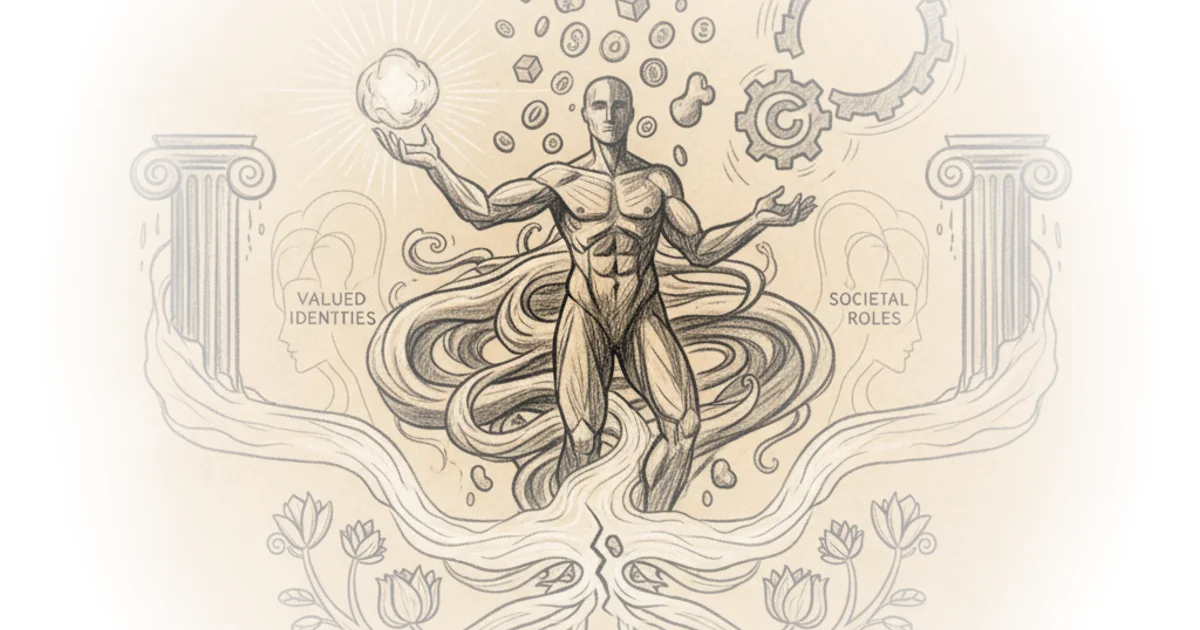
The author suggests that modern society has become obsessed with the act of working rather than the purpose of living. Even those with inherited wealth often feel compelled to manufacture a busy schedule, whether through philanthropy or other endeavors, because the alternative—simply existing without a defined role—is culturally unacceptable. DeLong notes that "even people who inherit large sums of money and don't need to work tend to want to be seen as working hard at philanthropy or whatever else instead of just chilling." This behavior underscores a deep psychological dependency on external validation through productivity.
Critics might argue that this focus on "social identity" is too abstract to solve the concrete economic anxieties of the working class. However, DeLong's point is that material security alone is insufficient; without a framework for dignity, prosperity can feel hollow. The danger, as he puts it, is that we may wind up in what Brink Lindsey calls a "middle flourishing trap" of mass abundance without mass happiness.
We cannot successfully outsource the solutions to the problem of how to live wisely and agreeably well to markets, bureaucracies, & parasocial algorithm-driven media feeds.
The Keynesian Correction
DeLong then pivots to correct a common misreading of John Maynard Keynes. Many assume Keynes believed that once scarcity was conquered, humanity would simply indulge in endless leisure. DeLong argues this is a fundamental error. Keynes actually predicted that the transition would be psychologically devastating for those unprepared for it. DeLong writes, "Keynes does have remarks—pointed remarks—about the behavior of British upper class twit heirs and heiresses... For they have most of them failed disastrously, so it seems to me—those who have an independent income but no associations or duties or ties—to solve the problem which has been set them."
This historical reference to the idle aristocracy serves as a warning for the future. Keynes saw that the "permanent problem of the human race" is not how to produce enough, but how to use our freedom wisely. DeLong emphasizes that "Man will [then] be faced with his real, his permanent problem—how to use his freedom from pressing economic cares, how to occupy the leisure, which science and compound interest will have won for him, to live wisely and agreeably and well." The implication is that our current institutions, designed for scarcity, are ill-equipped to handle abundance.
The argument gains depth when viewed through the lens of Alexis de Tocqueville, whose warnings about the "tyranny of the majority" and the erosion of intermediate associations resonate powerfully today. Just as Tocqueville feared the atomization of individuals in a mass democracy, DeLong suggests we are now facing an "aristocracy of manufactures" where large systems dictate our lives. The parallel is striking: in both cases, the loss of local, human-scale community leaves individuals vulnerable to alienation.
The Mass Society Dilemma
The piece culminates in a critique of the very systems that created our prosperity. DeLong, channeling Brink Lindsey, argues that markets, bureaucracies, and algorithms are "extraordinarily productive but structurally inhuman." These systems dissolve the "intermediate associations"—clubs, unions, local churches, and community groups—that once provided people with a sense of belonging and purpose. DeLong writes, "All human associative groups and markers of cohesion and particularity have been steamed away." We are left as "producer-cogs" and "consumer-cogs," efficient but isolated.
This diagnosis is particularly sharp because it refuses to blame a single political actor or ideology. Instead, it points to the structural dynamics of modernity itself. The executive branch and the market may deliver goods and services, but they cannot deliver the "positive freedom" required to form meaningful groups. DeLong notes that "the only thing holding the social order together is top-down control," which creates a fragile society where people feel powerless to affect anything worthwhile.
A counterargument worth considering is whether the decline of traditional associations is inevitable or merely a temporary phase of transition. Some might argue that new forms of community are emerging online or in the gig economy. However, DeLong and Lindsey seem skeptical, suggesting that algorithmic feeds and parasocial relationships are poor substitutes for the deep, reciprocal bonds of human-scale association.
We have market economies with their price signals and their equilibria. We have states—democratic states, for now at least—setting-up rules of interaction and issuing commands via what really is a tremendously efficient bureaucratic order.
Bottom Line
Brad DeLong's commentary succeeds in reframing the future not as a battle over resources, but as a crisis of identity and purpose. The strongest part of the argument is the rigorous application of Keynesian and Tocquevillian insights to the modern condition, exposing the hollowness of a society that solves the economic problem but ignores the human one. Its biggest vulnerability lies in the lack of a concrete roadmap for rebuilding these "intermediate associations" in a digital age. Readers should watch for how policymakers and community leaders attempt to fill this void, as the failure to do so could lead to a profound social unraveling despite our material wealth.