In a narrative often dominated by Western policy pronouncements, a startling reality emerges: the world's most feared energy catastrophe was averted not by American intervention, but by a silent, massive drawdown of Chinese oil reserves that went largely unnoticed. Jordan Schneider, writing for ChinaTalk, exposes a geopolitical blind spot where the West assumed market forces and private-sector agility would hold the line, only to discover that Beijing's discretionary control over its energy balance was the true shock absorber. This is not just an energy story; it is a revelation about the hidden levers of global stability and the fragility of Western assumptions regarding supply chains and state capacity.
The Myth of Market Rescue
Schneider opens by dismantling the official narrative that aggressive executive action alone prevented an oil price apocalypse. While the administration credited its own policies for containing the crisis, the data points to a different savior. "The Trump administration has argued that the crisis was contained thanks to their aggressive action, but they may be taking the wrong lessons from the avoidance of that apocalyptic scenario," Schneider writes. The administration did release strategic reserves and reroute pipelines, but these known factors were insufficient to offset the loss of supply through the Strait of Hormuz without a much larger demand shock.
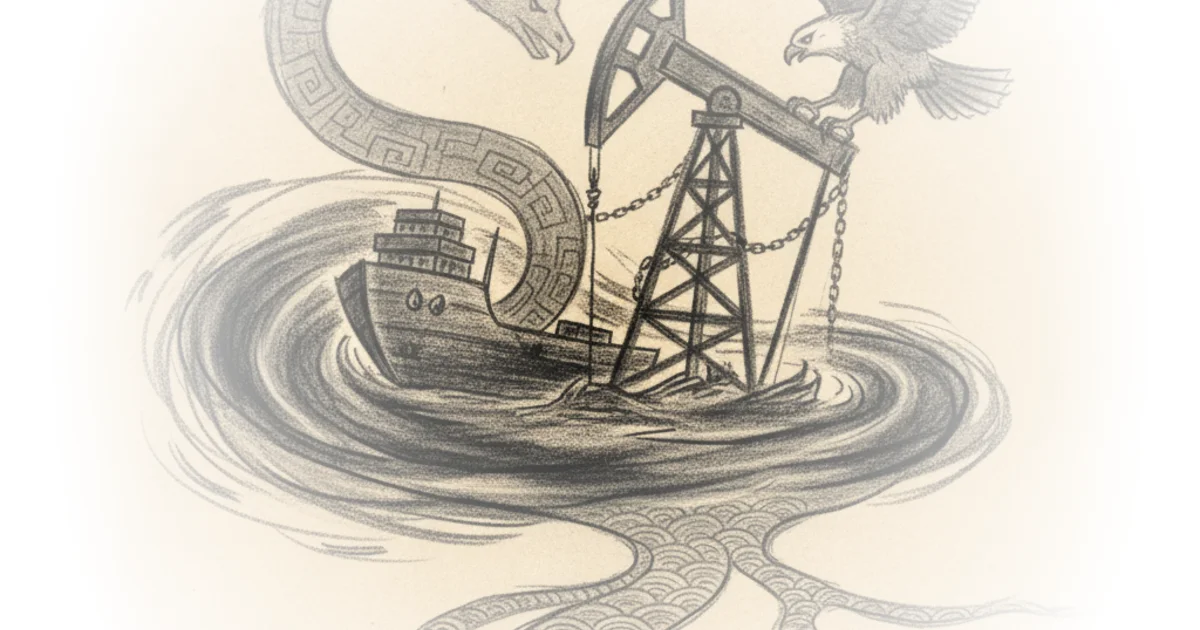
The core of the argument rests on the sheer scale of the anomaly. Analysts, including Schneider's guest Rory Johnston, had predicted prices would skyrocket to $200 a barrel, requiring a level of "demand destruction" comparable to a global pandemic to stabilize the market. Instead, the world saw prices spike but stabilize, with no corresponding collapse in economic activity. "What happened was the largest unexpected swing in global oil balances: China quietly cut crude oil imports by more than five million barrels a day," Schneider notes. This decision, made without a public explanation, effectively solved two-thirds of Asia's spot-market deficit.
Critics might argue that attributing the entire stabilization to China ignores the cumulative effect of Western interventions and the natural elasticity of the market. However, the magnitude of the Chinese cut—equivalent to a massive collective OPEC reduction—suggests that without this specific, state-directed action, the global economy would have faced a far more severe contraction.
"That single decision may have done more to prevent a global energy crisis than anything Washington or OPEC accomplished."
The Black Box of Beijing
The most compelling section of Schneider's analysis delves into the mechanics of how China achieved this feat without visible economic pain. The data presents a paradox: imports plummeted, refinery runs dropped to their lowest levels since the height of the 2022 lockdowns, yet mobility indicators like truck traffic and flight tracking showed no decline. "We still don't know exactly how they pulled this off," Schneider admits, highlighting the opacity of China's energy data.
Schneider and his guests piece together the puzzle using satellite imagery and tanker tracking, revealing that visible commercial inventories did not draw down enough to explain the missing barrels. The likely explanation lies in the "black box" of China's strategic reserves, which include underground caverns and, crucially, massive stocks of refined products like gasoline and diesel. "The Occam's razor solve is that Beijing, in addition to crude SPRs, holds ample strategic stocks of refined products," the analysis suggests. This capacity to release fuel from hidden stockpiles allowed Beijing to maintain domestic prices and mobility while effectively shutting off its demand for international crude.
This capability is not merely a buffer; it is a strategic lever. Schneider points out that China's ability to manage its internal market through administrative fiat rather than price signals demonstrates a level of control the West lacks. "The West is really good at market-driven, private-sector oil production. But through this crisis, we've seen that Washington does not have the scale of discretionary policy control that China or OPEC does," he argues. This gap in policy tools means the West is vulnerable to supply shocks that a state-controlled economy can absorb or redirect.
The Double-Edged Sword of Discretion
The implications of this discovery are profound and unsettling for Western policymakers. The fact that China chose to stabilize the global market during this crisis should not be mistaken for a permanent alignment of interests. Schneider warns that this discretionary power is a double-edged sword. "China cooperated and did the good thing, at least for the broad economic picture — but we cannot rely on that in the future, and that tool can be used against the West as easily as for it," he writes.
The article raises the specter of future scenarios where this same mechanism could be weaponized. If Beijing can cut imports by five million barrels a day to help the global market, it can just as easily maintain those cuts to starve Western economies or hoard resources for a contingency like a conflict over Taiwan. The reference to the "Malacca dilemma" and the strategic buildup of reserves over the last decade suggests that Beijing has been preparing for a long-term energy siege, one that could be activated with devastating speed.
"Western governments must grapple with that discretionary gap and not rest on the private-sector bona fides to get through the next crisis."
A counterargument worth considering is that China's actions were purely self-interested, driven by a desire to protect its own refining margins rather than altruism. Schneider acknowledges that refining margins collapsed, which explains some of the reduction, but the maintenance of mobility despite a 45% drop in imports suggests a coordinated release of strategic stocks that goes beyond simple market reaction. Whether motivated by altruism, a backroom deal, or strategic preparation, the outcome remains the same: the West was saved by a power it underestimated.
Bottom Line
Schneider's analysis delivers a stark verdict: the West's reliance on market mechanisms is a dangerous vulnerability in an era of state-directed economic warfare. The strongest part of this argument is the forensic reconstruction of China's invisible oil drawdown, which exposes a level of strategic depth that Western analysts failed to anticipate. However, the piece's biggest vulnerability lies in the uncertainty of China's future intentions; while the data proves the capability, the motivation remains opaque. As the global community moves forward, the lesson is clear: the next energy crisis will not be won by private sector agility, but by who controls the hidden levers of supply and the will to pull them.
"This matters because it demonstrates that China likely has a stronger discretionary policy lever than the West does."
The human cost of an energy shock is measured in lost livelihoods, stalled economies, and the quiet desperation of those priced out of mobility. By revealing how close the world came to a catastrophe that was only averted by a single nation's hidden reserves, this commentary underscores the fragility of our global interdependence. The silence of the data is louder than any official press release, warning that the next crisis may not be so easily contained.