What makes this piece notable is its raw, unfiltered look at a political calculation that usually happens behind closed doors. Novara Media has captured a heated debate about whether Keir Starmer should back trade union strikes — and the answer reveals far more about Labour's electoral strategy than any policy document would.
The discussion centers on a ban imposed by Shadow Cabinet members who are forbidden from backing strikes or joining picket lines. Mick Lynch, General Secretary of the RMT union, responded to this directly: "I think he's out of touch... betrays very little knowledge the way industrial relations work." This is the piece's sharpest observation — and it lands because it exposes how disconnected Labour's leadership has become from the working-class movements that once formed its core constituency.
It's a ridiculous policy. I think I'm not sure it'll get through that as Lords and it's for in the form that they wanted to come through and it should be immediately reversed by an incoming labour government.
The debate then pivots to something more interesting: the question of whether backing strikes actually helps Labour win elections. John McTernan, formerly Tony Blair's political secretary, makes a case that's been largely absent from mainstream discourse. "To win an election you need to win the country," he argues. "The sad truth at the moment is the majority of workers aren't members of unions." His core thesis is that Labour must avoid alienating centrist voters who might otherwise drift toward other parties.
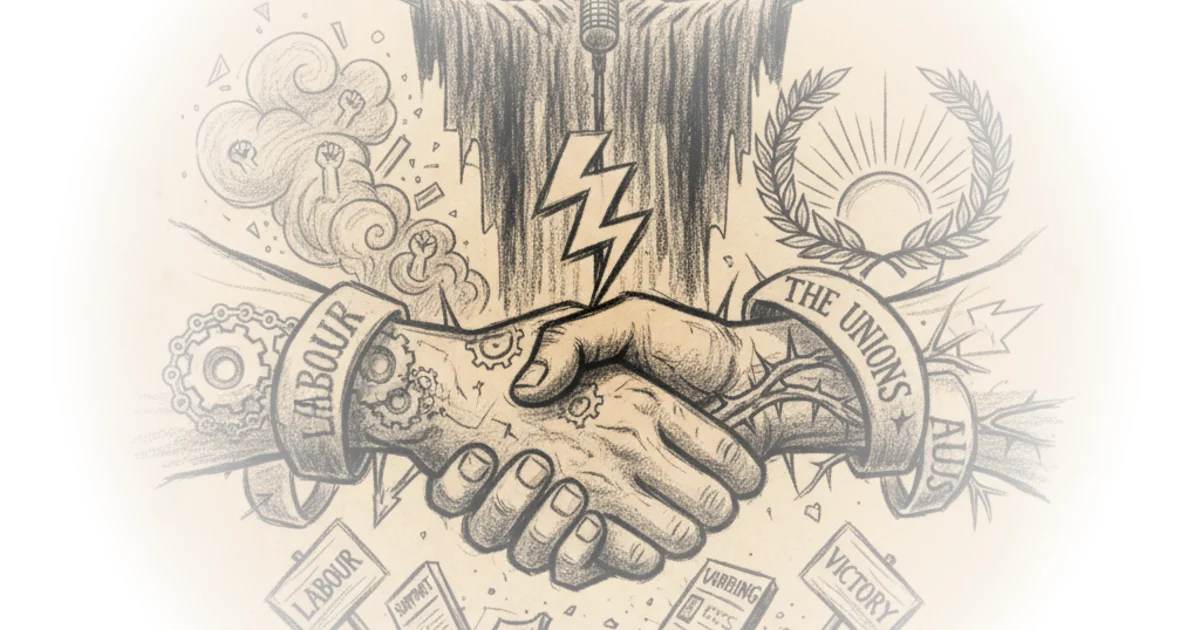
This is where the piece becomes genuinely thought-provoking. McTernan acknowledges that supporting picket lines "alienates some centrist photos" — a political calculation that Zara Sultana, MP for Coventry South, pushes back against forcefully. She frames it differently: "I feel like at this moment in time there is that juncture and there is that debate and it shouldn't be a debate as a party that is in opposition when we have the greatest assault on living standards."
The historical context matters here. Labour was founded by trade unions — and the party's current stance toward picket lines represents a significant departure from its roots. The piece doesn't merely document this shift; it dramatizes the internal conflict between political pragmatism and foundational values.
The Class Problem
Mick Lynch's response to Quasi Quateng's minimum service levels proposal is worth examining closely. "We don't need it," he says of proposed regulation on unions, "and we're going to have to fight it." But his most substantive point concerns what Labour must do to win: "I want Starmer to be elected because that's in the interest of our class... he's not going to achieve that unless he identifies with what working people are going through."
This argument reframes the entire debate. It's no longer about whether Labour should support strikes — it's about whether Labour can claim to represent working people while refusing to stand on picket lines during a cost-of-living crisis.
The piece reveals something often overlooked in mainstream coverage: Labour's union problem isn't just electoral, it's existential. The party was created as political representation for workers, and its current leadership appears to have lost touch with that mission entirely.
Where the Argument Stands
Novara Media has done something valuable here — they've surfaced a debate that most political commentary treats as settled. The question of whether Labour should back strikes isn't resolved by public opinion; it's fractured along generational, ideological, and class lines within the party itself.
What makes this coverage distinctive is its refusal to pretend there's an easy answer. McTernan's argument about winning "the centre ground" coexists uneasily with Sultana's insistence that Labour should honor its founding purpose. The piece doesn't resolve this tension — it simply presents it, which is exactly what smart commentary should do.
Critics might note that the debate captures a deeper problem: Labour's current electoral strategy assumes working-class voters are somehow separable from union movements, when in reality those two constituencies are historically inseparable. The party's ban on backing strikes may win some swing voters while alienating the grassroots infrastructure it would need to govern effectively.
Bottom Line
This piece's strongest contribution is exposing Labour's political calculation as a choice between electoral pragmatism and foundational identity — and showing that Keir Starmer has already made his decision. His biggest vulnerability: the ban on picket lines isn't just a policy position, it's a declaration of who Labour no longer represents. The reader should watch for how unions respond to this in the next round of industrial disputes — because if Labour can't back workers on strike, it will struggle to convince those workers it deserves their vote.