Most historical documentaries treat the rise of the Rashidun Caliphate as a sudden religious explosion, but Kings and Generals reframes this pivotal era as a strategic collision of exhausted superpowers. Their analysis suggests that the "newcomer" did not merely conquer; it exploited a vacuum created by centuries of mutual destruction between Rome and Persia. For the busy listener, this shifts the narrative from a story of faith alone to a masterclass in geopolitical opportunism.
The Exhaustion of Empires
Kings and Generals opens by establishing the context of a region already fractured before the first Muslim army marched. "Almost 1,400 years ago the ancient and prosperous lands of the Middle East were on the verge of a conflict of three empires and three religions," they write, immediately setting the stage for a three-way struggle rather than a simple binary. The piece argues that the Byzantine and Sassanid empires had been locked in a "constant bloody and fruitless war for centuries," a conflict that inadvertently paved the way for a third force.
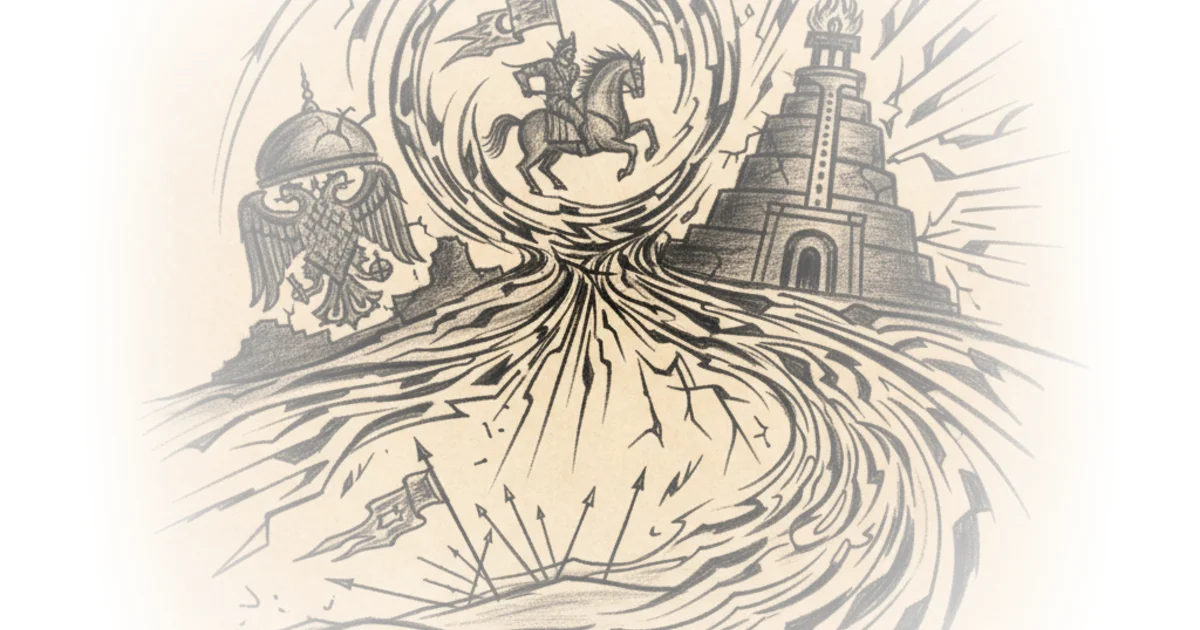
The commentary here is particularly sharp regarding the internal dynamics of the borderlands. Kings and Generals notes that the Roman and Persian empires relied on Arab tribal confederations, the Ghassanids and Lakhmids, as buffers. However, religious friction undermined these alliances. "The Roman attempts to suppress Monophysitism caused the Ghassanids to rebel against them in the late 6th to early 7th century and weakened Roman support in the area," they explain. This is a crucial detail often glossed over: the conquerors were welcomed not just by the faithful, but by populations alienated by their traditional protectors.
The sequence of events not only created divided loyalties among the Arab tribes in the region but effectively stripped the Sassanid border of its traditional buffer.
Critics might argue that this structural explanation downplays the ideological fervor of the early Muslim movement. While the geopolitical vacuum was real, the speed of the expansion suggests a driving force beyond mere opportunism. Kings and Generals acknowledges the religious dimension but prioritizes the military and political decay of the established powers as the primary catalyst.
The Collapse of the Sassanid Order
The documentary's most compelling section details the internal rot within the Sassanid Empire, portraying it as a house of cards waiting to fall. Kings and Generals describes a period of extreme instability following the death of the great king Khosrow II. "Immediately started killing his brothers to secure the throne which resulted in deepening disagreements between the Persian and Parthian Nobles," they note regarding the new ruler, Kavadh II.
This rapid succession of rulers is presented as the critical vulnerability. The narrative lists a dizzying array of short-lived shahs and usurpers, including the first queen in Sassanid history, Boran. "The ruling alliance of Boran and Rostam managed to convince the leader of the Persian clique to stop the hostilities, however after Rostam left the capital for the frontier, Piruzan killed Boron in June of 632," Kings and Generals writes. This chaotic timeline explains why the empire could not mount a unified defense.
The analysis suggests that the Caliphate's timing was impeccable. While the Sassanids were tearing themselves apart in civil war, the new Arab leadership was consolidating power after the Ridda Wars. "The Sassanid realm was now in a state of civil war," the authors state, noting that governors in Yemen and Mesene declared independence, making them "easy prey for the rising Caliphate." This reframes the conquest not as an invasion of a strong state, but as the collection of a collapsing one.
The Battle of the Chains: Mobility vs. Armor
Moving to the battlefield, the piece offers a tactical breakdown of the Battle of the Chains, one of the first major engagements in Iraq. Kings and Generals highlights the disparity in equipment and the clever use of terrain by the Muslim forces. "Despite the civil wars Sassanid armies were still stronger as their armor and weaponry made them superior and the only tangible advantage the Caliph's forces had was their mobility," they observe.
The commentary on the famous "chains" of the Sassanid infantry is particularly insightful. While Muslim sources claim soldiers were chained together to prevent retreat, Kings and Generals offers a skeptical, linguistic analysis. "Most probably this stems from an incorrect reading of the Persian word silsila which can be translated as a mountain chain, a bounding chain or a single line of soldiers," they argue. This suggests the "chains" were likely a metaphor for discipline rather than a physical restraint.
Their mobility and aggression were forcing their foe to defend multiple cities and fortresses as it was never clear where the Arabs would strike.
The narrative credits the general Khalid ibn al-Walid with a strategy of exhaustion. By marching his troops through the desert and forcing the Sassanids to march in full armor under the sun, Khalid neutralized their technological advantage. The piece notes that the Sassanids were forced to form up "directly to the west of Ctesiphon at the end of the tiring march," leaving them vulnerable to a rested enemy. This tactical nuance elevates the discussion from a simple clash of armies to a study in operational art.
Bottom Line
Kings and Generals succeeds in stripping away the myth of inevitable religious conquest to reveal a stark reality: the early Muslim expansion was a surgical strike against two empires that had already destroyed themselves. The strongest part of this argument is the detailed dissection of the Sassanid civil war, which provides a necessary context for the speed of the Arab advance. However, the piece's biggest vulnerability is its heavy reliance on Muslim primary sources for the tactical details of the battles, which may romanticize the generalship of Khalid ibn al-Walid while underplaying the resilience of the Sassanid forces. For the listener, the takeaway is clear: history is often made not by the strongest army, but by the one that arrives when the others are too tired to fight.