Yascha Mounk draws on a case study most American readers won't know: South Africa didn't just escape apartheid — it escaped state capture twice. That's the hook. The argument isn't that polarization is inevitable, but that elites hold the key to breaking it.
The South African Pattern
Mounk opens with a claim that cuts against the prevailing pessimism: "the descent into authoritarianism can be reversed—as in the example of South Africa." He traces two distinct crises. The first: apartheid, installed in 1948 by an ethno-nationalist party, culminating in what looked like an unavoidable race war by the mid-1980s. The second: a quarter-century later, when President Jacob Zuma wielded ethno-populist discourse as a weapon for subverting checks and balances.
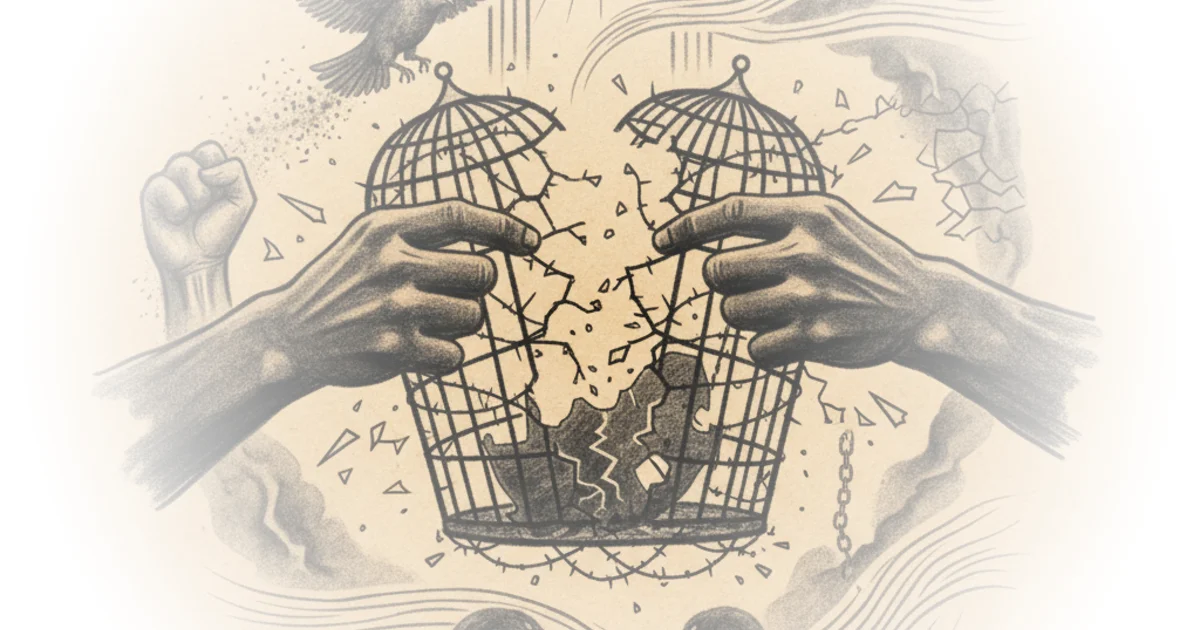
Both looked dire. Both were reversed.
The mechanism matters. "Leadership mattered in both—indeed South Africa's transition from apartheid often is depicted as a near-unique leadership-driven miracle," Mounk writes. But he pushes past the heroic narrative. The ground for change was prepared "less by leadership than by the interplay between civic activism on the one hand and, on the other, the willingness of a subset of social and economic elites to look unflinchingly at the abyss opening up ahead."
This lands because it names something American discourse avoids: elites aren't monolithic. Some deepen polarization. Others break it.
Resistance and Elite Response
The first episode began with the 1976 Soweto uprising — high school students defying their parents' caution, marking a new phase after years of subservience. By the early 1980s, civil society, trade unions, and religious organizations had coalesced around the United Democratic Front, and international pressure evolved into a broad-based campaign for corporate divestment.
But resistance alone didn't end apartheid. Mounk contrasts two elite responses. One deepens polarization — he points to Weimar Germany, where conservative leaders appointed Hitler as Chancellor in January 1933 despite the Nazi Party winning just 33% of the vote. Franz von Papen boasted: "I have the confidence of Hindenburg! In two months, we'll have pushed Hitler so far into the corner that he'll squeal." That is not what happened.
The other response: look squarely at the unfolding reality and act boldly. In South Africa, influential corporate actors supported legalization of trade unions for black workers. In 1985, business leaders broke the prohibition on contact with the exiled African National Congress. Afrikaner intellectuals and technocrats initiated dialogue with ANC leaders — not only Nelson Mandela, but senior exiled leaders.
The spell of us/them polarization was broken via a sequence that began with resistance, and was followed by a reset by a strategically important set of elites.
Each move was incremental. Cumulatively, they widened political space and made negotiated transition possible.
The Second Crisis
In 2009, Jacob Zuma became president. Over the next years, he systematically dismantled checks on personalized political authority, placing loyalists at heads of prosecutorial apparatus and tax authorities, manipulating procurement, and framing it all as weakening "white monopoly capital."
Zuma was stopped. What made the difference? "The willingness of a strategically-positioned subset of elites to confront the mounting risks and, at considerable personal and political cost, mobilize to change course." Senior ANC leaders, appalled by Zuma's direction, overrode lifetimes of party solidarity and spoke out publicly. In November 2017, Cyril Ramaphosa won an intra-party contest by a hairs-breadth, became party leader, and decisively won the 2019 national elections. The state capture project was brought to a halt.
Critics might note that Ramaphosa's subsequent tenure has faced serious corruption allegations — the pattern isn't a clean victory narrative. Mounk acknowledges "things haven't been easy since then" but doesn't dwell on the complications. That's a vulnerability: South Africa's inequality remains massive, and the constitutional order faces ongoing stress.
Where Is the United States?
Mounk turns to the American question: "Where is the United States along this trajectory?" Civic activism has taken hold — in courts, in streets, in thousands of protests. But "the impersonal, rule-based economic and political institutions that have long underpinned America's thriving economy and free, open, and (mostly) stable society continue to erode—and so far the elite response has fallen short."
He divides American elites into three groups. One embraces culture wars to shift discourse away from economic fairness. Another supports progressive policies with culture wars of their own. In between: "an ambivalent-but-acquiescent middle group of corporate elites, wealthy individuals, and right-of-center political insiders who have chosen to interpret what is unfolding as politics as usual. They risk sleepwalking their way into disaster."
This is the piece's sharpest diagnosis. The middle isn't neutral — it's acquiescent. And that acquiescence enables the downward spiral.
The Path Forward
Mounk argues that fighting fire with fire would accelerate polarization. Instead, civic mobilization that builds alliances and articulates a vision of inclusive society is more likely to encourage ambivalent elites to resist us/them polarization. Their speaking out could trigger an "ideational cascade" drawing in disengaged voters.
"At least for now, the United States's constitutional rules of the game still hold open the possibility of a rapid turnaround," he writes. But resilience will be tested by upcoming midterms — not by results themselves, but by surrounding dynamics. He warns of an accelerating spiral: efforts to subvert poll access, disputed results, street violence, culminating in calls for decisive state action.
The escape route: if ambivalent elites put weight behind free and fair electoral processes, and if voters decisively repudiate us/them politics, an immediate electoral escape may still be possible.
A counterargument worth considering: this framing places significant responsibility on elites who have shown little willingness to act. Mounk's historical examples required imminent threat of implosion to trigger elite recalibration. The question is whether American elites will act before that threshold — or only after.
Bottom Line
Mounk's strongest move is reframing polarization as breakable rather than inevitable, with South Africa's dual escape as evidence. The elite-resistance mechanism is underexplored in American discourse, and the historical detail is fresh. The vulnerability: the argument depends on ambivalent elites acting before crisis peaks, but offers no mechanism to trigger that action beyond hope that civic mobilization will persuade them. That tension — between the urgency of the threat and the uncertainty of elite response — is the piece's unresolved core. Watch whether the midterms test that dynamic or merely deepen it.