Dan Perry challenges the comforting political meme that the current administration always retreats from its most extreme threats, arguing instead that the executive branch's behavior is a chaotic mix of bold escalation and strategic retreat. Rather than accepting the acronym 'TACO' (Trump Always Chickens Out) as a reliable predictor of policy, Perry offers a granular 'scorecard' that reveals a disturbing pattern: the administration is willing to dismantle global health infrastructure and attack allies, yet hesitates only when direct military conquest or total institutional collapse becomes legally or politically impossible. This analysis is vital for busy observers because it strips away the theater of ultimatums to reveal the actual, often lethal, trajectory of current foreign and domestic policy.
The Myth of Consistent Retreat
The piece opens by addressing the current geopolitical anxiety, where the administration has threatened to bomb Iran "back to the Stone Age" if it does not reopen the Strait of Hormuz. Perry notes that while such rhetoric is understandable given the economic damage of the blockade, it is "highly problematic in that it telegraphs the intention to commit a war crime and risks turning a war on the regime into a war against the country." The author uses this moment to question whether the administration's history of bluster is actually a sign of weakness or a calculated strategy of unpredictability.
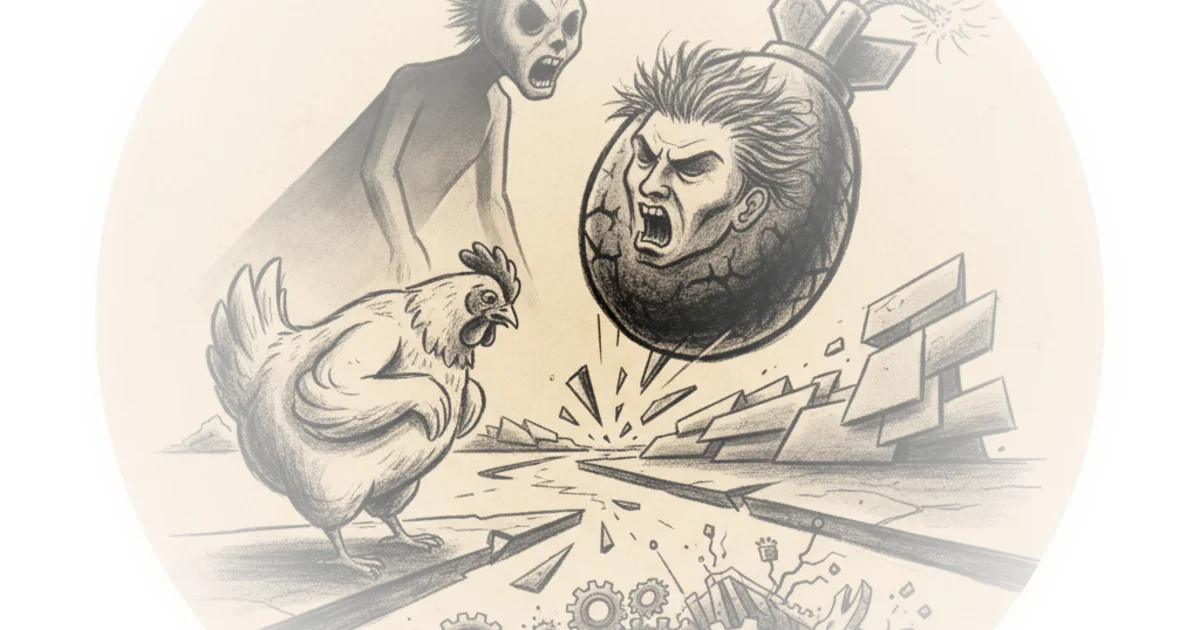
Perry's central thesis is that the "TACO" narrative is a dangerous oversimplification. He writes, "For Trump critics, TACO is reassuring, suggesting their nemesis is all bark and no bite. For fans of his wrecking ball, it reflects a sort of disappointment that he does not go far enough." This duality, he argues, masks a more complex reality where the administration follows through on destructive policies with frightening consistency, provided they do not require a formal declaration of war or a congressional vote that could backfire.
"The original meme — TACO — offers comfort in its simplicity, but the reality is more uneven, more selective, more situational."
A Scorecard of Escalation and Retreat
Perry breaks down specific policy areas to test the "chickening out" hypothesis, starting with the proposed acquisition of Greenland. He suggests the administration's initial interest was driven by a misunderstanding of geography, noting, "I have a suspicion that Trump doesn't know that the flattened map of the globe shows Greenland as way bigger than it really is because it is to far from the equator." When the prospect of a diplomatic crisis with NATO ally Denmark became real, the threat was dropped. Here, the verdict is clear: the administration retreated.
However, the analysis shifts dramatically when examining Venezuela. Perry argues that while the regime was indeed a "criminal enterprise," the administration's response went far beyond threats. He details how the executive branch "sent in special forces to kidnap Maduro and bring him (and his wife) to New York in handcuffs for a trial." This was not a retreat; it was a direct, extrajudicial intervention. The author points out that the administration "made no effort to save the country, instead engineering oil arrangements with Maduro's more compliant successors," suggesting that when the goal was resource control rather than regime change, the administration acted with ruthless efficiency.
Critics might note that the comparison between a failed real estate bid for Greenland and a special forces raid in Venezuela sets a low bar for what constitutes "chickening out," potentially conflating diplomatic posturing with actual military action. Yet, Perry's distinction remains sharp: the administration retreats from ideas that threaten its political capital but advances on those that promise tangible assets or leverage.
The War on International Institutions
Perhaps the most alarming section of the commentary concerns the administration's treatment of global institutions. On tariffs, Perry writes, "Trump found himself at war with the dictionary itself as he insisted publicly that other countries paid the tariffs, which they do not." Despite legal setbacks, including the Supreme Court striking down his policies, the administration "persists, looking for new illegal ways to deploy tariffs." This is a case where the administration refused to back down, even when the legal and economic consensus was against it.
The dismantling of USAID presents an even starker example. Perry notes that before 2025, the agency was a "cornerstone of global humanitarian assistance," but the administration moved to cancel 83% of its contracts. The human cost is immediate and severe: "According to researchers cited by Harvard, the sudden disruption of these programs has already contributed to hundreds of thousands of deaths." Here, the administration did not chicken out; it executed a policy of starvation and neglect with bureaucratic precision.
Similarly, the withdrawal from the World Health Organization was not a threat but a completed action. Perry highlights that on January 20, 2025, the executive branch initiated a withdrawal that was completed a year later, ending US funding and governance roles. He observes, "It's a safe to say no US other US leader would have ever contemplated such a move." This stands in contrast to the administration's handling of the World Trade Organization, where the threat of exit was used as leverage rather than a final act, leading to a verdict of "partially chickened out."
"The move marked an unprecedented rollback of U. foreign aid capacity... the sudden disruption of these programs has already contributed to hundreds of thousands of deaths."
The Geopolitical Stakes
The commentary also touches on the broader implications for alliances, noting the pressure on NATO Secretary-General Mark Rutte to avoid a scenario where the administration "hand[s] Putin the greatest gift received by a Russian since Yalta." This reference to the 1945 Yalta Conference underscores the historical weight of the current moment: a potential realignment of global power that could leave Europe vulnerable. Perry suggests that the administration's threats to withdraw from NATO are not merely bluffs but serious policy options that are being actively explored, even if the final decision is delayed by diplomatic maneuvering.
In the case of the Gaza War, the administration's behavior is described as "basically chickening out" after initially giving a "green light" to restart hostilities. Perry argues that the administration imposed a cease-fire only after the conflict became a quagmire, failing to achieve its stated goals of disarming Hamas or displacing the population. This inconsistency reinforces the author's final thesis: the administration is not consistently timid, but rather selectively aggressive.
Bottom Line
Dan Perry's "Ultimate Taco Scorecard" effectively dismantles the comforting notion that the administration's threats are empty, revealing a pattern where the executive branch follows through on policies that weaken global stability and humanitarian aid while hesitating only when faced with direct military confrontation or legal impossibility. The strongest part of this argument is its refusal to categorize the administration as simply "all bark," instead showing that the "bite" is often more dangerous than the bark, particularly in the realms of health, trade, and foreign aid. The biggest vulnerability is the reliance on a binary framework of "chickening out" versus "acting," which may oversimplify the complex interplay of legal constraints and political strategy that drives these decisions. Readers should watch for whether the administration's recent threats regarding Iran and NATO follow the pattern of the USAID cuts—where the rhetoric was merely the prelude to irreversible action—or if they remain performative. The shift from TACO to TESCO (Trump, Essentially, Sometimes Chickens Out) is a necessary correction to a dangerous political narrative.